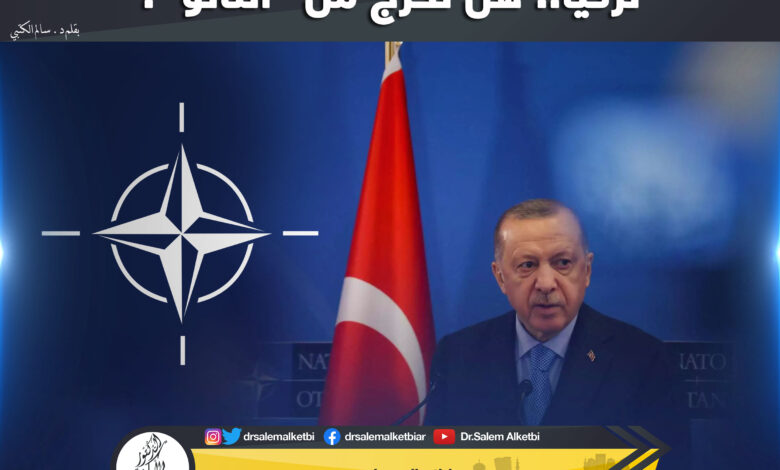
In recent years, Turkey has moved strategically in a direction that runs counter to its NATO membership obligations.
Following a political confrontation that nearly led to a military clash with Greece, a NATO member state, tensions and political disputes with other members of the alliance, and the crisis over the purchase of Russian S-400 missiles, one of the main points of contention between Washington and Ankara, Turkey has recently taken a number of steps that call into question its future membership in NATO.
After a crisis in which it opposed and then agreed to Finland and Sweden joining the alliance, Turkey wants to open the door to trade with Russia in their national currencies. This offers Russia the opportunity to limit the impact of sanctions imposed by Western countries, especially NATO members. Turkey intends to gradually move to buying Russian gas in rubles.
Turkish media report that this move is only the beginning; the two countries have agreed to abandon the dollar altogether in intra-regional trade. True, Turkey has not joined Western sanctions and restrictions imposed on Russia over the war in Ukraine. But its move to indirectly support the Russian economy has certainly angered Western capitals.
If this happens, Turkey could become a transit port for Russian goods to access European markets. Turkey’s positions of concern to Europe do not stop here. In fact, Turkey is in the process of opening direct channels of communication with its Syrian neighbor.
Russia is trying to persuade Ankara to engage in direct bilateral dialogue with Damascus; President Recep Tayyip Erdogan is not opposed to this approach. This is a new reason for disagreement with Washington, trying to continue its policy of isolating the Syrian regime, despite all the Arab and regional breakthroughs in this policy.
The combination of these facts fuels the expectation that Turkey’s membership in NATO may appear unsustainable. These predictions are based on the fact that Turkey’s foreign policy in recent years has become inconsistent with the Alliance’s policies, objectives, and strategic guidelines; inconsistencies between Ankara and the Alliance are no longer correctable.
In contrast, there is another view, according to which the issue is not so much Turkish foreign policy as President Recep Tayyip Erdoğan’s ruling party’s ideology. It is about Turkey’s identity, no longer as organically linked to shared political values with the rest of NATO; the ruling Islamist Justice and Development Party (AKP) is pushing for a change in Turkey’s identity.
These are issues related to the party’s leadership in the Turkish political arena for about two decades and have nothing to do with the Turkish state as a whole.
They are considered a temporary phenomenon. The decline of the party’s popularity and the end of Erdogan’s term is seen as the end of most current Turkish leanings. After that, Turkey would regain its true colors, which would be more NATO-oriented and move away from Russia, Iran, China, and the other US strategic adversaries.
A third group believes that a review of Turkey’s NATO membership would set a precedent in the history of the Alliance, whose founding rules do not provide for cases, such as the one with Turkey now, in which a member is kicked out or its fate even debated, and the Alliance’s position is determined on the political behavior of a member that acts in a direction contrary to the orientation and goals of the other members.
It should also be noted that talks on Turkey’s future membership in the Alliance have stepped up after NATO initiated a formal procedure to admit Sweden and Finland.
These two countries can compensate for Turkey’s absence or withdrawal from the alliance because they have a strong professional army and a geostrategic placement that provides an alternative to Turkey’s – which gave Ankara a great deal of weight in the alliance – and because they share a common set of values with the West, according to some European experts.
On the other hand, perhaps one of the motives for Turkey’s increasing rapprochement with Russia and other anti-Western countries and powers was the regular call for its exclusion from NATO. In 2016 (after the failed coup attempt) and 2019 (after the military operations in northern Syria), there were voices calling for Turkey’s exclusion from NATO.
But in reality, given the ongoing conflict between Russia and the West, this idea remains unlikely, at least for now. Turkey remains important for European countries in particular, especially with regard to the Syrian refugee problem, and to keep Russia from having a full-fledged strategic partner that strengthens its position in the bitter conflict with the West.
In addition, there are those who are betting on the possibility of a regime change in Turkey, followed by a change in Turkey’s foreign policy agenda and a return to the previous orientations that prevailed before 2002, a hypothesis that will be tested in next year’s elections June 2023.
The country is headed for new presidential and parliamentary elections, in which the AKP’s chances are waning, judging by the opinion polls and the results of the recent parliamentary elections.