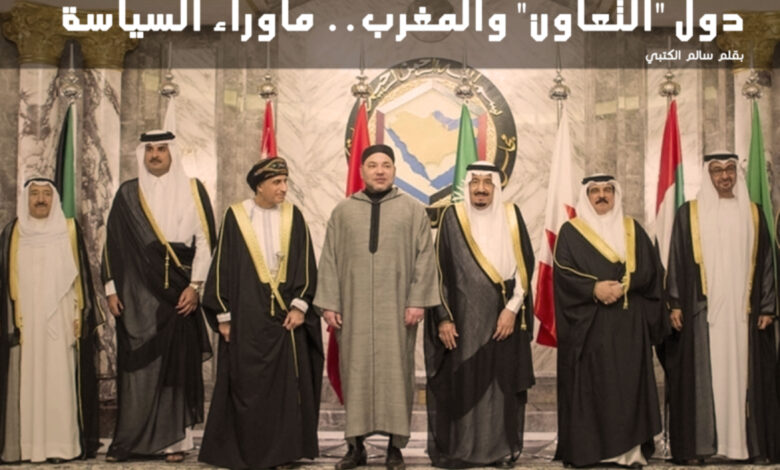
A lot of specialists and researchers may restrict the strong relations between the Gulf Cooperation Council for the Arab States of the Gulf on the one hand, and the brother Kingdom of Morocco on the other hand, to the conceptual and idiomatic circle associated with political science and international relations.
Sometimes these relationships are classified under the concept of “strategic partnership”, while others consider them to be a “strategic alliance”, and between the first and second classification, there is a long list of definitions and categorizations, all of which seek to frame these relations and to develop a realistic conceptual approach to them.
For my part, as an Arab citizen of the Gulf, interested in the culture of Morocco and having many approaches in research, media, and intellectual Moroccan circles, I have no doubt that the ties that bind the ‘cooperation’ countries and their peoples to Moroccan brothers are much deeper than the “strategic” descriptions and the political and cognitive frames that surround these relationships conceptually as I noted above.
What basically connects the Gulf Arab peoples to the Moroccan people is history and human relations and ties of blood and kinship, not just the growing strategic partnership in all fields. This partnership, which is of the utmost importance to achieve an actual correlation between the two sides, is not enough to express, in an integrated manner, the feelings of brotherhood that bind the peoples of the Gulf Cooperation Council and the Moroccan brothers. So, it was not surprising that the first Gulf Moroccan summit took place in Riyadh recently, as it was not an emergency position adopted by the GCC leaders when they declared their solidarity with the Kingdom of Morocco in the Sahara issue.
And it is also certain that the historical and human depth of the Gulf Moroccan relations is reflected in certain historical situations, and there may be nothing that reflects this depth more than what was announced by the Moroccan monarch, His Majesty King Mohammed VI, when he said, “We are facing plots targeting our collective security. Defending our security is our duty, and the Gulf security is the security of Morocco.”
The renewal of the GCC leaders’ support to the autonomy initiative presented by the Kingdom of Morocco over the Sahara is a support to the choices of the Moroccan people to preserve the territorial integrity of their country, adhere to their land and exercise all forms of sovereignty over it. The statement of the summit was not confined to the strong political support for Morocco’s position in its sovereignty issue, but included emphasis on the fundamentals of this relationship, as all leaders renewed their “faith in a common destiny and shared goals, and their adherence to the values of active solidarity and sincere fraternity, which are the basis of the extraordinary historical relations between the Kingdom of Morocco and the Gulf Cooperation Council.”
The strength of the Gulf-Moroccan relations are also clearly reflected in the drafting of the final statement of the summit. It contained terms and points that are very important, and deserve a lot of analysis and political interpretation to clarify their dimensions and implications to the public opinion of the Gulf and Morocco in particular, and the Arab world in general, including the confirmation of the leaders of the need to give the strategic partnership between the Gulf and Morocco a strong qualitative impulse and to develop it institutionally, but more importantly, in my estimation, is the special point on expressing the “commitment” of the leaders of the Gulf Cooperation Council countries and the Kingdom of Morocco to the joint defense of the “security of their countries, their stability and the respect for their sovereignty, territorial integrity and national constants, and the rejection of any attempt aimed at destabilizing security and stability, and at the dissemination of separatism and segregation to redraw the map of nations or split it, which threatens peace and security regionally and internationally.”
Proceeding from the above, the statement has gone on to provide significant support from the Gulf countries to the brotherly Kingdom of Morocco to the extent of “sculpting” a new concept of relations between the two sides, as the summit stressed that “the Gulf Cooperation Council and the Kingdom of Morocco constitute a united strategic bloc, as any violation to the security of one affects the other’s security,” Accordingly, the leaders of the Gulf Cooperation Council renewed their principled position that the issue of the Moroccan Sahara is also the issue of the Gulf Cooperation Council, and stressed “their position in support of the Moroccan Sahara, and their support for the initiative of autonomy presented by Morocco, as the basis for any solution to this artificial regional dispute. They also expressed their rejection to any violation of the supreme interests of Morocco given the serious indicators on this file over the last weeks.”
These bold proactive steps in addressing the sources of risk and strategic threat faced by both the Kingdom of Morocco and the GCC countries, reflect earnest strategic visions and perceptions that give the GCC countries the opportunity to “act” and take the initiative in regional crisis management, and to not just rely on the policy of “reacting”, which brought a lot of problems and complications to regional crises, which in turn affect the national security of the GCC countries, notably terrorism and the crisis in Yemen, Syria, etc.… “Reactive” policies also contributed to the establishment of expansionist regional powers, primarily Iran, completely false perceptions and perspectives about the strategic thinking of the leaders of the GCC States and the available margins of strategic movement they have available and then their ability to act and influence the strategic environment around them, in order to preserve security and stability in their countries and to maintain the gains of their own people.
The Gulf-Morocco summit represents the cornerstone of a new rooted relationship that combines history, strategy, interests, humanity aspects and links of blood, and this step represents a strong fortification to the security and stability of the two sides in the face of plots, plans and measures against the security and stability of the Arab peoples. The Kingdom of Morocco with its own strategic, human and knowledge capabilities, constitutes one of the building blocks of Arab national security, and the GCC countries are convinced of the principle of the unity of the Arab common destiny, particularly at this critical historical moments; and then linking the two wings of the Arab nation, in the east and the west, becomes a wise attitude in the face of existing and potential sources of strategic threat.