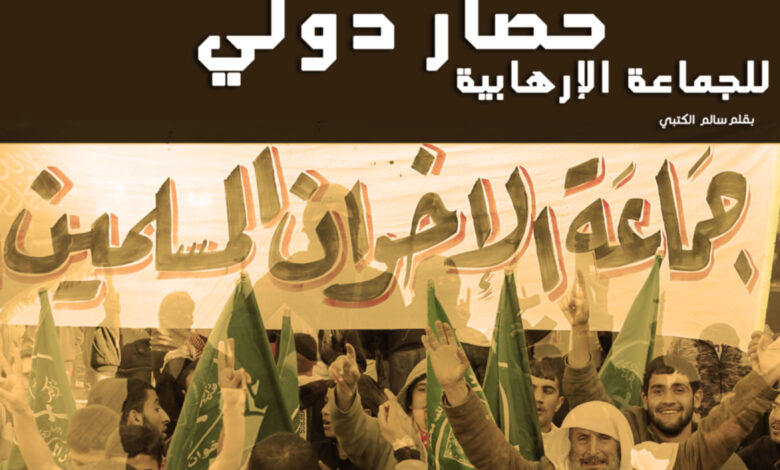
The recent vote by the Judiciary Committee in the US House of Representatives on the draft of a resolution that considers the Muslim Brotherhood a terrorist organization, reflects an international mood that opposes these groups and organizations, and also reflects the entrenched conviction that the terrorist organization of the Muslim Brotherhood is one of the main sources of radical thought, whether through its theoreticians, who established the foundations of the ideology of terrorism, through the writings of Sayyid Qutb, Said Hawwa, Fathi Yakan, Mustafa Sibai, Mohamed Ghazali, and Youssef al-Qaradawi, and others who can be described as the source of ideological supply, among theorists that are not organizationally affiliated to the group, such as Fahmi Howeidi and others, or through continued secret cooperation and coordination with terrorism organizations, such as “Al-Qaeda” and its various branches, which was embodied in the crimes of the “Bait Al Maqdis” organization in sister Egypt, crimes which started since the popular overthrow of the rule of the Muslim Brotherhood on the thirtieth of June 2013.
The most dangerous significance in the position of the Judiciary Committee in the US House of Representatives is that this position has been adopted by a high legislative authority, rather than an executive authority, and thus the voting acquires a stronger effectiveness and authority, as it represents the authority of American legislators towards the penetration of the terrorist group in the Western environments in general, and the American ones in particular. The vote represents a strong slap in the face of the international organization of the terrorist group, and a real blockade to it in one of the countries where its elements were moving with intense activity over the past years and decades. Indeed, the elements belonging to the organization were freely frequenting the US State Department headquarters in order to deliver messages aiming at convincing the American authorities to adopt hardline policies against Egypt.
Although the vote of the Judicial Committee of the US House of Representatives is awaiting a final vote from the Council, the voting itself is a strong indicator that will resolve the positions of many European countries that are hesitant about the terrorist group, and will contribute to an earnest international blockade on the movements of the group’s elements, and to reducing its activities and to drying its sources of funding, as it is supposed that the Muslim Brotherhood group should be formally classified in the American list of terrorism, and that the US administration prohibits foreigners who are involved with the group to enter the United States, in addition to criminalizing dealing with them on the part of Americans and residents within the United States, and the submission of the group to federal prosecution, as well as freezing their assets.
Although there is controversy among experts and specialists on the current US administration’s position on the classification of the Muslim Brotherhood within the terrorism list, the vote of the Judiciary Committee in the House of Representatives sends a powerful message to Obama’s administration and even to the next US administration, not to deal complacently with the terrorist group and to address its danger, as well as the need to recognize an important issue related to the American legislative aspect, given that the issuance of a law on the classification of the Muslim Brotherhood as a terrorist group on the part of both houses of Congress, will put the US administration in a very delicate position in terms of whether to apply the standards of the American Law concerning the classification of terrorist groups, or not.
Whatever the outcome of the final vote of the US House of Representatives about the terrorist group, there is no more room in the United States for the group elements as in the past. The Judiciary Committee’s project has shed light on several things, some regard the Muslim Brotherhood members’ activities and their suspicious relations with terrorist attacks in various regions of the world, while others regard the relations between the Brotherhood elements with some American officials.
My personal conviction is that the policy of the United States, as a superpower, does not take strong positions in such matters, but leaves the door ajar and opens up a space, even a minimal one, for access to areas of joint coordination and cooperation between the United States and other parties, including States, organizations and groups that are always placed in the hostility box with the American side. Here, the proposed draft law appears like an important test for diplomacy because it asks US Secretary of State to prepare a report within 60 days presenting the Ministry opinion about the classification of the Muslim Brotherhood as a terrorist group, according to the standards prescribed by US law in this regard. It also puts him in the obligation to explain the justifications and legal grounds in case the Ministry saw that these standards do not apply to the Group.
It is clear from the position of the US State Department so far that it agrees with the opinion of the Judiciary Committee, as US Secretary of State, John Kerry, said earlier in a testimony before the Foreign Affairs Committee, that the United States was aware of the involvement of members of the Brotherhood in violence acts, and denied hosting members of the Brotherhood during their visit to Washington last year, pointing out that it was not known that one of the members of the delegation belongs to a party related to the Muslim Brotherhood. And most importantly, he referred in his testimony to the existence of some branches of the group that carry out violence acts, which points out at a similar position of the US State Department if both houses of the US Congress approved the recommendation of the Judiciary Committee.
What also interests me in this matter is that the proposed draft of the American law deepens the wounds of the international organization of the terrorist group, and pushes in the direction of the disintegration of this extremely dangerous organizational entity on security and stability in the Arab and Muslim world, through its plots and plans to overthrow regimes and attempt to kidnap power under a big project aiming at getting to what the leader-founder of the group named as “the world professorship” (the moral leadership of the world), a parallel idea to the idea of the “caliphate”, advocated by other terrorist organizations, which was drawn from the literature of the Muslim Brotherhood, after the organization tried to circumvent the idea of the “caliphate” and resorted to political maneuvers, through the promotion of Al Banna’s old idea of “the world professorship”, a virulent ideological formula to build a theocratic State based on the same foundations advocated by al-Baghdadi and al-Zawahiri and other international terrorist organizations’ leaders.
I realize that the elimination of the malign thought of the Muslim Brotherhood will not be in Washington or London, but in the original headwaters in the Arab and Muslim countries, but I am sure it is an integrated effort. The eradication of the roots of a complex organizational framework that lasted nearly nine decades will not be achieved overnight, but requires hard work and strenuous effort at many levels, some of which are related to the dismantling of legal and regulatory frameworks and structural infrastructure, and some focus on cognitive, intellectual and ideological structures, others are aimed at supply and finances and human recruitment centers, while others concern geographical frames and target the deployment of these efforts at the regional and international levels, focusing on trapping the Brotherhood project geographically, politically and intellectually. And therefore this represents a set of complex chains of successive efforts, requiring a firm belief in the value of these efforts in order to achieve security and stability in the long term, not just tactical victories due to a temporary “ebb” of the terrorist group’s activities that would soon be followed by a “flow” that brings waves of activity that are stronger than before.