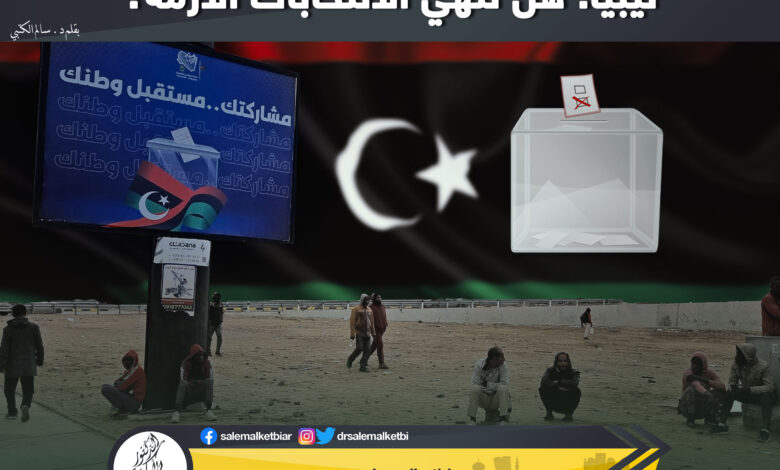
The situation in Libya is becoming more complex by the day. A real political consensus in this Arab country seems to be far away. Elections, which many expected to break the political deadlock and restore security and stability, were postponed for a month at the suggestion of the High Electoral Commission. At the time of writing, this date had not yet been officially
set. The crisis facing Libya’s elections, related to the failure of electoral laws and, in particular, the role of the judiciary in deciding electoral appeals and disputes, can be resolved. But what is really difficult to find is the environment that will ensure fair elections throughout Libya. Militias and weapons are scattered, and the specter of new fighting looms from time to time. The reasons for the ongoing crisis in Libya are clear to the international community with all its parties. Many resolutions, agreements, and understandings have not been implemented on the ground because of conflicts of interest among regional and international powers, and the resulting sharp divisions seem to be reflected in this conflict. Therefore, the crisis at home seems to be only an echo or reaction to the crisis abroad, or rather, to the international environment dealing with the conflict in Libya. It is true that postponing the Libyan elections is justified by the legal and judicial foundations. It does not matter who is responsible for the shortcomings or legal loopholes that have made it impossible to hold elections, whether it is the UN mission, in particular former UN envoy to Libya Jan Kubis, as many believe, or Libyan actors. This does not rule out the possibility that there are factors and considerations stronger than this reason. This raises the important question of whether these elections can be relied upon to bring Libya to safe harbor. Could this election already be the lifeline for Libya? The biggest quandary facing Libya in the short term, in my view, is the impossibility of holding the elections on the new date originally scheduled for January 24. This scenario is not very likely given the existing difficulties, especially with regard to creating a security environment suitable for the legitimacy of the elections. The postponement also poses logistical and regulatory difficulties. Early indications suggest that the Western powers – the US, France, Britain, Germany, and Italy – are pushing for a new election date. In a joint statement, they called for the rapid “fixing of an election date and the immediate publication of the final list of presidential candidates.” This is a good point. But it requires the effective implementation of serious measures and positions on the ground to advance the elections and then eliminate all causes of chaos that could prevent the elected figures from running the country. The only lifeline for Libya is a political consensus based on safeguarding the national interests of the Libyan people. This will not be solved by the elections, but by a serious dialogue between all parties in Libya. The real disagreements are not focused on the date of the elections, but on the priority, parliament first or the presidency. Also, there’s flailing guns at every opportunity. In this context, it should be remembered that the ballot box can theoretically be a starting point for stability and overcoming conflict in any country suffering from chaos, unrest and division. In practice, however, it is left to the consensus of all parties to appeal to the people to listen to their voices and to consider the ballot as the surest way to make a good start in the post-conflict period. But experience shows something different, depending on the different situations, especially in our Arab countries. For example, the many electoral experiments in Iraq have not led to the desired political stability in the country. In an earlier article, I pointed out that the real concern in Libya is not how the elections will be conducted, but the possibility of conducting them at all. I said that the Libyan situation is all mixed up. Some powerful candidates are supported by influential states in Libyan affairs, matched by the rejection of other states that are no less influential, whether by virtue of geography, traditional ties, or international status that gives this or that party influence or the ability to act and exert influence. Personally, I see the predicament in Libya, as in other Arab countries, as being that the old model of governance is no longer relevant. The chaos model of change has pushed this country into the realm of failed states. Therefore, the bet remains on the ability of its citizens to overcome the complexity of the present and the bitterness of the past, and to look to the future on the basis of national reconciliation. There is no alternative to all this except submission to the will of terrorist organizations, extremism and political groups that do not have a project capable of overcoming social crises and leading the state to its rightful place. So will continue the chaotic scheme that maintains all the factors of failure, chaos, violence and bloodshed not only in Libya but in the entire Arab region we live in. The scenario that all parties in Libya and regional and international powers must watch out for is that Libya becomes another Lebanon, where militiamen and forces that have weapons, influence and external loyalties counter the influence of the state and its national army, or at least disrupt the institutions responsible for establishing security. This requires that everyone overcome the tribal and regional conflicts, uphold the national interest, and then focus on what matters most, getting rid of the militias and limiting arming to the state, because that is the only way to ensure security and stability for the Libyan people.