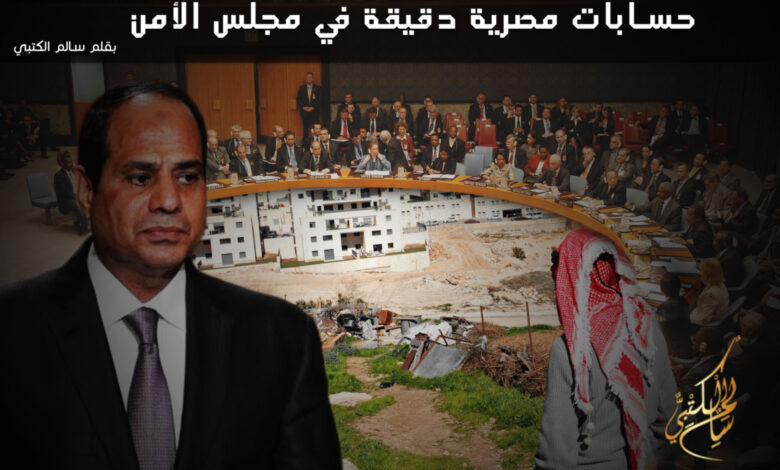
There is a large controversy and a tremendous clamor about Egypt’s position on the settlement draft resolution, which was submitted to the Security Council recently. The Egyptian diplomacy was chased by media accusations the least of which is related to abandoning the strategic and historical constants, and relinquishing its role and prestige in an issue that is central for Egypt and all Arabs.
I will not go into the identity of the media that “blew” in the fire of anti-Egyptian position campaigns, nor its objectives, and I will not make accusations of any kind to the prejudiced against the Egyptian stance in this regard, but the whole thing requires a tremendous amount of openness and frankness and transparency in the debate, and therefore we have to proceed from specific and accurate data in order to get to clear results and to a position of agreement, perhaps that would limit the space of dispute that is harmful to Egypt and to the issue in question at the same time.
At the forefront of these data is that there is a new US administration Israeli Prime Minister Benjamin Netanyahu asked to intervene directly to persuade the Egyptian side to abandon the draft resolution, which has actually happened. Any rational calculation, and I repeat rational calculation by Egyptian diplomacy in this position points out at the need to give priority to the strategic interest and to avoid the risk of slipping into a clash or tension with the new US president even before he officially takes office. If any other state was in the same position as Egypt in this crisis, it would have acted exactly as Cairo did, in light of the decision-making environment and its strategic calculations well known to strategists. The second thing is that there are discrepancies in the calculations of Egypt and the Obama administration regarding this situation. The Obama administration wants to leave an argumentative imprint, and it is trying to send messages to Israel on the White House’s position on the settlement file. The US abstention from voting against the resolution later on, and the fact of not using the “veto” is a strong expression of the position of President Obama, who actually has a counter stand for the continuation of the Israeli settlement policy. He tried to persuade Netanyahu to this position more than once, but always found himself unable to achieve anything in this regard because of the strategic calculation of interests with the Israeli ally.
The third piece of data is that the majority of those who criticize the Egyptian position completely ignore what happens behind the scenes in such international gatherings. What goes on behind the scenes is much more than what is going on openly. Therefore, why those criticizers exclude the possibility of an understanding or coordination between Egypt and the four countries which submitted the draft resolution the following day? Were those criticizers interested in that the decision shall be taken or in that Egypt shall submit it regardless of the potential impact on the Egyptian strategic interests? Is there a relationship between such adverse positions and the fact of wanting to push the Egyptian diplomacy into a clash with the next US administration, especially in light of restlessness among some because of the existence of some sort of understanding between President Abdel Fattah al-Sissi and the new American President Donald Trump?
Personally, I am confident that Egypt manages its affairs based on pragmatic calculations taking into account the interests of Egypt and its people without compromising the rights or interests of other Arab countries as long as possible. I am also confident that Egypt will not let down its constants and its support for the Palestinian cause. What was actually achieved is the embodiment of what was said formerly, but wailers are trading positions and take advantage of any loophole, even if artificial, to criticize the Egyptian position.
For objectivity, I say that the diplomatic work in our time is different than what it used to be in previous eras. The current phase is extremely complex and precise, and requires unconventional maneuvers to achieve interests without risking a loss even if possible, or in the long term. Egypt’s position regarding the Palestinian issue is constant and cannot be subject to defamation. It is a state that bore the brunt of this issue historically, and initiated to formulate the draft settlement decision and no one pushed it to do so. It was possible for Egypt to not be involved in this matter if it were not convinced of its position from the beginning. It tried to exploit the end of President Obama’s term to pass a strong draft resolution like that, but it collided with the position of the new administration, which is strongly supportive to the Government of Netanyahu even before the new president takes office officially.
Some make fun of saying that Egypt’s insistence on passing the draft resolution through it would have closed the door to potential efforts by Trump to conduct direct negotiations between the Israeli and Palestinian sides. But this is a fact, the new administration needs Egypt’s strong position as a mediator in the peace process, and this could not have happened if there was an early crisis as the Egyptian diplomatic estimated, which is a correct pragmatic estimation.
Egyptian diplomacy’s problematic in this topic stems from the fact that Egypt’s position is real and serious, and not a propaganda position. It is a position that stems from responsibility and precise calculations of profits and losses. It did not target propaganda and political marketing, and therefore it did not have a share in them. It was rather the target of attacks, both by some Arab media or through social media.