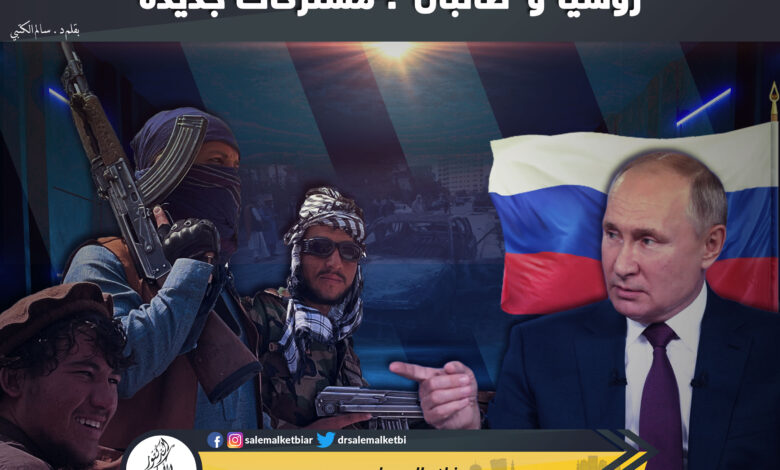
Given the escalating indicators of geostrategic conflict between regional and major powers, it is perhaps very important to try to understand Russia’s strategic vision regarding the return of the Taliban to power in Afghanistan. One can note the foundations of this vision, the first of which is to question the effectiveness of US-led international alliances.
Russian political discourse focuses on demonstrating the lack of credibility of these alliances and the inability of the US, as a strategic ally, to fulfill its commitments to defend the interests and national security of states. That would be reflected in the attitudes of Atlantic allies as well as US allies in various parts of the world who view Washington as a strong and reliable ally.
The second is that President Putin is working to circumvent any US plan to make the Taliban regime a thorn in the side of Russia and China by containing the Taliban threat and building strong ties with the movement regardless of its intransigence and obscurantism. The ideological dimension no longer exists in Russian foreign policy.
Moscow has one of its strongest international alliances with the mullah regime of Iran, not very different from the Taliban’s project of religious rule. Thus, Russia is not afraid of the movement’s closed religious vision and does not care about freedoms and human rights, which the West believes is a problem in relations with the Taliban.
It should be noted here that Russia seeks its own interests and realizes that Western discourse on rights and freedoms is often subject to political employment.
The proof is that the West itself is discussing with the Iranian regime on other strategic issues, certainly not including the issue of human rights or freedoms in Iran, and that Iran’s ally can open channels of communication and relations with the West if an agreement is reached that will serve the interests of both sides.
The third point concerns Russia’s attempt to torpedo the reconstruction of the countries that the US has long promoted under the so-called creative chaos theory. Russia and China specifically seem to have a demonstrated strategic interest in ending the US approach to nation-building and imposing a democratic governance model in the post-conflict phases.
Russia sees the Afghan model as yet another example of the failure of imposing a system of government from abroad without taking into account the internal, historical, and social contexts and conditions of the states, their sectarian, religious, and ethnic particularities, and their historical traditions.
Social and political experiments of this kind have never been successful; they have only resulted in the destruction of states and the deterioration of political and social systems, according to President Vladimir Putin. The fourth point concerned Putin’s desire to take advantage of the mistakes of the US and the West to promote and restore Russia’s global influence.
Although Russia officially shows some reluctance on the issue of recognizing the Taliban and the need to monitor their behavior and actions, there are clear signs of Moscow’s intentions for rapprochement with the movement. President Putin himself made these remarks in his first statement since the Taliban took control of the Afghan capital.
“These are the realities and these are the realities that we must proceed from, preventing the collapse of the Afghan state,” he said.
He added that the Taliban have declared a cessation of hostilities and have begun to establish law and order. They have pledged to provide security for the local population and foreign diplomats, expressing hope that these commitments will be implemented on the ground.
He also hoped that the UN Security Council would coordinate the treatment of the Taliban and evaluate their positions and policies.
That gives Russia and China a key role in shaping the Afghan reality in the post-US withdrawal period, to avoid a repeat of the unilateral management by the US and its Western allies of important issues that have negatively impacted Chinese and Russian strategic interests.
Certainly, the Taliban is taking advantage of Russia’s position in the public relations campaign, seeking to consolidate the failure of the US and NATO in Afghanistan. Russian positions strongly support the Taliban’s direction.
Moscow has seen from the first hours of Taliban control of the Afghan capital that the situation in Kabul is not as bad and dangerous as the Western media portrays it. The situation is said to be so stable that the Russian ambassador to Afghanistan, Dmitriy Zhirnov, indirectly did the Taliban an important favor by stating that “nothing threatens normal life in Kabul.”
He stated that he sees from the embassy window “the continuation of studies in one of the girls’ education schools adjacent to the embassy building.” Clearly, Russia’s official direction is based on suspending the trial of the Taliban. New common interests are now being explored by Russia with the Taliban.
But this does not mean the possibility of an alliance. Rather, it means a tendency for the parties to build tactical deals that serve their common interests.