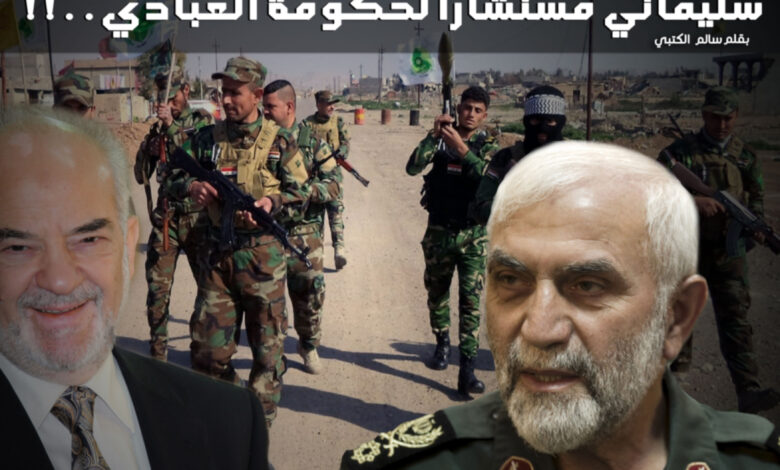
It was no surprise that the Iraqi Foreign Minister Ibrahim Al-Jaafari announced the commander of the Qods Force of the Iranian Revolutionary Guard Gen, Qassem Soleimani, is officially working in Iraq as a military adviser to the Iraqi government. This recognition is only a fig leaf by which the Iraqi government is trying to cover the fact that it is incapable to control the country and limit the Iranian interference, just to claim some sovereignty.
Indeed, Abadi and his foreign minister did have many options besides this announcement and exposing the limits of relations between the sectarian Government of Haider al-Abadi at one hand and the Supreme Leader Ali Khamenei’s office on the other hand.
Neither al-Abadi nor his Foreign Minister Ibrahim al-Jaafari can prevent Iran from interfering in Iraqi affairs. They do not have the audacity to open a discussion with Khamenei or his advisers about the limits of the intervention, in order to preserve sovereignty or a minimum of political dignity in the face of public opinion.
The immediate cause for this is that Haider al-Abadi was appointed by a decision of Tehran, which abandoned al-Maliki and hired a new man for a new phase to carry out specific tasks to control the future of the Iraqi people. Also, al-Abadi preserved his position with direct support from Khamenei.
a few months ago, Ali Akbar Velayati, a main adviser to Khamenei, said that ‘no Iraqi force is capable to overthrow the president Fuad Masum, Prime Minister Haider al-Abadi or Parliament Speaker Salim al-Jubouri,’ pointing out that the ‘Popular Mobilization Forces will address the irresponsible parties that cause turmoil and unrest in the Iraqi arena.’ he also challenged the Sadrist Movement opposing Abadi, saying that ‘what has been said, that there is a possibility to remove the current Iraqi government is a form of delusion and fantasy’.
Moreover, media reports confirmed months ago that Kamal Kharrazi, the head of the Strategic Council for Foreign Relations in the Supreme Leader Ali Khamenei’s office, paid a visit to Baghdad, where he transmitted a direct warning from Khamenei to Haider Al-Abadi.
The Iranian Supreme Leader warned he will topple Iraqi Prime Minister if he did not abide by the directives agreed on the formation of the Iraqi government. The series of scandals are long and extended about this concern. It is well known that Iran’s Mullahs have provided protection for the Abadi’s Government in the face of recent popular protests, and they ordered the Mobilization Forces to confront and oppress them, especially that the protests opposed Iranian interference in Iraq’s affairs. If these reports were inaccurate, Abadi must reveal everything about his campaign on corruption and how he swallowed his tongue when he found that Iran’s mullahs are not satisfied with the trial of the heads of corruption in Iraq, among which is Nouri Al-Maliki.
If this is the reality of the government, which survives through direct support from Iran, it should not be surprising that the foreign minister commits a political sin as he appointed a military official lead of another State’s militia forces that are illegal and included in the lists of international terrorism, in the function of military adviser to his prime minister.
The sin makes no difference in the case of Iraq, because Qassem Soleimani is staying in Iraq. He does not depend on Haider al-Abadi’s government. He rather provides protection for this government which cannot deny this.
The only truth expressed by Al Jaafari in his remarks is that ‘Soleimani is working in the Iraqi territory and the Iraqi government is aware of this,’ and the man is right about that. The government cannot deny this too.
Al Jaafari maybe thought acknowledging Gen. Soleimani and giving him the title of counselor would respond to the opposition voices, but the man just went wrong to think that the opponents of the presence of Soleimani care for the Iraqi government, so he tried to deny allegations of the existence of the elephant in the room. The opponents of the Abadi government—whose record is not unknown—actually care for Iraq which is not short of expertise and military and strategic competencies that outweigh Soleimani. but the political and sectarian bias limit the government options into receiving the dictates of those who put it in power, offending and not caring for the dignity of the Iraqis, leaving a foreign professional take revenge on Sunni Muslims in their country under the pretext of providing military consulting.
After such an ugly official announcement, how can the Abadi government dare claiming to be a government for all Iraqis and that it is not sectarian?
The catastrophe is that the Popular Mobilization want to completely occupy Iraq and practice ethnic cleansing, and the Abadi’s Government now publicly acknowledges this intervention regardless of the opinion of the Iraqi people.
Unfortunately, Abadi’s government broke governance rules, principles and foundations related to the sovereignty of the State, avowing using a current military official of another country and appointing him to the post of military adviser to the president of the Iraqi government. Another insult has been written in the history of this ancient country. ‘If you feel no shame, then do what you want’. What a shame.