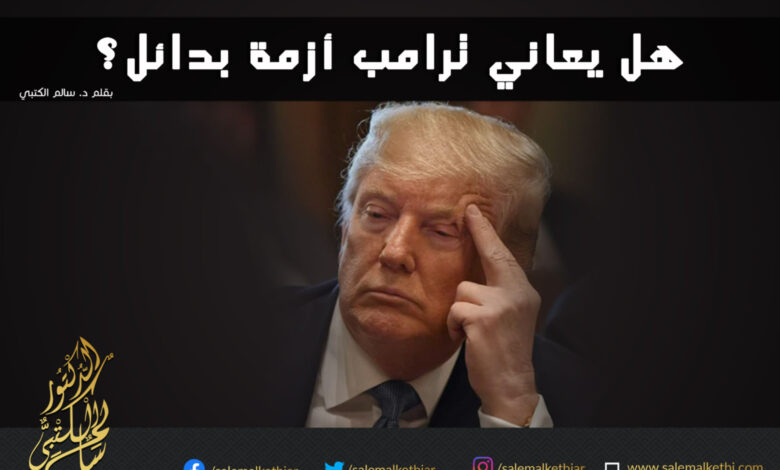
In the Middle East, it is still hard to work out scenarios for the coming period, and so a traditional question has to be asked. Faced with the Iranian crisis, is the administration of American President Donald Trump facing a crisis of strategic alternatives?
This hypothesis of a crisis of alternatives is mainly due to the limited options available to the presidency to respond to Iranian military provocations and violations that undermine the security and stability of the region and the world.
To get into this hypothesis, we must first accept something. President Trump does not actually prefer to use the military option. This is a clear observation that must be addressed and it is also one of the causes of this crisis of alternatives.
But what about the other options? Crisis management, no matter what the crisis, becomes more complicated when one of the most important options is left out of the table from the beginning. And since President Trump has completely set aside the military option, he has practically emptied the other options of their meaning.
What do you mean? First, let us assume that mullahcracy is not a traditional political system. This theocratic system has an extremist expansionist ideology that advocates the transfer of conflict to the land of others. He uses the strategy of proxy warfare through extremist currents in several Arab countries.
Therefore, the way of thinking that dominates Iranian decision-making today does not promote political understanding or resolution of crises if the regime does not get what it wants, to see free hand and hegemony in the region. The Iranian regime’s leaders boasted that they had taken control of Arab capitals and that their influence had spread to the Mediterranean coasts throughout Iraq and Syria.
Western observers argue that President Trump made a mistake by withdrawing from the Iranian nuclear agreement signed in 2015 with the P5+1 group. They believe that he has not studied the possible steps and scenarios according to the expected reaction of the mullahs’ regime, a regime that already has a suicidal temperament that does not contribute to security and stability. This point of view has some analytical relevance.
Others also believe that the problem does not concern the withdrawal of the nuclear agreement. The White House’s silence on the fall of the American drone may have pushed the mullahs to commit other follies.
But I think the most serious strategic mistake is that President Trump has disowned the protection of his Saudi ally.
The United States’ clear and repeated statements about its refusal to make any commitment to protect the Saudi ally have torpedoed all the strategic alliance formulas that the United States-Saudi strategic partnership has long discussed, and whether it is such an alliance or a strategic partnership.
Then President Trump came to deny any traditional requirement for partnership arrangements. is to develop an innovative arrangement that may not be consistent with the history of the strategic interests of both countries.
Faced with his options crisis, President Trump is well aware that not reacting will encourage the mullahs to perpetuate their nonsense. But he fears that any military strike against Iran will affect his political future.
President Trump does not plan to leave Saudi Arabia alone in the face of the Iranian threat. However, he is not ready to risk his future in the White House. He set up an international alliance to protect shipping in the Gulf, then left it to Saudi Arabia to decide how to react and announced new sanctions against Iran. All this means that Trump gives its own interest top priority at this stage.
The problem is that Trump wants to provide an international framework to respond firmly to Iran. It is a difficult case because he is well aware that his strategic opponents, such as China and Russia, are not ready to support him.
Perhaps the thorniest dilemma is that President Trump and the mullahs have reached a point where it is difficult to reach a settlement without substantial concessions on both sides. This is another aspect of the crisis of alternatives.
The mullahs are a suicidal regime that will not hesitate to continue its stubbornness, simply because it is not suffering the consequences of the severe American economic blockade; the Iranian people are suffering them. President Trump will not be able to sign any amendments to the nuclear agreement unless he understands part of what he expected. In this way, he will be able to present it to the American voters as a political victory.
Now, the question is whether Trump can force the mullahs’ regime to sit at the negotiating table for a new agreement or amendments to the current nuclear agreement.
The answer is probably no, unless the regime is really scared that a military attack will threaten its survival or the White House makes a major political concession.