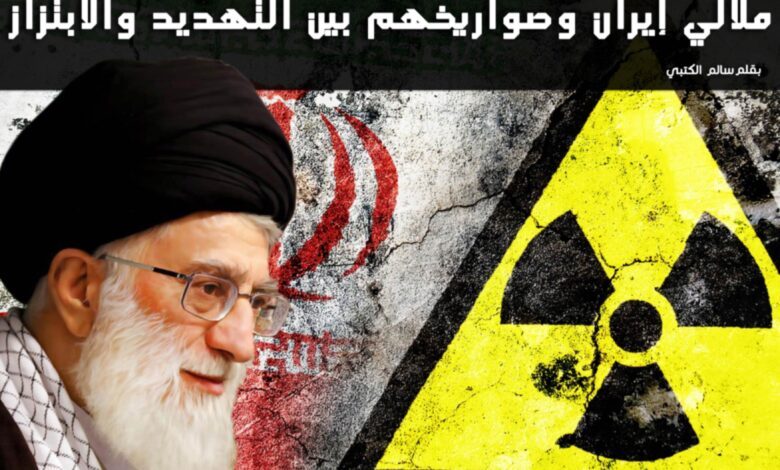
Recently, Iran’s Supreme Leader Ali Khamenei said his country considers its missile program a symbol of its strength. He said explicitly, “The future of the Islamic Republic is not in negotiations, but in missiles.” Not only did he say this, but he renewed his support to the Revolutionary Guards in the development of this program. Most observers considered this statement to be surprising in the light of the recent developments in the relationship between Iran and the major Western powers. Some argued that this program could push the American-Iranian relations specifically to the area of tension again. While some analysts argued that Khamenei’s comments were mainly addressed to President Hassan Rouhani, who now boasts his political accomplishment of signing the nuclear deal and getting Iran out of international isolation.
It is interesting that a large segment of the analysts who stand to explain Iran’s foreign policy are not careful followers of this policy, and even overlook important things that will provide a clearer picture of it. Those who say that there is what is described as a struggle in Iran about the relationship with the West, left out the truth that the political conflict in Iran does not include a dispute over the constants, and does not include a debate about strategies, but focuses on the tactical level. And the clearest evidence about this is that president Rouhani, who made a qualitative breakthrough in the relations with the West, is the same who said a few days before Khamenei’s remarks, “The strengthening of Iran’s defense capabilities is a strategic policy.” But he diverged from Khamenei in tactics when he said in the same statement that “Iran must be careful not to provoke its enemies, and it must be careful so that the enemies of Iran do not find any excuse to exploit that position.”
I personally think that the timing of the “heating” of the Iranian missile program file is deliberate and intentional. It is unreasonable for any beginner in politics to commit the error of conducting disturbing missile tests only a few months after the signing of the nuclear agreement that ended the controversy about this concerning program for both the neighboring countries and the West. Nor does it make sense that Tehran provokes major powers with missile tests at a time when the Iranian frozen funds are not fully released, nor does it also make sense to choose the “worst time” to conduct missile tests unless Tehran was deliberately provoking the West and seeking to raise its concerns, which it certainly does not want to do.
One may say that the permanent approach of Iran is to resort to challenge, not provocation, and that the West will comply with its demands as it complied with the nuclear file. But this analysis involves a half-truth, not all the truth. It is true that Iran has often resorted to the language of challenge, but a challenge that is accurately calculated, and it does not slip into the trap of strategic risk. Skeptics should review Iran’s political history to realize that its steps are calculated accurately and with great caution, and it is not in its nature to rush and to take risks. Thus, the Iranian missile tests at this time, the worst for the interests of Iran, are far from being a rushed action or a challenge or anything similar to this.
Most probably, Tehran is seeking to open a new blackmailing area with the West, and the United States specifically. It is fully aware of the sensitivity and the awkwardness of the position of President Obama, and the difficulty of adopting the opposite position of his policy of appeasement towards Iran in recent years. He bet on the effectiveness of dialogue to contain its danger, and risked his political future in order to support difficult marathon negotiations with the Iranian delegation headed by Javad Zarif, who converted from an enemy into a genial friend to US officials as a result of the large number of meetings and dialogues. Hence Iran’s mullahs realize that President Obama will not destroy his dream with his own hands, and will not undermine what he considers one of the most important achievements of his two terms, which is opening up to Iran, and therefore, Tehran will likely resort to blackmailing the White House and embarrassing it during the remaining final months of the second term of the current president.
The mullahs also realize the danger of the accumulation of evidence of their involvement in planning the attacks of September 11, 2001, so we find them rushing at an accelerated pace towards creating a new front of discord with the West, which was eager to win a share of the “cake” of the economic rapprochement with Iran, in pursuit of a new deal that constitutes a barter of Iran’s support for international terrorism, through opening the doors of the Iranian gas and economy to Western companies.
What is certain is that the mullahs are proving day after day that they do not change and are unchangeable, and someone who believes them to be otherwise is committing a grave strategic error. They are able to maneuver and turn around, and there is a large difference between maneuvering and changing. I do not think they are ambiguous to the extent of fooling any expert in the philosophy of government in Iran. I also think that President Obama has been duped with regard to Iran’s intentions, but he seeks to clone the scenario of dismantling the regime from the inside. He is aware of the fragility of the Iranian regime, and is confident that penetrating it culturally and politically will hasten its collapse. But what he missed is the fact that the mullahs have uncovered his plan, and that sticking to the Iranian missile capabilities is just an act of hunkering down from the possible collapse of the regime under the weight of the rapprochement with the West.
I also do not agree with the idea that the mullahs are trying to threaten the West with their ballistic missiles. They understand that the Iranian missile arsenal is not a guarantee to realize their Persian expansionist dreams, but it can be a good blackmailing tool to win some of the booties in the conflict of sharing interests between the major powers in Syria and other areas.
So there are numerous possible causes for the heating by Iran of its missile file and its seeking to accelerate the pace of its events in an evolution that differs from expectations and from the nature of things. But it is generally difficult for theocratic regimes to coexist peacefully with their geo-strategic surroundings in accordance with the internationally accepted standards. They are confrontational regimes in nature, and live only in an atmosphere of crisis and conflict, and if they do not find such an atmosphere, they create it. Crises are their cherished natural habitat, which guarantees popular rally, and the lining up of followers and supporters at home and abroad.