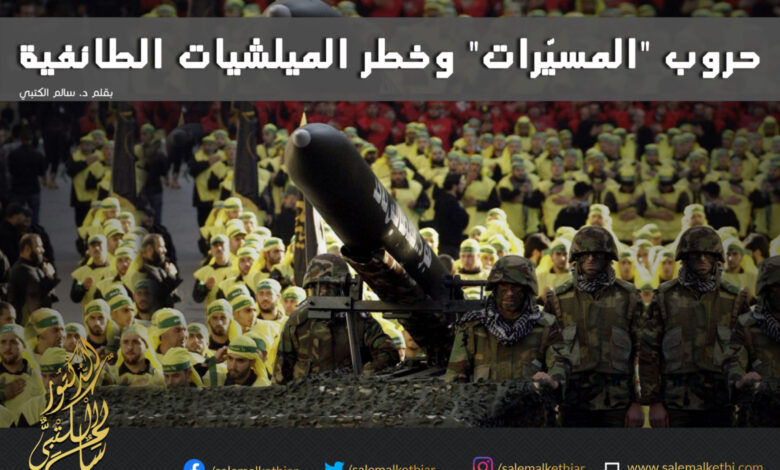
We have repeatedly said that the erosion of national sovereignty in the Middle East in the interest of terrorist militias and sectarian arms poses a grave threat to regional security and stability. This fact is known to the decision-makers in the major countries and the dominant forces in international decision-making. But the overlap and intersection of interests still stand in the way of building a unified international position that addresses the growing threat of sectarian militias and arms.
Now we are waking up daily to news of attacks with UAVs and missiles that are increasing in their range and growing in their operational and weapons capabilities, as the parties that supplied the militias wanted.
Attacks are no longer confined to a particular country or territory, but are witnessed by several countries in the Middle East, in Lebanon, Yemen, Iraq and Syria. Some countries in the region can no longer control the militias on their territory.
Some of these militias no longer recognize the sovereignty of their state. The “Lebanese” Hezbollah admitted in the words of its leader Hassan Nasrallah, recently, that it is working under the leadership of Iran’s Supreme Leader Ali Khamenei. Nasrallah and his party, which has seats in government and parliament, placed their militias under the command of the Iranian leadership, shirking all Lebanese authorities.
There is a huge and growing dilemma in Lebanon. The Lebanese prime minister recently said that Hezbollah can cause “a flare or a war that might happen for regional reasons that we have no say in it in Lebanon” but “is not running the government (…) We do.” He also said “it isn’t my problem that Hezbollah became this strong.” “I do not agree with Hezbollah with these actions.” Hariri said that “Hezbollah is not a Lebanese problem – only – it is a regional problem,” expressing fears of a potential war in the Middle East.
That an internal militia turns into a state within a state and a force not under the control of the state to which it belongs is a real strategic dilemma. The most important problem in my opinion is that the Lebanese Hezbollah has become a model that regional militias, such as the Houthi militias in Yemen, the Popular Mobilization in Iraq, and other militias that are ordered by the commanders of the Iranian Revolutionary Guard, are seeking to reproduce.
To be sure, Iran’s fingerprints on the capabilities of terrorist militias are clearer than ever. How else do we explain the viral spread of drones and guided missiles used by militias in attacks against several countries in the region, such as Saudi Arabia?
It is inconceivable that the massive proliferation of drones in the hands of all militias, from Hezbollah to the Houthis, was a coincidence. It is absurd to think that the capabilities of these militias, which have become very similar, whether in launching missiles and drones or responding to attacks with the defensive capabilities that rival the capabilities of regular armies owned by States, came by chance.
Certainly, what is happening is a direct result of increased coordination, cooperation and implementation of the orders of Iran’s Revolutionary Guards commanders. Sectarian arms were provided with military capabilities to spread chaos, distract attention, widen the threat of regional warfare to the widest possible geographical reach, relieving strategic pressure on the Iranian regime and giving the regime a tremendous negotiating leverage in the crisis with the United States and its allies.
Leaving things as they are in the Middle East produces more conflict and chaos that can make it difficult to control existing conflicts and emerging crises. The lack of confidence in the ability of the world order and the dominant major powers to rein in militias opens the door to a further ebbing of state sovereignty and nurtures sectarianism, partisanship and ideological entrenchment.
One way to restore regional security and stability is to contain the threat of militias and completely dry up the sources of their military and financial funding. I believe that the issue should be an exceptional priority in any planned negotiations with the mullahs’ regime, which directs, funds, equips and directs a large network of sectarian militias and arms in many Middle Eastern countries.
Restoring security and stability begins with bringing back the prestige and influence of the central state in one of the world’s most sensitive and volatile regions.