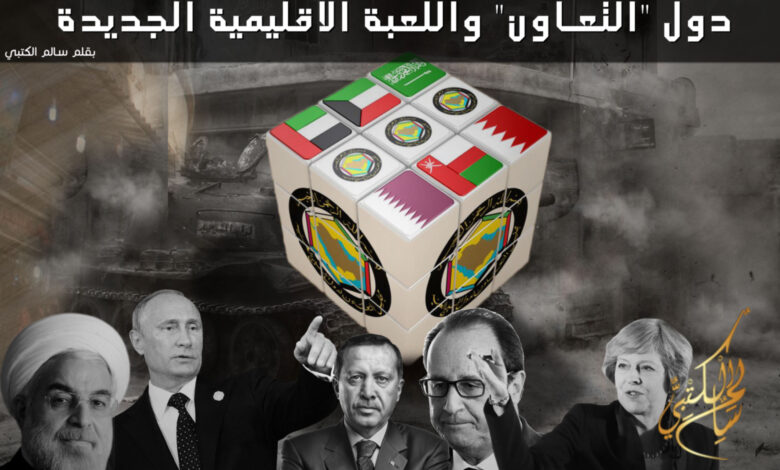
There is a tremendous amount of analyses about the crucial strategic changes witnessed in the area of at the current stage. There is a new US administration, Russia is seeking to emphasize its Middle East role through the Syrian gate, Britain returned to the area strongly through the gate of the Manama summit held by the leaders of the Gulf cooperation Council (GCC) recently in the Bahraini capital, France exist strongly in the Arabian Gulf and the Middle East, Iran is trying to revive its expansionist ambitions through obsolete tools, and Turkey seeks to restore its geopolitical role, after the emergence of deep discrepancies in strategic interests with American NATO ally.
In short, there is a new regional game taking place on the ground, and certainly the GCC countries are aware of the dimensions of this game, as this was clearly evident in the Manama summit held recently.
It is true that there is not full agreement on the Saudi suggestion concerning the union between the GCC states, but the existing discrepancy in views is healthy. The issue deserves some time for study and research so as it does not turn from an opportunity to a challenge, especially since the Gulf Cooperation Council countries are actually linked strategically, and those links ensure them a high degree of cohesion and coherence in the face of regional and international adversity and the changes prevailing, not to mention that the GCC countries, especially Saudi Arabia and the United Arab Emirates, believe in the need to address any threat or risk facing any of the GCC countries or affecting the gains of its people and its security and stability. The two countries have proven their conviction of that, and have maintained a deep degree of solidarity and cooperation that translate this deeply rooted conviction.
GCC countries have accomplished a lot of strategic achievements in Yemen, the most important of which is that they prevented the control of this ancient Arab country by Iran through its agents. The mullahs aimed at surrounding the GCC strategically across stationing points in the north and the south, but the plot failed due to the vigilance of the Arab coalition countries and their rapid and active moves through the “Decisive Storm” and “Restore Hope” operations. These countries are now seeking to search for a settlement formula that will restore security and stability to the Yemeni people. But Iran’s allies and its agents refuse this, and cling to a destructive strategy aimed at draining the Arab coalition countries, without any regard for the impact of the time factor on the Yemeni people, who actually suffers from the effects of the violence and destruction the transgressing Houthi group and its allies, followers of ousted President Ali Abdullah Saleh, caused during the past period.
As for the other regional files, there is a state of anticipation as to the new US administration taking power in January. But events do not stop. The Manama summit has seen a strong return of Britain to the Arabian Gulf region, as Britain’s Prime Minister, Theresa May, participated at the summit of the “Cooperation”. She took advantage of the opportunity and stressed that “the Gulf security also means Britain’s security”, to put a new base in the strategic equations relating to the security of the Gulf region, as there is a strong British commitment to the security of this region and its countries, but this does not mean by extension the absence or reduction of the US role, as some imagine.
Britain’s strategic relations with the US throughout the past years are deep. They are partners in addressing all crises in the region, and therefore it is inaccurate to explain Britain’s new role as an alternative to the American role. What happened is that there is a new Gulf- British partnership, and there is a joint pledge to fight terrorism.
This means a lot to the Gulf Cooperation Council. Britain has for decades been accused of hosting the leaders of some terrorist organizations, such as the Muslim Brotherhood and others. Efforts that have been made before failed in persuading the British side to end this relationship that negatively affects the relations of many Arab countries affected by terrorism, with Britain.
Now, it is possible to launch a new dialogue between the GCC and Britain on dealing with terror organizations, and to dismantle the ambiguous relationship between hosting some of the leaders of these organizations on the one hand, and human rights and freedoms on the other hand.
In my view, Britain is aware of the sensitivity of the next stage in the Middle East, and does not want to leave room for Russia to move freely in this vital region of the world. It is also aware that the new US administration may not take into account Britain’s strategic interests as was the case in the past.
After the summit, Foreign Minister of the Kingdom of Bahrain, explicitly denied that the strategic partnership launched by the Manama summit with the British government would be at the expense of what he called “the privileged relations with the United States”, and this is true. It is difficult to say the era of US-Gulf partnership has come to an end, but what is more likely to happen is to set new rules for the partnership, or to reformulate it according to the vision of the new US administration.
I am Confident that the GCC countries are attentive to the rules of the new regional game, and aware of the accelerated strategy changes going on around them, and realize that all of these changes produce several negative effects, but the calm and patience of these countries make me feel optimistic about the efficient management of this complex strategic reality on the part of the leaders of nations of the GCC.