‘Kill the Arabs’, a song that went viral on the internet in recent months, was only a manifestation of the grudge in the hearts of the many Iranians towards the Arabs. In spite of denials that it received official license, the anti-Arab rap song received much attention. The lyrics of the song reveal a huge amount of the Persian hate and racist speech.
Following the controversy about this monstrosity, I reflected on the real reasons for the Iranian behavior toward the Arabs and the basic drivers of such behavior. Imperial ideology and historical hatred motivated Iranian expansionism towards four Arab capitals. It was not rescuing the oppressed as the Iranian ideological discourse claims in order to fool the small minds. Since nearly fourteen centuries, the Iranians did not forget the fall of their empire following the Arab Muslim conquests. I do not question the news reports that have been circulating a while now, talking about Iranian plans to organize a referendum in Iraq to annex this Arab country to Iran.
The Iranian conflict with the Arabs does not date back to a few years, as some believe. It is a national conflict with political dimensions. It dates back to the pre-Islamic era, but it has been widely ideologized since the Khomeini revolution in 1979 when the mullahs wanted to exploit the Arab decline, claiming to be in the defense of the Shiites against the Sunnis and to speak on their behalf. It was done in order to cover historical expansionist ambitions with a cloak of ideology and sectarianism to divide the Sunni Arabs. The Arabs dealt with Iran as an ideological cloak and not a historical and political one. Some dealt with the Arab Shiite citizens as agents of Iran in their countries, contributing to strengthening the Iranian standpoint. Iran wanted to dismantle Arab national States through sectarian means and longed for attracting factions of Shia Arab to sympathize with it. That certainly weakened the national bonds in those countries.
Many indicators show that the Arab-Iranian conflict is a historic national conflict not a religious one. The Arabs are not all Sunni Muslims. There are millions of Arabs professing Shia Islam, Christianity, Judaism and other belief systems. Iran is not all Shia Muslims. There are about ten million Sunni Muslims living in the country that claims to defend Shiite Muslims in the region and the world.
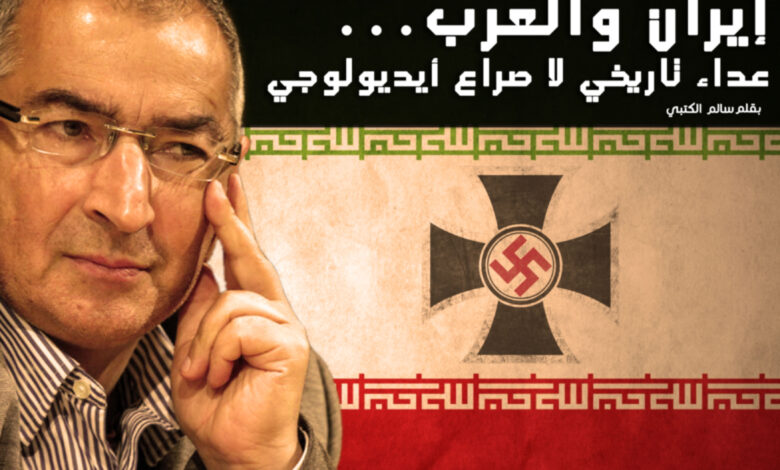
Iranian scholar and professor of political science at Tehran University Sadegh Zibakalam says that many Iranians, whether they are religious or secular, hate the Arabs. Four years ago, he was reported in an interview with Sobh Azadi weekly (translated by Al-Arabiya) to say ‘unfortunately, I am sure that many of us [Iranians] are racists.’ The Iranian perception about the Arabs is clear evidence of Iranian racism, he said, denying that there is a link between the low cultural level and the spread of racism among Iranians as is the case in the West. He added that ‘you can see a lot of intellectuals hate the Arabs, and you will find a lot of religious people loath them, but this phenomenon is more prevalent among Iranian intellectuals, while the religious ones tend to curse the Sunnis. The rancor toward the Sunnis and their figures among many Iranians is in fact another face of the hatred against the Arabs. “Sadegh relates Persian nationalist hatred for Arabs to the historic defeat of the Persians against the Arab Muslims in the battle of Qadisiyah, saying ‘It seems we, Iranians, did not yet forget the historic defeat against the Arabs in Qadisiyah after 1,400 years. In our hearts we have rancor and hatred towards the Arabs, as fire under the ashes may turn into flames whenever there is an opportunity.’ ‘These things are not illusions,’ he adds to confirm his interpretation, ‘whenever our neighbors in the UAE, Bahrain, Qatar and Kuwait take a stance against Iran, the Islamic Republic of Iran would respond with racism more than political stances.’ ‘When the spokesman for Foreign Affairs or the Minister of Foreign Affairs or the imam of Friday prayer or the Parliament Speaker […] speak, their words express superiority. For example, they say to them [Arab countries] are you humans? How is the UAE important? If the Iranians blow wind from this side of the Persian Gulf to the other, they will wipe you out of existence. “
I did not want to cite the famous Iranian professor further, but his objective stances seem more convincing than documented evidence about the national historic hostility and racism which controls Iran’s political conduct toward all Arabs. Therefore, I cited the Iranian Professor to tell Arabs who trust the claims that Iran defends religion, Jerusalem, the oppressed and so on, while it is in fact hiding plans and intentions of expansionist nationalism fueled by the nationalist hatred and historical hostility dominating Iranian political thought and conduct. The commander of Iran’s Revolutionary Guards, and TV personality, Gen. Qassem Soleimani, never announced one single plan to liberate Jerusalem, not even a single inch of the occupied Syrian Golan, in spite of his strong interest in taking pictures while he travels in the provinces of Iraq. You who have the power and influence in Syria and Iraq can embarrass and put military pressure on Israel, can’t you?
Personally, I believe that the main objective of the Iranian strategy plans does not extend to the Arab territories occupied by Israel in any way. It does not touch with the idea of liberating Jerusalem and such claims. It is rather centered on control over the largest possible area of land, capitals and neighboring Arab countries. The religious slogans are just sectarian heresies or a new Trojan horse that the Iranians used in order to divide the Iraqis into warring sects and factions, providing a valuable opportunity for Iran to avenge what the Arab Muslims have incurred to it in Iraq.