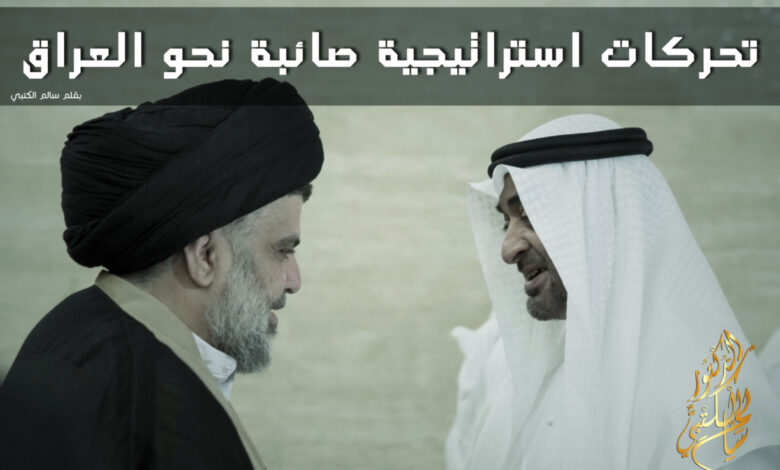
His Highness Sheikh Mohammed bin Zayed Al Nahyan, Crown Prince of Abu Dhabi and Deputy Supreme Commander of the UAE Armed Forces met with Moqtada al-Sadr, the leader of the Sadrist movement in Iraq. The GCC countries are working hard to bring Iraq back to its place in the Arab space and counter the increasing Iranian influence. After territories seized by Daesh were freed, Iran wanted to fill the power vacuum in Iraq.
The visit of al-Sadr to the United Arab Emirates, shortly after his visit to Saudi Arabia, shows that Iraqi national figures are making efforts against the Iranification of Iraq. Strategically, these efforts are moving in the right direction. The scenario of the division of Iraq is unfolding, as the Iraqi Kurdistan rejected a US request to postpone the referendum on the secession of the region from Baghdad on September 25.
Although the US demand for the postponement of the referendum is directly related to the impact of such step on the war against Daash, the referendum itself opens the door wide to the geographic disintegration of Iraq. Other demands for separation could turn Iraq into small states. Such a scenario can even repeat itself in other countries.
Even more serious than partition is the destabilizing Iranian military presence in Iraq that fuels turmoil and insecurity. It is the primary instigator of separatist strife, chaos and violence. Iran does not want Iraq to regain its sovereignty, regional role and international reputation. Rather, it wants a client state that receives its instructions from Tehran. Once the capital of the Abbasids, Baghdad, had been conquered by the Iranians, they officially boasted this “victory” and instructed their agents in Baghdad to appoint IRG General Qassem Soleimani as adviser to the Iraqi government.
No Iraqi can accept Iran’s dictates, or allow Iran to drain his country’s resources and fuel sectarian strife, and “engineer” Iraq’s demography to deepen sectarian conflicts and sow the seeds of disintegration and division there. What Tehran fears is that Iraq might return as strong as it was, so it tries to use its agents present in the Iraqi political arena to implement its own agenda to draw the map of future Iraq.
Neither the UAE nor Saudi Arabia has a direct objective or is motivated by self-interest in Iraq. For these two countries, the great Iraq should return to its right place to recover the balance of regional powers lost since 2003. The absence of Iraq from the equation of regional security and the strategic vacuum it left was filled by Iran. The IRI exploited the errors of the previous US administrations, infiltrated not only into Iraq but also Syria and Yemen with the purpose of establishing a “sectarian crescent” to encircle the GCC countries.
The GCC arranged meetings with al-Sadr, an Iraqi national figure who refuses to yield to Iranian or foreign influence. The meeting helped correcting some mistakes of the past. When Arab countries gave up on Iraq, Iran appeared in the picture, creating a highly polarized atmosphere of sectarian tensions among Iraqis.
Relations with the Iraqi people should be re-evaluated, valuing the Arab dimension instead of the malicious Iranian sectarianism. This approach could be the gateway to dealing with many of the crises Iran started in the region.
The UAE looks forward to a secure and stable Iraq that plays a key role in regional and international interactions and a national role in the Arab scene. The Arab countries need to join forces to serve the interests and gains of the Arab community. In his meeting with Muqtada al-Sadr, Sheikh Mohammed bin Zayed Al Nahyan said that the experience taught us to always call for what brings us together as Arabs and Muslims, and to reject the calls to division. To reach common ground is our starting point towards regional and international security and stability and towards eradicating terrorism that has been wrecking our region for years.
Now is a historic opportunity for Iraqis to take back their country after the great victory over terrorists. Now we must invest in the nation building that brings together all Iraqis, as His Highness said, voicing the UAE’s wish for a brighter tomorrow for Iraq.