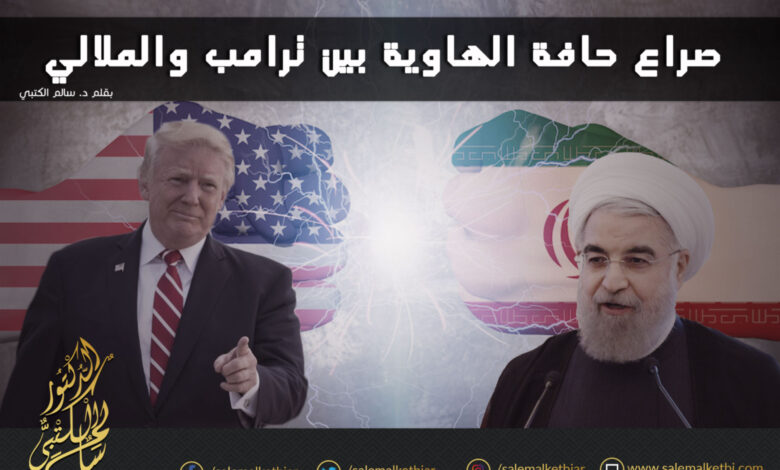
The events of the current crisis between Iran and the United States are taking place at such a pace that it is hard to predict their course in the coming days.
It is not easy to say that war is off the table, even slightly, after US President Donald Trump gave the order to cancel the strikes he had approved against some Iranian installations.
It is also unclear that the war is about to break out suddenly, after everyone was surprised on Friday morning that the strikes were scheduled at dawn that day and that hundreds of millions of people, both in the region and worldwide, would wake up to the news that war was on.
On the backdrop of this deliberate ambiguity, particularly from the US side, are some indicators that can be read calmly in the middle of this crisis.
First, President Trump has shown the US public and the world a high level of composure and political maturity. He did not rush behind the provocative actions of the mullahs’ regime, which has diligently incited the US in recent days to engage in an open military confrontation with Iran.
I think President Trump has not entirely dropped the plan to launch a military strike against Iran. But, in contrast to what he tweeted, the immediate reason for this tactical retreat may not be fear of casualties. The most likely reason is that he has found an opportunity to leverage US political gains and take advantage of Iran’s huge strategic error—to bring down the US drone in flight in international airspace.
In the last minutes before the military strike, Trump turned to another scenario that will delay the attack for some time, but will give more weight to the US position, increase international pressure on the Iranian regime and help build a cause to punish the mullahs’ regime, either through a limited military strike or a large-scale operation.
In the hours following President Trump’s withdrawal from the limited strike decision, he apparently wanted to clean up the atmosphere in the event that hostilities would escalate.
President Trump right away made a call to Crown Prince Mohammed bin Salman. The leaders discussed the threat posed by Iran. Their talks probably also focused on ways to compensate for any shortage of oil supplies and to ensure the Kingdom’s ability to calm global oil markets and contain any impact of high oil prices.
This point is a decisive element for the White House’s position in the conflict with Iran. The White House confirmed this in an official statement. “leaders discussed Saudi Arabia’s critical role in ensuring stability in the Middle East and in the global oil market. ”
The second indicator explains the President’s decision to postpone the military strike. The US administration immediately requested a closed meeting of the UN Security Council to discuss recent developments concerning Iran’s actions in the Gulf region.
This meeting is scheduled for Monday afternoon, June 24. The meeting is very important because it will allow President Trump to prevent any accusations from his opponents of bypassing the international legitimacy that the Security Council represents.
It also provides a valuable opportunity to prevent such a strike before the G20 summit in Osaka on June 28 and 29. The summit will give Trump the chance to discuss with allies the next step towards Iran. Trump will then learn about Russia’s and China’s positions in the event of a military conflict with Iran.
Third, President Trump may want to be sure there be no casualties among American military personnel and experts in countries like Iraq. The expected Iranian response could target US military bases in several countries.
Despite all the Iranian provocations and attempts to lure his country into a military confrontation, President Trump is still betting on the effectiveness of sanctions. He takes the view that the Iranian regime’s lost calm is only a direct result of the US sanctions. As such, Trump decided to add further sanctions on Thursday evening along with the decision to respond militarily. Tighter financial control over Iran will be ensured by the FATF.
The regime’s financial flows around the world will eventually buckle down under the sanctions, which would confirm why the White House continued to focus on the economic option.
President Trump’s brinkmanship strategy to contain the Iranian regime’s threat is not necessarily shared by his administration or his regional and global strategic allies. But, it is obviously an effective mechanism that explains why the mullahs’ regime went mad recently.
Certainly, the regime knows that sanctions are more serious than military conflict. This weapon of mass destruction can harm the political future of the regime. This is why the mullahs are trying in various ways to commit crimes and provoke President Trump to order a military strike. After that, the mullahs will have the opportunity to execute their plan of igniting the entire region with proxy wars.
However, the most urgent question is whether President Trump, through his vision of crisis management, will manage to keep the situation under control and win the round in points, or will the mullahs increase the pressure on the White House to lose patience and order a strike against Iran in the days, if not hours to come?