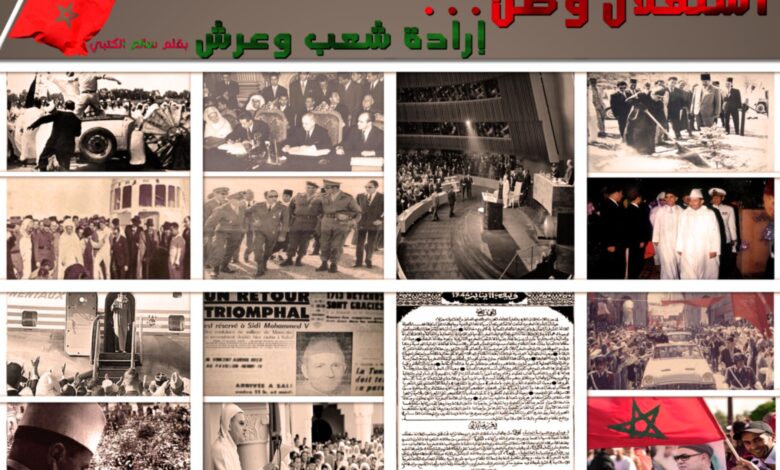
When researchers remember national independence dates as important marks in the history of nations, there comes to their minds the idea of how much rooted is the idea of independence in the consciousness of peoples, since independence does not mean only the disengagement in all its forms with the colonizer and colonization as was the case in the past, but independence means free will, which is the most important aspect and the brightest side of such historic moments.
For the Kingdom of Morocco, and by virtue of my interest in the history of this ancient country, I realized it is replete with bright moments, but the Independence Day remains one of the most prominent of these historic moments. Independence came after much struggle, which combined the will of the people and the throne. This magnificent cohesion remains the most important symbol of nationalism and belonging to this country.
The independence of the Kingdom of Morocco is the embodiment of a struggle filled with lessons. It is full of inspiration about the sense of belonging to the nation, with its historical memories that distinguish it from other experiences and give it a tremendous amount of historical uniqueness.
Considering the Independence Day is not a kind of historical, cultural and political luxury, nor is it a revival of memories that have become obsolete, but it is a necessary step to conjure up nationalism in the collective consciousness of the people, and to renew our national energies strongly needed by everyone in the current conditions globally and regionally. Indeed, the idea of homeland and of an independent and sovereign state has become prone to discredit and attacks from organization and currents that cross geography, and others that undermine the foundations of states and push for transforming the world into a state of strife and conflict under religious and ethnic and sectarian banners, all motivated by self-interest.
It is evident to conjure up the national will on Morocco’s Independence Day, so as to push the process of work, production and development in this country, whose history is filled with challenges and inspirational experiences of struggle. Fighting the battle of independence has had a high cost at the human and physical levels, and these costs have contributed to the consolidation of unity and alignment and cohesion of the national structure of the Kingdom of Morocco since independence. Unity between Moroccans is exceptionally symbolic and unique. It is the jewel in the crown of this country, and its fort in the face of challenges, some of which are still ever-present testing the will of Morocco and Moroccans alike.
There is no doubt that the development process in the Moroccan kingdom led wisely by His Majesty King Mohammed VI, proves that the cohesion of the people and the leadership in the Kingdom is above any other consideration. This cohesion succeeded in sparing the Kingdom of Morocco most troubles, and represented a bulwark in the face of any attempts to undermine the security of the brotherly Moroccan people and its national independence.
In days like this six decades ago, the late king Mohammed V declared “the end of the era of the protectorate and the beginning of the dawn of freedom and independence,” to mark the victory of the throne and the people’s revolution. And in days like these the Kingdom of Morocco came out from the colonial experience as a strong and cohesive nation able to safeguard its identity and its will and authentic values, which is the same spirit that is still present in Morocco. This spirit safeguarded Morocco’s historical and civilizational role as a beacon of cultural, intellectual, humanitarian and religious radiance, and as a vital fulcrum for the launching of ideas of modernization and development and the convergence of civilizations and cultures and human communication.
The brotherly Moroccan people has a wonderful historical experience in linking past and present. It did not interrupt its relationship with its past, even if it was marked by colonization. It managed to extract what it wants from that bygone era without any negative impact on its identity and civilization and culture, It therefore enjoys an exclusive uniqueness combining the history of Morocco and its cultural and moral and religious heritage on the one hand, and the historical experiences and cultural frictions that it experienced with their civilizational and cultural legacy. The result of this combination was human communication and the resulting Moroccan personality, an expressions of civilizations and cultures that mingled and fused on the ground of Morocco and produced a tremendous amount of openness and coexistence, moderation and tolerance, as well as cultural and humanitarian pluralism.
The anniversary of the national Independence Day of the Kingdom of Morocco calls for many research discussions, and conjures to the same extent the spirit of national struggle in the face of the current development challenges, as development and construction battles are not less ferocious than the struggle against colonialism. The popular will and national efforts play the most prominent roles in development battles, which makes this anniversary a very important moment, not only at the level of celebration, but also in terms of encouraging national motivation to realize more achievements and gains we all wish to this brotherly country.