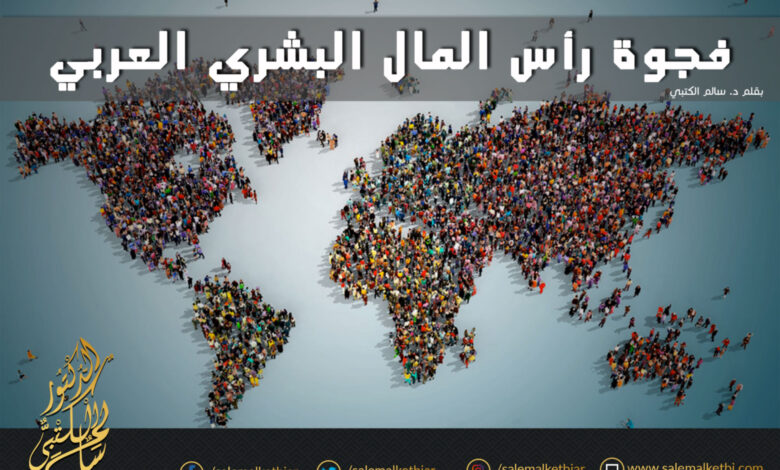
According to the World Bank, the world is facing a gap in human capital. Investment in education and the rehabilitation of human resources are lacking in most countries where they are supposed to prepare to meet the future challenges of technological change.
One of the most important of these challenges is the increase in the population with a decline in employment opportunities and the increase in unemployment rates due to technological development and the Fourth Industrial Revolution. The world is going to witness a robot revolution. Automation is growing at very rapid pace, costing thousands of jobs.
Thus, the various specialized reports indicate that investment in people represents the best strategic investment in the long run. UN statistics indicate that the world’s current population of 7.6 billion will reach 8.6 billion in 2030 and 8.9 billion in 2050, And 11.2 billion in 2100. This increase is compounded by the increase in life expectancy due to progress in good care and health services. In 2005, the average age of men was 65 years and 69 years old for women, while in 2015 these rates increased to 69 years for men and 73 years for women. All these are stressful indicators for economies, planners and decision-makers in all countries of the world.
What makes the situation worse for our region is that it suffers from the spread of extremism and terrorism and also suffers from the world’s highest unemployment rate among young people, which is about 30% in 2016, three times the average of the youth unemployment in the world! It is enough that Arabs, who make up about 5% of the world’s population, represent 47% of the world’s displaced people, and 58% of the total number of refugees in the world!
UN reports of past years paint a bleak picture of Arab youth, predicting that three in four Arabs will live in conflict-prone areas in 2020.
The UAE has long been aware of the importance of investing in human resources and has become the top Arab country in terms of investment in human capital as the main driver of sustained economic growth, according to the World Bank. International reports confirm that every child born in the UAE today will be a productive individual with a rate of up to 66% with advanced education and comprehensive health care.
According to World Bank reports, the UAE is a contributor to the World Bank’s Human Capital Project, which sees human capital as an engine of inclusive growth.
The UAE strategy on youth is not just about providing education and health opportunities, but also empowering youth and women for the comprehensive development of the country.
In a region where you hear the news of conflicts and violence, the Gulf country is a beacon of development, tolerance and moderation. It is a renowned country fighting against Arab youth radicalization, obscurantist groups and expansionist polities.