Since the UAE signed an agreement to establish bilateral relations with Israel, nothing announced promised the Palestinian cause a final peace settlement and an end to the Israeli occupation of Palestinian territory. Nevertheless, it was stressed that this was a great step to gain time and to break through the wall of inertia that surrounds the reality and future of this issue.
But as the UAE’s diplomatic advance has put the Palestinian leaders faced with choices requiring courageous decisions, they chose to retreat into evasive maneuvers and push people into sterile debates on the concepts and terminology of the UAE-Israel agreement.
Palestinian officials, for example, talk in the media about the difference between the English and Arabic versions of the tripartite declaration issued at the end of the recent Israeli-American visit to the UAE. They debate whether Tel Aviv has indeed stopped annexing Palestinian territories.
Palestinian officials claim that the English version refers to an agreement on establishing relations “that led to the suspension of Israel’s plans to extend its sovereignty over territories in the West Bank.”
The Arabic version published by Emirates News Agency, on the other hand, indicates that the agreement “has stopped Israel’s plans to annex the Palestinian territories,” they say. In a tweet, PLO Secretary General Saeb Erekat asked his supporters to compare the two versions, pointing out the difference between the words “stop” and “suspend.”
In response, the chief of Policy Planning and International Cooperation at the UAE Ministry of Foreign Affairs pointed out that “the phrasing difference is just a nuance in translation.” “If anyone can find a better term than [the Arabic word for] stop for the controversial English word, go ahead,” he assured reporters, stressing that one of the conditions for starting bilateral relations “was to stop the annexation.”
The official clarification of the UAE did not convince the Palestinian side either. It is, according to Hanan Ashrawi, a “deceptive” approach to influence Arab public opinion. “I don’t think it’s a translation problem; I think it’s a dishonest way of manipulating the discourse,” she told Reuters. She added that the Arabic translation is a way to mislead Arab public opinion by saying that the UAE has managed to stop the annexation of territories when what happened was just a suspension.
This illogical Palestinian debate deserves two observations. The first concerns the reference to the UAE resolution. The Emirates had confirmed that the decision to establish relations with Israel was sovereign. The sovereign decisions of states do not need to be justified and supported to convince the other parties.
In any case, the UAE used its own capabilities and political and diplomatic leverage to overcome the stagnation and stalemate that dominated the almost deadlocked path of negotiations. UAE’s official discourse was clear.
Anwar Gargash, Minister of State for Foreign Affairs, was clear that a normalization agreement with Israel was necessary to save the two-state solution and buy time to resume negotiations between Tel Aviv and the Palestinians. “The annexation issue is a ticking time bomb that has caused concern to everyone, so we have taken it off the negotiating table and bought time,” Gargash said.
These comments speak clearly of a diplomatic tactic that is in everyone’s interest, as long as the party concerned (the Palestinians) takes advantage of the new circumstances, which will make the Israeli side more cautious in its pressure on the Palestinians. This is not out of fear of a particular Palestinian or Arab reaction. But let us say that it is out of ambition to get closer to more Arab friends in the region, which would offer strategic advantages to Israel.
Here, one might wonder why the UAE has put itself in a political embarrassment, since it is not one of the main Arab powers involved in the Arab-Palestinian conflict.
But what’s really involved here is the current Arab geopolitical reality, the scale of the crisis suffered by the official Arab regime since the unrest of 2011, the active role of Saudi Arabia and the UAE in managing the successive collapses of Arab nation-states, and the steep bill they have had to pay to cope with the foreign interventions, ambitions, seductions and conspiracies against Arab societies.
The UAE has become an active player in restoring regional security and stability. What is strange about its quest to play an active role in peace efforts?
The second observation in this debate is that the Palestinian side has chosen to flee rather than find alternatives and solutions that can help resolve the crisis situation.
The strategic framework of the historic conflict between Palestinians and Israelis has taken a new turn in recent years. Arab support for the Palestinian cause no longer enjoys the same level of trust as before.
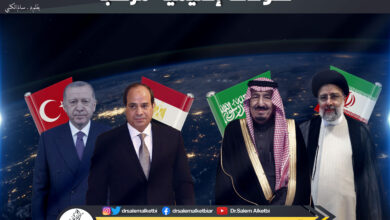
In addition, regional parties, such as Iran and Turkey, exploit the cause in the political and media battlefields in the most odious forms of opportunism, supported by their Arab affiliates, which regroup organizations, officials and elements with ties of interest, ideological, financial and sectarian with these two countries.
Formal relations between the UAE and Israel do not infringe on the principles of the Arab countries. In June 1996, it was agreed at the extraordinary Arab summit in Cairo that a just and comprehensive peace is a strategic choice for Arab countries.
Therefore, what has happened and is happening is nothing more than a search for new diplomatic tactics to overcome the obstacles to the implementation of the proposed initiatives to achieve a comprehensive Arab strategic choice, as long as it is part of a “sovereign decision” by a state that has a history of support for the Palestinian cause and people.
Proposals for solutions that go beyond the traditional framework of solutions proposed for decades must be studied in a rational manner. But there are some who consider any break with the useless solutions of the past as betrayal and sell-out.
The official Palestinian reaction looks like a reiteration of past mistakes. We must not miss any opportunity that would open a new door of hope for millions of Palestinians.