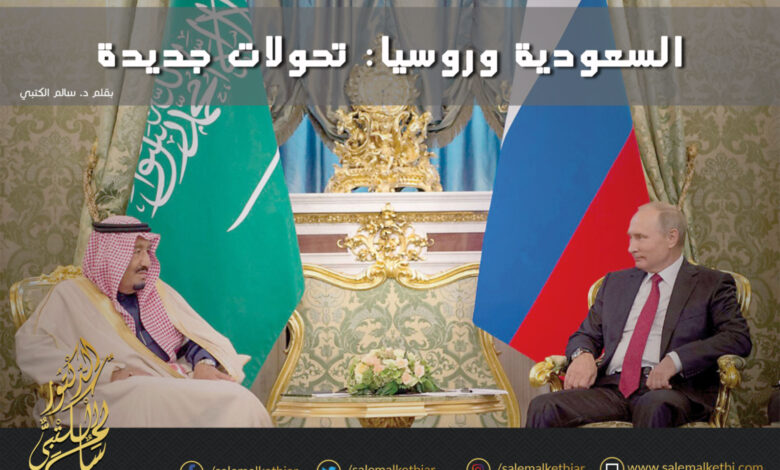
The recent visit of Saudi King Salman bin Abdul Aziz to Russia will have strategic effects on politics, security and the economy.
Many analysts believe that the visit means Saudi Arabia has turned its back on the United States and that it has realized the new global balance of power. For them, the balances now tend in favor of Russia. But this wishful thinking overlooks the fact that in today’s politics, alignment and non-alignment are obsolete and strategic moves are interest-driven. Saudi Arabia can build strong positive relations with Russia without affecting its existing strategic partnership with Washington. If things were not the case, the United States would not remain silent on its Turkish NATO ally’s unprecedented rapprochement with Russia, as such a move back in the cold war days would have meant crossing a red line.
As the world changes, the rules of the geo-strategy do too. The second half of the 20th and the 21st are completely different stages. We should not forget that the map of international alliances and conflicts is no longer the same. Even the meaning of conflict has changed. The search for relations where everybody wins is no longer practical. Countries move in interconnected circles of interests where the main winning factor is the diplomacy and achieving “the possible” in conflicts between allies and adversaries alike.
The important visit came as Saudi Arabia became aware of the new Russian role in the Middle East through Syria, and in the world, and sought to restructure its relations with Moscow so as to ensure the Russians see their strategic interests in the region from a new perspective, or at least push the Kremlin to adopt a more neutral stance in the cross-Gulf conflict.
Vladimir Putin, commenting on the future of US-Saudi partnership in the light of the Saudi king’s visit said “nothing in the world is permanent”. He also spoke to the International Forum on Energy Efficiency in Moscow in response to what a panel coordinator said that the United States will always remain the main ally of Saudi Arabia in geopolitical affairs, saying that nothing is permanent, everything changes, and that having partner countries which pursue independent foreign policies is absolutely normal and does not prevent Russia from developing relations with other countries.
The Russian president’s speech is somewhat right. However, some things are unchangeable in the relations between some countries. The US-Saudi relations have become cooler since President Trump took office last January yet Riyadh will continue to use its influence and power to achieve its own strategic interests.
The visit will open the door to an important Russian role in pressuring Iran to halt its expansionist policy in the Middle East. A strong supporter of and influential in Iran, Russia wants to prove itself as an international player respected and trusted regionally and internationally.
Saudi Arabia moves to curb Iran’s influence in the Middle East and wants to ensure its isolation if it insists on escalating positions towards the Kingdom. The visit could also open the door for an effective role for Russia in resolving the Yemeni crisis, as Moscow continues to look for ways to prove its policies effective in the Middle East.
Building Saudi–Russian networks of interests will have a definite effect on Russia’s policies in the Middle East, as Saudi Arabia uses its influence and pressure cards to stabilize and secure the region.