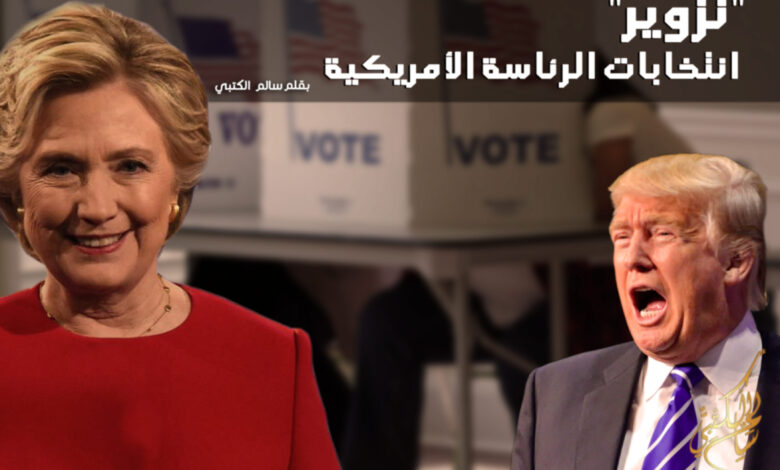
The interactions and political exchanges happening so far in the US presidential race seems in many respects ordinary and a repetition of what happened in previous electoral rounds. But what drew the attention of experts and observers in the third debate in particular, is when Republican presidential candidate Donald Trump hinted that he may not accept the results of the elections in the event of losing the presidential race. He said he would consider it at the time, repeating earlier accusations that the elections are “rigged”.
Trump speaks with remarkable confidence of what he describes as rigging the eighth of the November elections, and he repeated these accusations in many media meetings. He then returned and threw these accusations like a bomb in the third debate, as if he was paving the way for his defeat or justifying it in advance, especially since most of the opinion polls, which followed the electoral debates, including in the third debate, still give precedence to his rival Hillary Clinton.
It is interesting that Trump is talking about the rigging elections without giving a single piece of evidence to the official authorities concerned to protect the electoral process from possible rigging according to his opinion. But he spoke in general about the media that influence the voters in favor of Hillary Clinton. Here he is suffering from an unprecedented problem. Indeed, most influential American newspapers, such as New York Times and Washington Post and Los Angeles Times have announced their support to his democratic rival. Some even denounced the waiting by some undecided voters for the third debate to decide for their position towards the two presidential candidates, considering that things are clear to all since the first debate.
What limits the importance of uncertainty and confusion raised by Donald Trump are two important factors. First, he often means the position of the American media that promote his rival and incite voters not to vote for him, and he does not intend the traditional customary rigging or that there are gaps in the American electoral system itself. The mechanisms of the electoral process in the United States are well-known and declared to all and are strongly supervised by civil society. The second factor is that senior Republican party officials, do not embrace Trump’s position and his claims about the elections, and expressed more than once their absolute confidence in the integrity and strength of the electoral system in the country, which prompted him to attack them and say that they are “extremely naïve”. It seems that these officials are now facing a real problem, and they have to try to come out from Trump’s impasse with the least political losses.
Trump committed a politically fatal error American political history will not forgive him. Never a presidential candidate has doubted the electoral system. This system is a matter of pride for American politicians and everyone always speaks of it as one of the bases of the model of American democracy.
If this scenario actually happened, the American political circles will face a unique unprecedented event in the political history of the country, which will make one of the biggest democracies in the world face a unique qualitative position.
Of course there are precise rules governing the electoral exercise in the United States, but the questioning by a presidential candidate of the integrity of the election itself is a reality that would perhaps open public debate on many dossiers, especially that Trump is primarily not a political candidate but a businessman with a dialectic personality that always makes him interesting for the media.
Trump’s nervousness in the face of accusations of successive sex scandals, has weakened his competitive position too much, and reduced his chances of winning. Republican Party officials could no longer provide support for a candidate who questioned the country’s electoral system. It is enough that US experts had considered that Trump has submitted himself to the American media the rope to hang his political future, and here is an important lesson for the need that citizens respect their countries and put a limit to political dispute so as not to intersect with red lines relating to the security and stability of nations.
The third debate in particular was characterized by more heat and tension perhaps because it was the last chance for the Republican candidate to prove his superiority over his opponent after his defeat in the polls in the first two debates. He was so emotional that he accused his rival of being an “evil or hateful woman”. Of course Clinton did not fall silent in the face of such accusations. She described Trump as “the most dangerous candidate” in contemporary American history. And the end of the third debate was revealing of the atmosphere of the relationship between the rival candidates, as they did not shake hands after its completion, unlike the second debate, when a question from the audience forced them to show respect for each other.
From the analysis of the three debates, it seems that both candidates inflicted to one another fatal political injuries, so the winner, whatever his identity, will not come out completely intact from this competitive fierce round. The doubts and accusations raised by his rival will pursue him for the years of his presidency. Here the world will witness a US president who begins his term with the same weakness with which the previous administration ended!!
Political literature used to describe any American president at the end of his second term as a lame duck, an accurate description of an existing situation that is recurrent in the American political scene, but it has never occurred that a president initiated his term with a weakness caused by the accusations they faced during the campaign period.
The heated debate that was raised during the second and third debates specifically about US-Russian relations, gave birth to indicators difficult for any incoming president to skip. The Republican candidate Donald Trump will not forget that his rival called him a “puppet” and that Russian President Vladimir Putin prefers to “see a puppet as president the United States,”, and on the other hand, the Democratic candidate Hillary Clinton will not forget Trump’s saying that the Russian president does not have any respect for her.