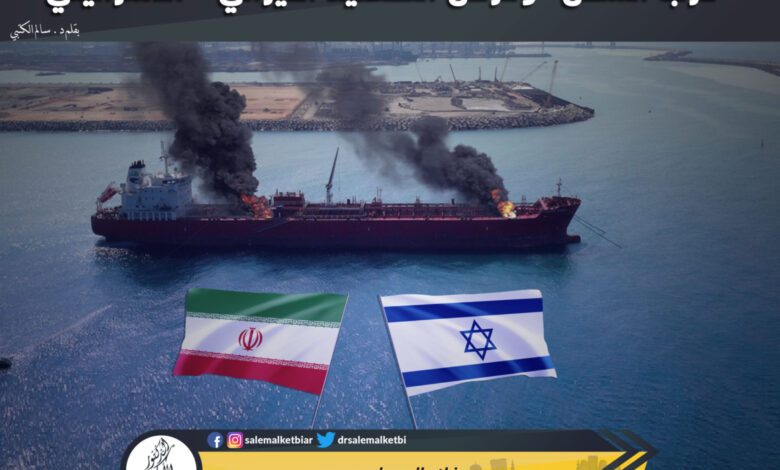
Israel’s targeting of one of the Iranian naval vessels near the coast of Djibouti recently was nothing but one episode of the hidden war that has been going on between the two countries for many years ago. What is new in this extended confrontation is that it moved to the sea coast and proceeded at an accelerated pace in recent months, which witnessed mutual naval attacks on ships belonging to Iran or Israel, in the midst of a state of denial, at least formally. The most prominent development in terms of Israeli-Iranian tension comes from the Israelis ’apparent concern about US President Joe Biden’s plans to return to the nuclear agreement signed in 2015 between Iran and six world powers.
According to what the “New York Times” published, the Israelis considered the attack on the Iranian ship “Soys” as a response to previous Iranian strikes that targeted Israeli ships. As usual, Iran’s mullahs deny the nature and functions of this ship, and claim that it was accompanying Iranian merchant ships in the Red Sea, despite the fact that this means, at first glance, that this ship has military and security missions. Otherwise, what is the need for it to accompany the merchant ships? According to the American “Global Security.org” website, the Iranian ship is managed by the Revolutionary Guards, which is logical by virtue of the hegemony of the Guard Navy over the operational and logistical affairs of the Iranian Navy.
The question that arises in this context is: What are the chances of the “ships war” moving into an all-out war between Iran and Israel? What are the potential developments in the context of the current escalation? Here, it can be pointed out that the scenario of a total war seems unlikely, at least in light of the existing strategic facts. But the most likely scenario is that Israel launches a limited military operation against Iranian nuclear facilities, but this scenario remains dependent on the fate of the efforts that President Joe Biden is currently making to contain the Iranian nuclear threats, meaning that in case of failure of these efforts, or even the reproduction of the “Joint Comprehensive Plan of Action” that was signed in 2015 with a different timeframe while keeping the same framework, this may prompt Israel to seriously consider aborting Iran’s nuclear ambitions and preventing this threat from being postponed to future generations.
The truth is that the problem of Israel, as well as the Cooperation Council States, with the Iranian mullahs, lies in the difficulty of ensuring that they adhere to the agreements they sign regarding their nuclear program. Indeed, the reality confirms that the mullahs are copying the North Korea scenario and proceeding with meticulous implementation, and therefore it is difficult to accept the content of any nuclear agreement that does not include a comprehensive treatment of the Iranian threat, or the admission that Iranian nuclear technology only targets the civilian side. The absence of transparency, the continuous deception and secret facilities that the IAEA discovers from time to time are testimony to the existence of secret objectives and intentions for this program. Consequently, there will remain disagreement among all over the timeframe that the mullahs need to reach the “bomb”, especially since their statements during the past months have exposed their intentions and have spoken clearly – in the context of pressure on the new American administration – about the possibility of disavowing the “Supreme Leader’s fatwa” regarding the prohibition of possession of a nuclear weapon, and the issuance of a decision to manufacture it, which means that the issue is not related to nuclear technology or Iranian manufacturing capabilities, but rather to the existence of a political will on the part of the Supreme Guide, the top of the pyramid of power, and here it is not possible for many countries that fall within the scope of the Iranian nuclear threat to subordinate the stability of their people and their national security to a fatwa that a reckless regime alludes at dropping every now and then!
The constant in Iranian-Israeli relations is that the concentration of militias loyal to the mullahs in Syria, as well as the Lebanese “Hezbollah”, is one of the causes of the escalation of tension, because this means the presence of a long arm of the mullahs able to harm Israel when necessary, meaning that Israel could be a victim of an Iranian war by proxy in case the mullahs decide so. Thus the question becomes: why did the mullahs not carry out any strike against Israel as long as they possessed the necessary force in Syria? The answer is first, the fear of a widespread Israeli retaliation, and second, the fear of the wrath of the United States, Israel’s traditional strategic ally. The mullahs know very well that Washington can bring down their regime or create the internal conditions for that at least, in light of the growing Iranian popular anger over the deterioration of living conditions, the absence of development, corruption, the collapse of the economy, etc, not to mention that the mullahs are practicing “political taqiyyah”, turning a blind eye – tactically – to effective Israeli strikes such as the assassination of nuclear scientist Mohsen Fakhri Zada in the heart of Iran, fearing that any unpredictable Iranian reaction against Israel would thwart the mullahs’ efforts to restore the United States to the nuclear agreement, which they consider as “the strategic umbrella” that opened the way wide to realize a large part of their expansion dreams since 2015, This explains to some extent the mullahs’ silence on dozens of Israeli strikes on Iranian military targets in Syria over the past years (previously they feared a hasty response from Trump, and now they fear thwarting President Biden’s enthusiasm to return to the nuclear agreement).
Israel also cannot initiate a surprise military strike against the Iranian nuclear facilities unless it obtains an explicit and clear American green light. Therefore, there is mutual caution and accurate calculations that lead the two parties to prefer a scenario of hidden war instead of getting involved in direct confrontations.
The truth is that the Iranian mullahs, despite their enthusiastic and sometimes fiery media and political rhetoric, look at strikes and counterstrikes with a standard different from what is declared, and their purpose is the final outcome that the regime gains, according to their own calculations regarding strategic profits and losses. For example, the implementation of the dream of reaching the shores of the Mediterranean across Syria and Lebanon, is – according to their vision – worth the sacrifice of some combat equipment and tens or hundreds of militia members, even if it comes to losing an influential leader like General Qassem Soleimani.
In light of the foregoing, it can be said that targeting the Iranian ship in the Red Sea by Israel or others does not open the door to the possibility of military escalation and sliding towards a greater confrontation, as the incident is part of the mutual deterrence messages aimed at exploring the limits of force and identifying the capabilities of the other side in the maritime domain after both parties have played this game many times in the arenas of cyberspace.