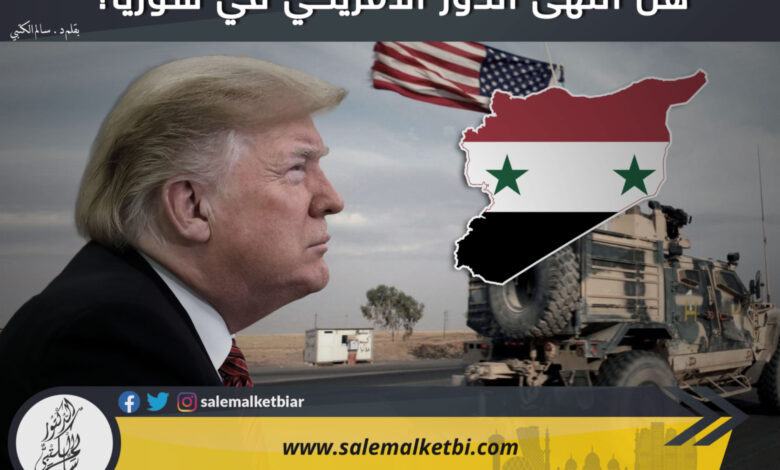
US President Donald Trump received strong criticism, both internally and externally, for abandoning the Kurds and leaving them in the grip of Turkish military aggression, and then signed a rapid agreement that gives Turkey everything or almost everything and allows it to achieve its military objectives through politics.
President Trump subsequently reversed his decision to withdraw all US forces from Syria. He said he was retaining some of these forces to protect oil and gas reserves in northeastern Syria.
The US Secretary of Defense, Mark Esper, recently spoke of strengthening his country’s military presence in al-Hasakah and east of Deir Ezzor, and protecting these areas from a possible fall into the hands of Daech members who remained or fled Kurdish prisons after Turkish military attacks against the Syrian Kurdish region.
This decline reflects the lack of an American strategy to deal with the Syrian question.
The decision to stay in Syria, however, is not a reversal of the decision to abandon the Kurds, which President Trump vigorously defends. It seems that it was born following indications from his close circle that the oil and gas reserve areas in Syria could return to the Syrian regime or fall into the hands of Russia and perhaps Iran or Turkey.
Perhaps that is what President Trump meant when he pointed to preventing Syrian oil fields from falling into the hands of Daesh or “any other groups [with] malign activities.”
Evidence suggests that a telephone conversation between President Trump and SDF commander Mazloum Abdi has brought relations between the two sides back to cooperation after accusations to the United States of abandoning the Kurds, who have agreed to return to the Syrian official fold for fear of falling into Turkey’s hands.
But it appeared that they only took days to return to the alliance with the United States again.
Remarkably, the US announcement of a return to protect Syrian oil coincided with accusations by the Russian Defense Ministry that Syrian “oil was actively being extracted and massively being sent for processing outside of Syria.”
“This, what Washington is doing now — capturing and maintaining control through the use of arms over oil fields in eastern Syria — that is, to put it simply, international, state-sponsored banditry,” Russian General Igor Konashenkov told Russia Today TV.
The statement reflects Russia’s outrage at the US retreating from its decision to withdraw its troops, insisting on remaining in the Syrian equation and not leaving things to Russia alone.
Regardless of these accusations and their impact on the alliance calculations inside Syria, the fact is that the United States has reversed the decision to withdraw completely from Syria, and that it will reconsider the alliance with the Kurds during an expected visit by Abdi to Washington soon. The visit could fuel tensions between the US and Turkey who has demanded Washington to extradite Abdi.
Since the beginning of the Turkish military invasion of Syrian territory, US troops exited areas not from those Syrian oil reserves areas, located in the northeast and east of Syria (Deir ez-Zor and Hasakah), is far from the areas of military conflict between the Turkish forces and the SDF, which still completely controls the oil areas.
There is no doubt that confusion is not limited to the US side. The evasion of the Kurds of Syria from returning to the Syrian fold and siding with the US represents a new complication of the map of alliances on Syrian soil.
However, the Turkish-Syrian dispute remains a major obstacle to the existence of an alliance between the parties to confront Kurdish forces in the north of Syria after it set back its cooperation with the Syrian regime.
Mediated by Russia, the cooperation could have brought the two parties together in a move that observers considered a vital victory for the Syrian regime, paving the way to regain control of the north of the country and end Kurdish autonomy in that oil-rich region.
To be sure, over the Syrian oil region, all the players in the Syrian arena are drooling. It produces about 300,000 barrels of oil a day, a huge asset that could help rebuild Syria after years of war.
Therefore, Russia is likely to consider supporting the Syrian regime forces in regaining control of these areas in order to finance the reconstruction later, as well as the strategic impact of completing control of Syrian territory and freeing the rest of it from the grip of terrorist organizations.
The United States is back to Syria under the pretext of protecting oil zones, and so is its alliance with Kurdish forces. But the Syrian state has become the only loser in recent weeks.
The Turkish military assault resulted in a reality determined by two agreements with the United States and Russia for the indefinite Turkish presence inside Syria. This only exacerbates the complexity of the Syrian crisis.