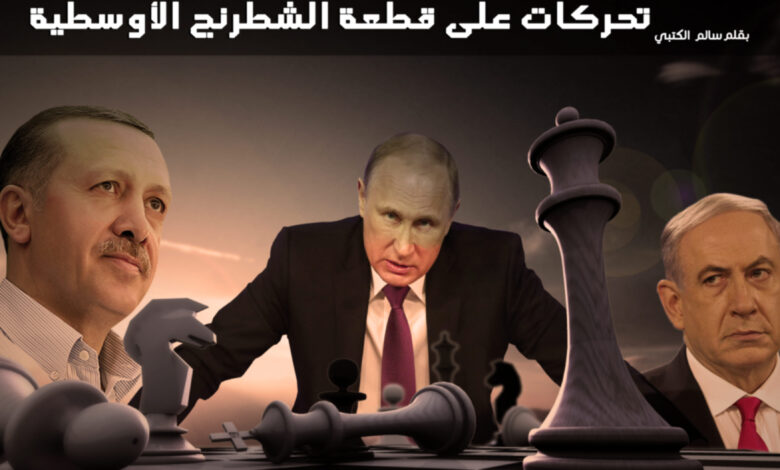
The observer cannot overlook the crucial strategic moves going on around him in recent days, where Turkey completely resumed its strategic ties with Israel, and the same day, a Turkish apology was issued to the Kremlin on the Russian plane crash, which requires asking questions about what is taking place around us in this vital region of the world, and trying to find answers to them.
First of all, it is clear that there were arrangements preceding the Turkish apology message, Indeed, Israeli Prime Minister Benjamin Netanyahu has made two visits to Moscow in two consecutive remarkably close times, while Turkey appeared to be in a hurry to rebuild relations with Russia as soon as possible.
It cannot be said that this Turkish moves are sudden, they are deliberate moves suggested by the signals issued from Ankara over the last two months. Those who accurately read Turkish officials statements directly after the dropping of the Russian aircraft, realize that Ankara realized the strategic mistake it committed when it got involved in this incident, but there was a need for time to pass messages and contain the effects of the incident and its repercussions inside Russia.
The most important problem in this incident was the Russian demand regarding an official apology from Turkey, which is difficult to the Turkish side according to what is known about it, so we can say that the last period was closer to an attempt to evade the official apology formula, but it seems that the settlement of a deal regarding relations with Israel under Israeli apology has facilitated the task of Turkish officials to offer a similar apology to Russia and to market it internally as a commonplace matter that does not negatively affect the image of the Turkish leadership, which got an Israeli apology, and justifies at the same time that Turkey presents an apology to Russia.
There is no doubt that the Turkish economy has been deeply affected by the crisis with Russia, and the crisis did not stop at the economy. Crises have been complicated in the region and affected the interests of Turkey strongly due to this crisis, and what exacerbated the situation of President Erdogan is that the American ally in the NATO clearly plays in the heart of the area of the Turkish strategic interests, and is not concerned with the fears of Ankara and its concerns about the situation of the Kurds regarding the Turkish state.
For the sake of objectivity, the Russian-Turkish crisis, was wisely managed at the diplomatic level by the Russian side. Moscow proved that it relies in its foreign relations on a legacy of deep historic experiences and events in such hot situations and crises, and on this basis, President Putin acted as a statesman capable of maintaining the interests of his country, without getting involved in emotional military confrontations. He even spoke several months after the Russian aircraft accident quietly and rationally calling on Turkey to adopt «concrete steps» to contain the effects of this incident, and therefore he removed embarrassment for the Turkish leadership.
The Turkish side also is aware of the consequences of the political earthquake that took place around it in the European Union, and realizes that it is difficult to continue in tension with Russia and to constantly risk losing a trade exchange that amounts to $ 60 billion a year with Russia before the Russian aircraft crisis, as well as to risk throwing all its strategic papers in the basket of the US ally, which did not take into consideration the Turkish interests in the Syrian crisis, and then, picking up the thread of pragmatism in the Russian crisis was an indispensable strategic alternative for turkey to preserve its interests.
Of course there are losers and winners in the accelerated Turkish settlements regionally, and among those are religious organizations with a political nature, which makes it difficult for Erdogan to maintain a strong support for them without taking into account the concerns of the Israeli and Russian allies. And the US side will be watching with suspicion the new path of Erdogan towards Russia, as well as do NATO partners that are strategically extending toward the Russian border. There are also the Palestinian factions which must not wait for strong support from the Turkish side, which will likely go on to the path of humanitarian aid and relief and focus on them during the coming period in order to preserve its interests with the Israel’s ally.
There are also calculations regarding the Syrian crisis. The disparity of interests is clear and deep between Russia and Turkey. There remain questions about the consequences of these developments and their impact on Turkey’s relations within its geographical perimeter. Here we can speculate that the apologies and reconciliations that took place may have effects on other disagreement files such as the Turkish Egyptian disagreement file, which may not exceed in its depth and dimensions what happened between Turkey and Israel, or between Turkey and Russia, and thus settlement becomes in this file like the rest of the controversial Turkish files, but on the condition of availability of certain circumstances including Turkey’s regional strategic calculations, and the extent of its willingness to restore rapprochement with an Arab state with the size and weight of Egypt, as well as Egypt’s position itself, and the extent of its willingness to restore relations with Turkey and to disregard the tensions and verbal attacks that took place in recent years. But what can be certain is that there is dismantling and reinstallation of international and regional relations in the next stage, and the GCC should engage with these developments and maximize its opportunities and take advantage of them.