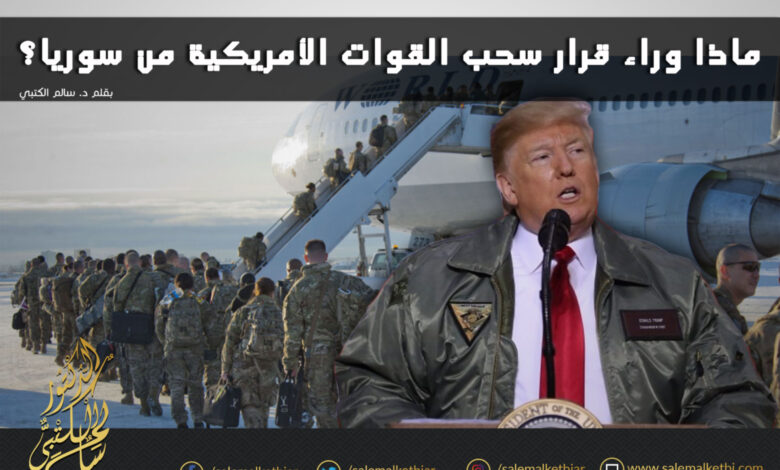
In a surprise decision, US President Donald Trump confused many parties and sparked widespread international controversy when he called for the withdrawal of US troops from Syria, saying the only objective of their presence, which was the defeat of the Daesh organization, has been realized, thus completing the presence of the US Army in Syria since 2015.
The US decision confused all parties involved in the Syrian file, caused great confusion among observers, similarly raised a wide-ranging American debate and maintained a clear link with the resignation of Defense Minister Jim Matisse to give the occasion as he said for the choice of a Defense Minister whose ideas and views converge with those of President Trump.
About 2,000 US troops are deployed in Syria, mainly concentrated in the east and north of the country, oil-rich areas where Syrian democratic forces (the Kurds being the main component) are fighting against the Daesh organization.
There are several strategic military bases in the Syrian border areas with Jordan, Turkey and Iraq. Therefore, the sudden withdrawal of these forces confuses the Syrian equation and raises many speculations about the reasons for this decision, its consequences and the expected repercussions.
Despite differences of opinion on the interpretation of the resolution, it is generally accepted that the Syrian democratic forces, US main Syrian ally, have lost their strategic value and should face military strikes from Turkey and militias supported by Ankara. The decision could be a “green light” to launch a Turkish military operation that would directly follow the end of the US withdrawal.
The controversy focused not only on the fate of Syria, but also on that of the Daesh organization. Britain felt that the organization had not yet been defeated and that it was still in Syria, while France confirmed its military commitment to expel Daesh from the last sites it controls in Syria, as for Germany, it saw that the American withdrawal could harm the battle against Daesh. These are reactions that mean that the administration of President Trump has not consulted the European allies on the resolution, a case confirmed by the presence of clues indicating that there is no consultation within the administration itself!
Naturally, Russia welcomed the US decision and considered it “fair”. Turkey has also done so. The resolution allows the two countries to share their interests in Syria in partnership with Iran, but offers a valuable opportunity for Turkey to strengthen its strategic position vis-à-vis Russia and Iran. And this decision is in the interest of the regime of President Assad and offers him an excellent opportunity to fully control the territory on which the Kurdish forces are based.
The Syrian regime is skeptical of President Trump’s intentions, and its media see this decision as an important opportunity for the US to exchange roles with Turkey, as evidenced by the escalation of the Turkish rhetoric about a war on the Kurdish forces.
Some observers have come to view President Trump’s decision as a return to the previous US agenda to reduce US interest in the Middle East and to resume the “Asia first ” strategy launched by former President Barack Obama, while others see a major strategic mistake as much as Obama’s mistake when he turned a blind eye to Assad’s use of chemical weapons and allowed him to penetrate the limits of the American red threat in this regard. While others went on to say that President Trump was pursuing his policy of implementing the promises made during the campaign for the presidential elections on the withdrawal of US troops from conflict zones under the “America First” strategy, others have speculated that this resolution was intended to provoke a major American domestic debate eclipsing the judicial investigations that are gradually approaching the president. In all these predictions there is some truth to different extents, Republicans themselves have considered this decision as a “free gift” for Russia and Iran!
President Trump seemed convinced of his decision and defended it fiercely, believing that this was not surprising at all and that he demanded the withdrawal of the troops several years ago. He had expressed the wish to withdraw the American troops for more than six months and had agreed to extend the duration for considerations whose time had ended. President Trump wondered, “Does the USA want to be the Policeman of the Middle East, getting NOTHING but spending precious lives and trillions of dollars protecting others who, in almost all cases, do not appreciate what we are doing? Do we want to be there forever? Time for others to finally fight,”
This tweet has several meanings. The first is that President Trump tied his decision to not getting enough funding for the US military presence in Syria. The second is that Trump does not reject the idea of military operations or wars. “It is finally time for others to fight”, which means that the withdrawal of US troops could be a prelude to another war, which could be interpreted as part of the military rise against Iran, whether it is to combat it or to intensify the military pressure on that country, especially since it is illogical to report the war to Iran in the presence of US troops concentrated in Syria and Afghanistan, and the fact is that preparations are being made to withdraw American troops from these two countries. This might not be a simple one both in terms of timing, or in terms of synchronization element with other developments related to the Iranian influence in the Middle East.
It is also certain that the resolution is closely linked to a certain agreement or understanding whose dimensions are still not clear with Turkey. The US decision was made following a phone call by President Trump with his Turkish counterpart Recep Tayyip Erdogan, where it was agreed to sell a $ 3.5 billion Patriot missile deal to Turkey; a very important sign of the improvement of Atlantic allies relations, which means that the climate is already favorable to strategic agreements that may include the withdrawal of the United States from Syria.
In the midst of these expectations and speculations, what about Israel? Does the US decision mean that President Trump is jeopardizing the security of the closest strategic ally to his administration? Israeli Prime Minister Netanyahu tried to soften the impact of the decision and said he had already been informed of Trump’s intention to withdraw his troops from Syria, but everyone knows that Israel is worried of Iran’s intensive presence in Syria, the proof is that Netanyahu himself has declared that Israel will remain alone in the region, which will cause an imbalance with regard to the alliance between Russia, Syria and Iran, while the Israeli media viewed Trump’s decision as a “slap on Israel” and a victory for Turkey, Iran and Russia.
It is likely that the decision to withdraw US forces from Syria is not yet clear and that the coming months will be full of surprises, some of which may reveal the real reasons for this decision. Should be taken into account here the character of President Trump and his tactical decisions based on a short-term goal that he abandons as soon as the short-term goal is achieved, which explains his fluctuation between one position and another, not by hesitation or by mistake, but in accordance with a strategic approach that he does not want to give up, hence the decision to withdraw troops is subject to modification, cancellation, reconsideration, that is to say to all possibilities.