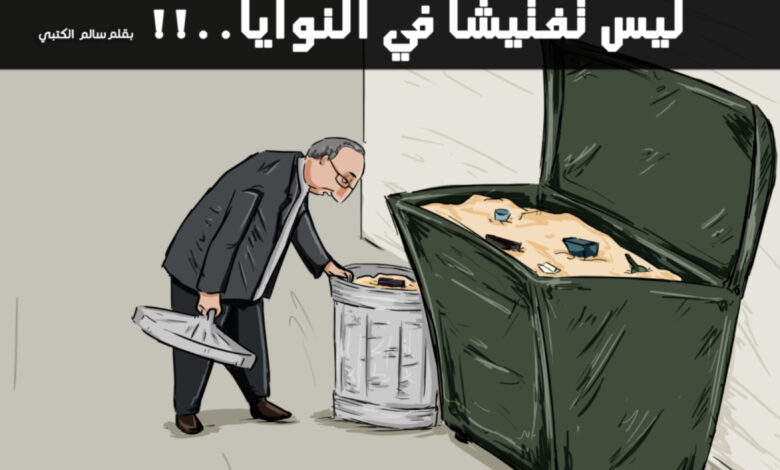
It seems that the story of Fahmi Huwaidi with the UAE does not stop at a specific point. The man can not cover his negative feelings towards the United Arab Emirates, no matter how hard he tries.
In a recent article entitled “Arab Marshall”, Huwaidi starts with a news report on Egyptian newspaper Ashorouk on Marshall Plan. The report claimed that the United Arab Emirates is consulting with the World Bank about the plan that includes reconstruction in three Arab countries, viz. Syria, Yemen and Libya. Huwaidi said it was a positive timely sign, but then went directly to his point.
About his maneuvering at the beginning of the article, I sensed something unusual for Fahmi Huwaidi, to praise the Emirates and its sense of responsibility towards the reconstruction of these countries. Huwaidi then pointed his gun questioning the intentions of the United Arab Emirates, citing some views that the motive of the US to support European Marshall project views is countering the ‘revolutionary tide’ which manifested in France and Italy at the time. Then Huwaidi criticized the UAE using his subtle journalistic style as he indicated that the alleged project requires, in addition to funding, expertise and qualified manpower that the UAE cannot provide. The man did not hear about the global UAE companies that manage seaports and airports in major developed countries, and other companies working in the fields of energy, drilling, exploration, telecoms and infrastructure. The global UAE companies in the field of construction, real estate and infrastructure in particular are among the best in the world. I do not think that this journalist never heard about large, world-renowned UAE companies.
Huwaidi thinks the UAE lacks human resources because he still considers the UAE and other GCC countries from an old perspective that does not take into account the development in these countries, especially at the level of educational systems, external scholarships and other means that contributed to the construction of a new generation of young specialists capable of assuming various responsibilities in many fields.
This generation is now in charge of the work in many of the major UAE companies. If Huwaidi did not know the facts, he should have done the research especially that this is not the first time for him to do so.
I feel pity that Huwaidi’s attempts to hide his deep hatred of the United Arab Emirates have failed; his words failed to cover for his hidden message.
Huwaidi claimed objectivity in the article, but his antagonism was again revealed by his sterile discussion of the backgrounds of the initiative and the protests and unrest in some Arab countries in recent years. He called for the adoption of this alleged initiative by the GCC or the Arab League, although he knows that the latter failed in many initiatives and projects. The man is not as interested in the project as he is in taking it away from the United Arab Emirates. Such initiatives have political and strategical impact in the relative weights of countries and associated regional and international roles. Huwaidi and other Islamist figures most certainly do not wish the UAE to have such impact.
Huwaidi’s intentions lie between the lines. He never wanted the GCC to activate cooperation, nor is he serious when he pretends to care about the financial burden of the project on the UAE.
The talk about any projects by the GCC to help troubled Arab countries meets severe rejection by extremist terrorist groups, particularly the Muslim Brotherhood, regardless of the project’s objectives and opportunities of implementation. By virtue of his professional experience, Huwaidi did not show rejection but did so through questioning the ability of one or two Gulf countries to implement the project, despite his absolute realization that this is the only way to implement the project as desired. The columnist threw the ball in the court of institutions and regional organizations, despite being aware that it can provoke further disagreements over roles and the limits of the responsibilities.
The article by Huwaidi was not the first of its kind that reflects opposition to any role of the Gulf States to support and assist the troubled Arab countries. Several articles by specific groups and organizations participate in the attack and claim this role will stand in the way of democratization in these countries, as if these extremist and terrorist groups want democracy.
Countering the expansion of extremist groups in the Arab world is one of the reasons the United Arab Emirates backs these countries in order not to fall into the clutches of illusion merchants and sectarianist seditionists. Such objectives are no secret. The United States moved to support Europe through the Marshal Plan to restore the elements of power and counter Soviet influence as the Communist parties rose in Central and Western Europe. Nonetheless, for the UAE, other more important objectives include historical ties and fraternal relations between the Arab peoples.