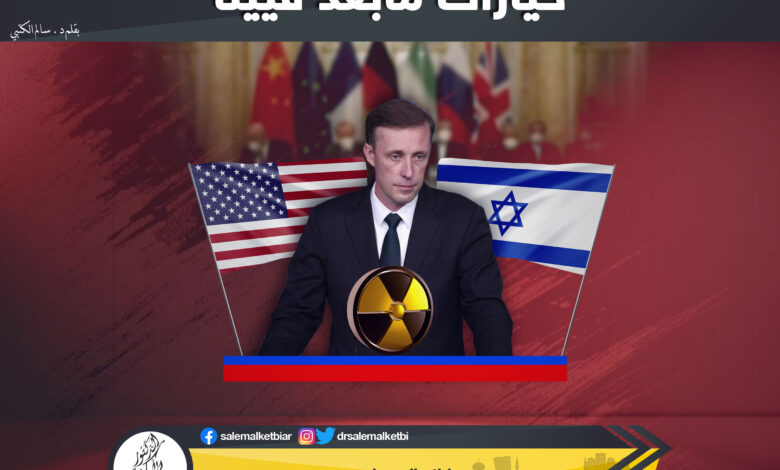
US National Security Advisor Jake Sullivan has allayed Israeli government concerns about the two countries’ differing views on Iran’s nuclear program, according to media reports.
One report quoted four senior Israeli officials who participated in Sullivan’s recent visit to Israel. They said the US national security adviser demonstrated the administration’s willingness to take a tougher stance on Iran if necessary and to consider Israel’s positions on the issue.
US ideas on future scenarios for the Vienna negotiations, which Sullivan presented to Israeli officials, reportedly made no reference to the military option. I believe in the legitimacy of this proposal for obvious reasons. First, President Biden completely avoids talking about US military involvement in conflicts that are closely tied to US strategic interests.
Consider specific examples here, including the ongoing US strategic ambiguity in the defense of Taiwan. Although President Biden has reaffirmed his country’s determination to defend Taiwan in the event of a Chinese invasion, all indications are that the US “commitment” to defend Taiwan is limited to providing the country with the weapons necessary for self-defense.
The question of direct US military intervention to protect Taiwan remains uncertain and is deliberately kept under wraps of ambiguity by Washington. US Defense Secretary Lloyd Austin was more unequivocal when he said the US remains committed to supporting Taiwan’s ability to defend itself.
As for the second most important crisis, concerns about a Russian invasion of Ukraine, President Biden categorically ruled out sending US troops to defend Ukraine in the event of a Russian attack. That step is not on the table now, he said, threatening Moscow only with “unprecedented” sanctions.
The US could increase its military presence in NATO countries close to Russia and provide defense assistance to Ukraine. All told, President Biden has already completely ruled out new military conflicts, albeit on a limited scale. The key is to find diplomatic solutions to the crises.
He relies on the impact of sanctions when diplomatic efforts fail. This is partly for domestic political reasons, but also partly to do with his own orientations and persuasions. This is certainly not surprising to Israeli politicians, who have met with US National Security Advisor Sullivan, with whom they reportedly discussed three possible scenarios regarding the Iran nuclear agreement.
Sullivan expected that an agreement could be reached in the coming weeks, although this is reportedly unlikely. Alternatively, it could be an interim “freeze-for-freeze” agreement, i.e., a freeze on sanctions in exchange for a freeze on Iran’s nuclear program. Otherwise, the failure of negotiations would result in fresh US sanctions being imposed.
I gather that the timing of the visit is not unrelated to what is happening in Vienna. That is, there are aspects that suggest that the administration is seeking consensus with its Israeli ally.
This could mean that the White House is trying to reach a comprehensive agreement with Israel on how to deal with Iran’s nuclear program in order to establish a good basis for pitching an agreement reached in Vienna to the American public, politicians, and media. This does not necessarily mean that the agreement is within reach.
But it does mean that the administration is trying to coordinate with its Israeli ally on the next step, whether negotiations fail or succeed. Appeasing and reassuring Israel is important to avoid unilateral Israeli military action against Iran, and it supports the White House’s ability to break the deadlock on the Iranian nuclear issue with as little political loss as possible.
On the other hand, the development of a common understanding or strategy between Israel and the US in dealing with the Iranian nuclear challenge is in Tehran’s interest. It provides a strong brake that will limit any Israeli attempt to strike Iran’s nuclear facilities. This could encourage Iranian negotiators to push even harder in Vienna for the maximum possible US concessions.