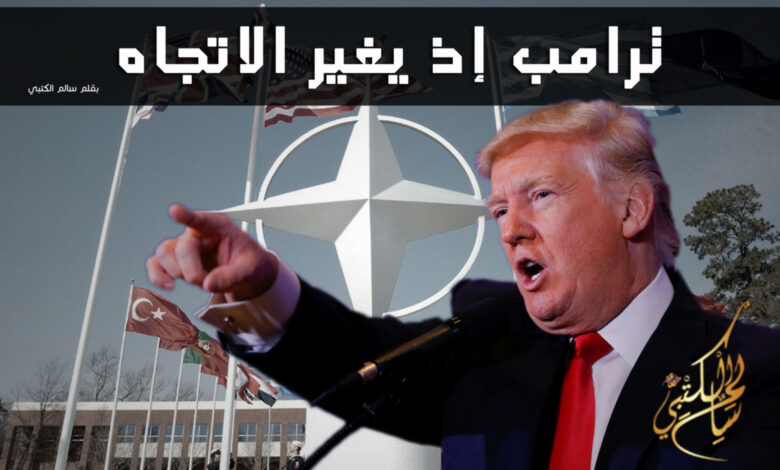
The political discourse of the Trump administration radically shifted on many issues, including relations with the NATO. After describing it as outdated, President Trump recently said that it is no longer an outdated entity.
The latest statement has scattered the concern NATO members had since Trump took power last January. It seems that NATO Secretary General Jens Stoltenberg’s recent visit to Washington was to take a closer look at Trump’s approach regarding the NATO.
It is remarkable that Trump was never satisfied with the role and objectives of the Alliance and even questioned its raison d’être, considering that the United States pays a high share of the expenses of the alliance compared to the rest of the member States. However, Trump then confirmed that the alliance gained great importance after the growing danger of terrorism, and called on the coalition to do more in combating international terrorism and supporting partners in Iraq and Afghanistan.
I like that Trump easily shifts positions, and does not feel embarrassed for changing his positions and views on countries and issues. It seems he does not even care about the differences between his position and the positions of the staff and advisers in his administration, which confirms what I have suggested in a previous article that the US administration adopts the strategy of confusion in dealing with the most sensitive and vital files in US foreign policy.
This strategy makes it difficult for others to anticipate the reactions of the US administration based on past experience. This contributes a lot to the US power of deterrence, especially since the missile strike on the Syrian base of al-Shayrat. The recent strike proved that the Trump administration is different from the Obama and that Trump does not rule out military measures.
In addition to the reports of the US specialized security services, which recognize the role and value of the alliance in the global strategies of the US, one of the most important factors in this position change on NATO is that the president realized the importance of the NATO partners support in future military decisions. Trump was clearly grateful for NATO’s support for the missile strike against the Syrian base, thanking the allies for supporting the decision.
There has been another relative shift in President Trump’s attitude toward Russia. In fact, the warm relationship between the Kremlin and the White House was speculated to last four years, but few weeks after Trump assumed his office the US–Russia relations were described as being “the worse ever”, especially because Moscow refused to retreat support for al-Assad after the apparent chemical weapons attack.
Trump used the divergence of interests with Putin to remind those criticizing his relationship with Russia of his catchphrase—America First, but Trump’s attitude to Russia may have changed – just like what happened with the NATO – after he became president and then was able to take a look at the intelligence and security reports.
The president might make more attitude changes and defend new attitudes fervently. A change of Trump’s attitude about Iran is expected, given that the US administration did not address the nuclear agreement signed with Iran recently. The US is committed to the nuclear agreement as long as there is nothing new in this regard, a senior US official told news agencies in a vague statement. If we consider this statement in light of the latest shifts in other files, it is very likely that something new has happened but Washington does not want to announce it so as not to anger its allies in the GCC.
We have to wait a bit to get to know the current agenda of the White House about Iran, especially since the US attention is now largely focused on the North Korean threat.
As for American-Russian relations, such shifts provide an important lesson in international relations, where personalization of relations is avoided because international relations depend on States’ interests. It is true that the personal factor, the chemistry of human relations, has some effect in strengthening or ruining interests of States; however, the basis of international relations remains focused on the interests of States rather than individuals. This is something missing in the Arab world, where many sacrifice their strategic interests for the sake of personal benefits for higher officials.
The Arab history tells many stories about the role of personal relations in the present situation of our region. The conflicts between some leaders and the sensitivities that exist among them have cost many opportunities and caused losing hope to improve the conditions for the peoples.