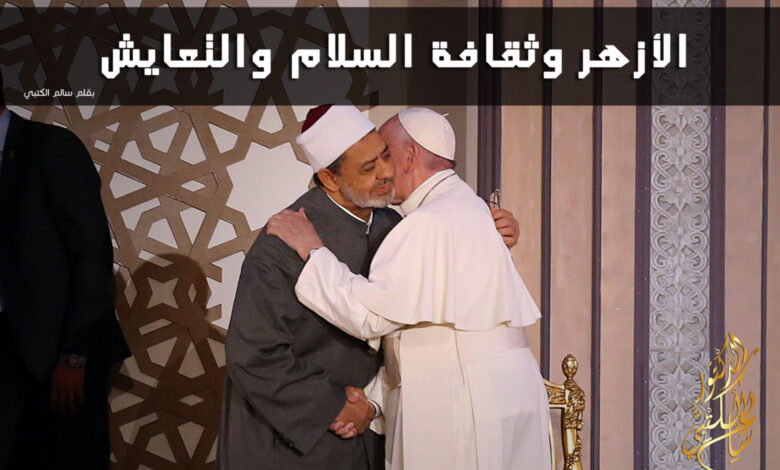
At the kind invitation of the Grand Imam Dr. Ahmed Al-Tayeb, the Sheikh of Al-Azhar Al-Sharif, Chairman of the Muslim Council Of Elders, I was pleased to participate in the World Peace Conference. The conference was held by Al-Azhar Al-Sharif under the patronage of President Abdel Fattah Al-Sisi, and the presence of his holiness Pope Francis of the Vatican, his Holiness Tawadros II, Pope of Alexandria and the Patriarch of St. Mark, a panel of the Islamic and Christian clergymen, politicians, academics and intellectuals. The conference is extraordinary in terms of timing, subject matter and organization.
Little did Al-Azhar Al-Sharif know, while planning to organize this world conference about a year ago, that it would be held at a time of harsh and uncalled-for criticism against it.
The timing of the conference was set since the visit of the Grand Sheikh of Al-Azhar to the Vatican in May last year, where he agreed with the Vatican to hold a world peace conference in the presence of the Pope in Cairo. The terrorist attacks on the Tanta and Alexandria churches gave the conference more importance and relevance.
Terrorism has intensified and the need to coexist became a necessity. The dangers and challenges are unnoticed by those who are interested in “clearing things up” with Al-Azhar Al-Sharif at this precise time. They do not know that Al-Azhar and its respectful Sheikh are busy arranging this global conference, thinking that it is the favorable timing to give Al-Azhar the kiss of death. They were eventually disappointed, as Al-Azhar survives in its men, religious and historical symbolism, and still has the support of Egyptians and Muslims.
Al-Azhar has realized the threats Egypt witnessed since 2011. It has addressed many challenges and tried to lay the foundations for real citizenship through the Al-Azhar Document in 2013. This historical document that many scholars did not pay attention to is important because it was the first time for Al-Azhar to participate as an institution, not as individuals, in the establishment of the idea of citizenship. This was the first time that Al-Azhar worked hand in hand with intellectuals to start an effective community dialogue, after it was accused of hostility to culture and promoting terrorism and extremism.
Al-Azhar and its Sheikh cannot be accused of supporting terrorism. The preamble of the document reads: “In the name of Al-Azhar, the ancient national scholarly institution, and with the participation of a group of senior scholars and representatives of Egyptian churches”. Al-Azhar presents itself in the preamble of the document as an Islamic jurisprudence institution but did not claim to be an exclusive representative of Islam. Perhaps Al-Azhar was careful to avoid this because it is quite famous, so there was a need to confirm that what was most important at that historically sensitive moment was the idea of citizenship alongside the idea of Islamic law.
This document clearly and unequivocally condemned violence and killing, emphasized citizenship, and addressed the Egyptian citizens without distinction between Muslims and Christians. However, there are people who announce through the media that Al-Azhar promotes extremism. This document clearly separates religion and the State. It did not speak in the name of religion, but talked about the State, progress, knowledge, justice, and the era of knowledge, highlighting dialogue, but those who attacked Al-Azhar have not read this historic document.
What is important is that the subject of the conference is peace, which we are all looking for in a region where murder, slaughter, bloodshed and bombings are a daily routine that have become the most common product in the Arab region’s exports to the world.
Peace needs a culture. The culture of peace is more important, stronger and sustainable than peace itself. Peace can be achieved through resolutions, agreements and understandings between nations, or through laws, documents and legislation within countries and among the people of one nation in case of conflict. The most important sustainable goal is instilling a culture of peace, and this is the true challenge of genuine intentions and desire for peace.
The culture of peace means coexistence and needs a value system involving tolerance, acceptance of the other, moderation and openness, which in turn require a strong role of the State, not just religious institutions. While it is unfair to place responsibility on a religious institution, to enshrine such value system is a State’s responsibility by means of education, as well as strategic media, politics, and community work. Hence, the discussions of this vital conference are important to figure out the benefits and requirements of peace.