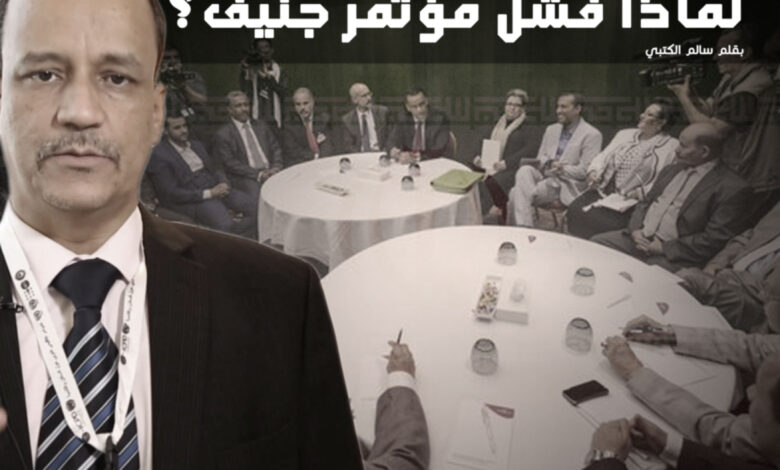
Many people may be shocked as the United Nations failed to come up with positive results from Geneva to seek solutions to the current crisis in Yemen. Doubts have been raised about the bias of the international organization representatives against Arab interests and siding with the Houthis under the influence of Iran and the United States strategic perceptions of the future Gulf region. It is questionable how the UN envoy Ismail Ould Cheikh Ahmed has rejected the resolutions of international legitimacy to be the starting point for dialogue in Geneva, which means by extension that the organization does not recognize the decisions it issues and makes no effort to implement and bind parties to those decisions, so how can these parties respect the UN resolutions?
One of the decisions that the United Nations representative ruled out in Geneva is Resolution No. 22,166, which stipulates the need for the withdrawal of rebels from the cities and regions they controlled since 21 September 2014 and hand over their weapons. This means adding free political points to the Houthis accounts.
Some analysts see the ‘willing to compromise’ demonstrated by the UN envoy to the arrogance of Houthi delegation in Geneva as a reflection of an American position to provide the ‘carrot’ to Iran, the official sponsor for the Houthis, in order to have the Iranians to adopt more flexible positions in the nuclear program negotiations as the date of the final signing nears; after all, no positive signs of the compromise President Obama was eagerly looking forward to were seen.
Reality confirms the limited capacities of the United Nations in resolving the crisis and its reluctance to play an active role in hot areas of the world. The international organization has turned into an area for controversy, debate and passing resolutions of weak impact. The United Nations moved not one iota to look for a serious solution to the crisis of Syria refugees other than fruitless protocols. The Palestinian issue remains the chronic historical witness to the ineffectiveness of the UN’s role in ending conflicts and settling crises and the search for just and lasting solutions to international issues.
Why is United Nations discussing the Yemen issue since it does not have diplomatic capacities to develop solutions binding to the parties to the conflict? The UN has ceased to be an active player in the dynamics and mechanisms working in the existing world order since this organization has turned into a tool to impart alleged international legitimacy to the decisions and policies of the major powers, taking into account their interests and objectives.
The problem lies not in the United Nations as an organization, nor in its bias and the uselessness of its representatives in crises, but in the current world order. The will of one superpower has turned the United Nations into one of its foreign policy executive institutions. This is not a accusation to the international organization but a description of reality, otherwise why are regional and international powers insisting on reforming the United Nations and the Security Council so as to create a sense of balance in the structure of international relations?
Still, United Nations is not to be accused of bias against Arab causes. A few weeks ago the corridors of the International Organization saw an unprecedented diplomatic and political victory for the Arab States in the Yemeni crisis through the issuance of UN Security Council Resolution 2216 on April 14 under Chapter VII of the Charter of the United Nations. It imposes a ban of weapons on the rebels and supporters of the ousted President Ali Abdullah Saleh, and calls on rebels to leave the cities and regions seized, including the capital Sanaa. 13 members voted in favor of the resolution, no country opposed, while Russia abstained. We cannot follow double standards when assessing the work of the United Nations.
The Geneva Conference failed not because of alleged “prejudice”by the United Nations, but intervention of outside parties such as Iran which is uninterested in settling the Yemeni crisis in the present time. Tehran wants Yemen to turn into a swamp to drain the resources of Saudi Arabia and divert its attention from other issues and regional crises such as Syria and Iraq, get negotiation cards from its proxy wars and drive attention away of its nuclear program.
The Houthis may not get a green light from Iran to resolve the situation in Yemen if Tehran does not get what it wants from the nuclear program negotiations and the crises in Syria and Iraq. The arrogant positions of the Houthis in Geneva were only a reflection of Tehran’s desire to prolong the Yemeni crisis until white smoke rises from inside the nuclear program negotiations rooms.
In light of the foregoing, the failure of the Geneva negotiations is a realistic reflection of the complexity of regional crises. It actually confirms that one player is confusing calculations for all regional and international parties, causing displacement and suffering of millions of Arabs at the expense of whom Iran is seizing the opportunity to achieve colonial expansionist ambitions.