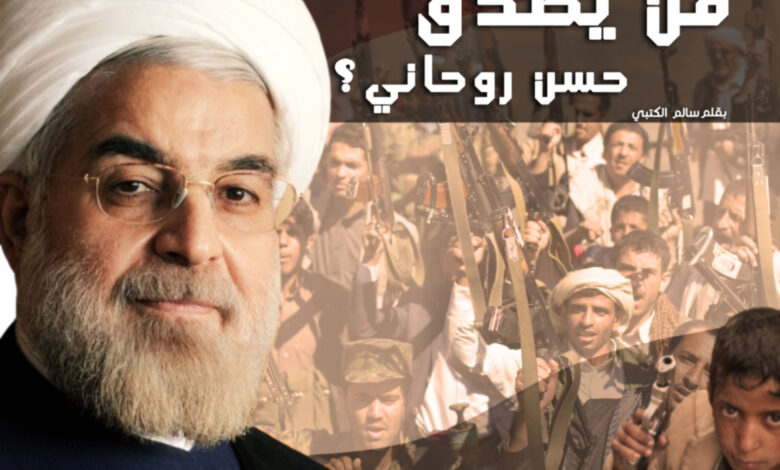
Iranian President Hassan Rouhani recently made intriguing statements denying Iran’s arming of the Houthi group in Yemen. He said that the coalition forces are bombing innocent Yemeni people. And he provocatively asked,”What does bombing the innocent people of Yemen mean?”
What are your goals?
Do you aim to increase your strength by killing children?
You have spread hatred in this region; you will get results sooner or later!!
He carried on saying: “Do not attack children, elderly and women in Yemen, because doing so is a shame”. It is obvious here that Iran aims to reveal a negative frame about the situation in Yemen, seeking to tarnish the reputation of Saudi Arabia and the rest of the coalition countries by falsely accusing them of targeting children and civilians in Yemen. Given the simplest rules of engagement, adoption of air strikes by the coalition countries will ensure the achievement of its goals, where everything moving on the land is to be killed, including Houthis, civilians, innocent and otherwise. This means the adoption of “scorched earth” strategy in the conflict. But this is not the principle of the GCC countries, which rely on an approach that combines achieving the goals of the air strikes while maintaining the safety of Yemeni people. Gulf armies and their leaders are perfectly able to realize the nature of the situation in Yemen; hence it is pointless to accuse them for killing Yemeni civilians!!
It is true that the coalition countries are in the Gulf for the sake of civilians, to preserve their interests and to help them face the sectarian Houthi aggression. It is absurd to believe the accusations of Ali Khamenei, Iran’s Supreme Leader, that the Coalition is waging a war of annihilation against the Yemeni people. We declare to Khamenei and his staff: stay away of Yemeni people, and do not deny your invidious reaction in Yemen trying to blame the coalition countries; the world is aware of the facts and the true situation in Yemen. This was a strong and clear message in the recent Security Council resolution.
Khamenei says that what happens in Yemen is “a crime and a war of annihilation” against the Yemeni people (!!), ignoring Iran’s role in supporting Houthis with weapons for years ago, and that it is not the coalition that provoked sectarian wars in Yemen and other countries. If there is a charge that can be directed to these countries it is the absence of rejection of Iranian interference in several Arab countries’ affairs.
Some GCC countries were betting on the Iranian president’s political rationality, but he accused Saudi Arabia of supplying terrorist movements in the Middle East.If this accusation is true, then the President Rouhani must tell the whole world about who supplies Hezbollah and Shiite militias in Iraq with weapons and men. Most obviously, commanders of Iran’s Revolutionary Guards are leading the fighting in Iraq.
Rouhani also said that Iran’s military goal is purely defensive. This is a truth that we agree about. But the other side of this truth is that Iran’s regional strategy is based on proxy wars. Tehran has decided to cause instability in many countries in the region expanding its regional influence depending on sectarian militant agents, rather than direct intervention. The GCC would have faced this with the same means. But since the fact that Saudi Arabia provides terrorist groups with weapons is a false accusation, which is aimed to blur the regional scene, the Gulf cooperation Council has adopted, under the cover of international legitimacy, direct military intervention attempting to deter Iran from its plans, and to preserve Yemeni people’s interests, as well as to support Yemen to face the sectarian aggression.