It is expected that the Syrian crisis will be witnessing qualitative developments over the next few weeks, and particularly after the new US president takes office on the twentieth of January 2017. These developments relate primarily to the positions of the four pivotal parties in Syria, the United States, Russia, Turkey and Iran, and the management of the relationship between them under a new key variable which is the President Trump administration with its new attitudes and visions and perceptions to deal with the Syrian crisis.
There is no doubt that all regional and international parties concerned with the Syrian crisis are awaiting the arrival of the new administration to learn about its positions especially that Trump has been, and still is, very critical of the management style of the current president Obama in dealing with Syria.
After a series of ambiguous positions, and sometimes contradictory ones, President Trump said recently that he plans to set up safe areas there, and this proposal is not new. It has already been raised and was rejected by the Obama administration. It is expected that this decision would raise deep differences between the parties that are now engaged in dialogue about the future of Syria, namely Turkey, Iran, and Russia.
Turkey is the most convinced and the one that most supports the idea of establishing safe zones in Syria among regional and international parties, while Russia and Iran strongly oppose the idea because of their concern from the exploitation of these areas to support and strengthen the influence of terrorist groups. This fear is obvious and verifiable regardless of the Iranian bad intentions toward Syria, and the real goals behind the odious Iranian interference in this ancient Arab country.
There is another complication that goes in parallel with the foregoing, which is the management of the complex relations between Russia and the United States and Iran. Trump’s administration wants to repair relations with Russia, while at the same time it wants to achieve its strategic objectives in the management of the conflict with Iran, especially regarding the fate of the nuclear deal.
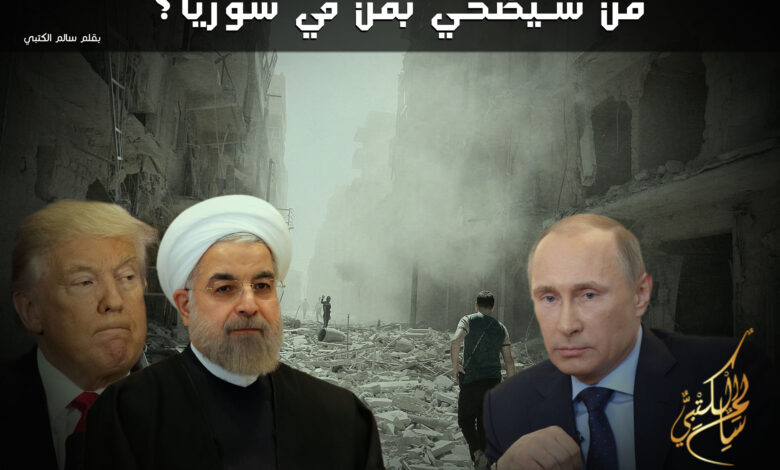
In light of the foregoing, an obvious question is raised: who will sacrifice whom in the struggle over Syria? Will Russia sacrifice the Iranian ally, or will it sacrifice its good relationship with President Trump?
The problematic is that the new US administration will have to come to an understanding with Russia on Syria, as I mentioned, but it also would seek to step up pressure, especially at the level of sanctions against Iran.
In the details on the ground in Syria, there is a potential clash of interests between Russia and Iran, and this clash seems more likely as much as the Syrian regime achieves more victories with the help and support of its Russian and Iranian allies, in addition to the Lebanese “Hezbollah”, and each of these parties is trying to win the largest share of the “cake” of shared interests.
While the war against “Daesh” has united Russia and Iran, the next phase carries differences in interests. The Russian Air Force is no longer of great importance in the stages of what is known as clearing towns of terrorism and so on, in addition to the weakness of its operational usefulness in the wars of the cities, which are mastered by Iran’s Revolutionary Guards’ elements and commanders on the ground in Syria, led by Gen. Qassem Soleimani, who recently appeared in a footage while having a walk in the city of Aleppo, which involves a great strategic importance for the Iranian project in Syria.
As for the likely relationship of President Trump with his Russian counterpart, it will be in all cases better than Putin’s relationship with President Obama. As for the relationship of Trump with Iran, indicators are clear and plain, as Trump chose three figures in his new administration who are hostile to Iran, and they are Gen. Michael Flynn, national security adviser, and James Mattis, the defense minister, and Mike Pompeo, director of the Central intelligence Agency (CIA).
President Trump must also settle his position on the future of President Bashar al-Assad in power, a key point in this file. He is fully aware that the presence of Al-Assad serves Iran’s interests in this conflict, and so does Russia, which can reach understandings more flexibly than Iran regarding the fate of Assad, but Trump would anger the Saudi side if he accepts that Assad remains in power, not to mention that his vision on the establishment of safe zones in Syria could spark a row with some of the GCC states in light of Trump’s recent talk as he said: “We will try to settle that and we will try to help people. We will create safe areas, and we will ask the Gulf states to fund the construction of these areas”, as the budgets of the GCC cannot stand more financial pressure because of the falling of oil prices, as well as the idea of financing this idea might imply recognition to bear the consequences of this conflict, and the disasters it caused as well as the humanitarian violations it involved.
It is possible that Russia sacrifices Iran in case it reached a complete deal with the United States and Europe over Syria and Ukraine, which means the recognition of the Russians’ influence in these two cases, in return for abandoning support for Iran. But it is also possible that Putin keeps his long-term strategic plans and maintains his strong ties with Iran, and tries to swap Syria for Ukraine, while only keeping his marine bases in Syria.
The coming weeks carry more qualitative developments in the Syrian file. We will see who will the sacrifice whom, though the only constant is that all have sacrificed, and are still sacrificing, the Syrian people, who pays expensively interests calculations.