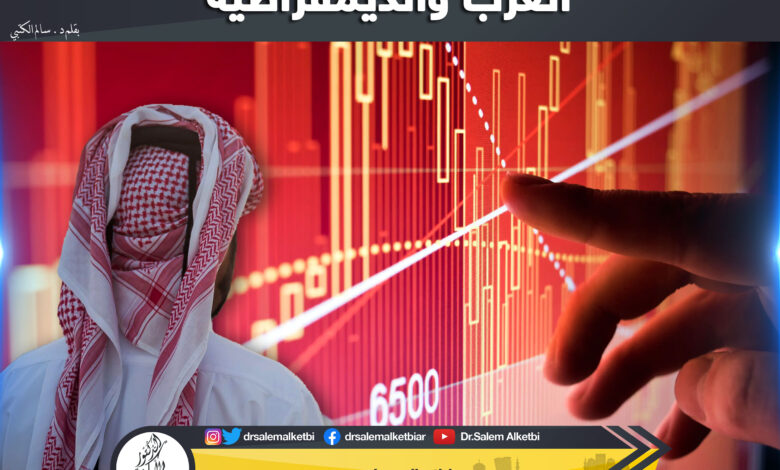
A recent BBC report shows that Arabs have lost confidence in the economic stability of democracy. The report is based on a study by the Arab Barometer Network, which surveyed some 23,000 people in nine Arab countries. According to most participants, the economy does not function well in democracy.
As for Arab societal trends, the findings are certainly not surprising. In fact, much has changed in Arab collective consciousness since 2011. At that time, some Arab societies entertained the illusions spread by known regional organizations and states. As a result, some of these countries have fallen into a trap of conflict and chaos that is still difficult to control.
Others have remained trapped in practices labeled “democratic” by their owners, while endangering the societies’ resources and their right to use their resources wisely for the benefit of development, construction and reconstruction.
This survey shows that public opinion in the Arab world has fundamentally moved away from the concept of democracy compared to the results of a similar survey conducted in 2018, and there seems to be a new conviction that democracy is not a magic wand that can be used to fix everything in these countries. That in itself is a model of social change brought about by reality and human experience.
Ultimately, people judge what they really get out of being politically engaged. They recognize that any system of government is ultimately a means to achieve desired development and political, social, security and economic stability. I am not writing here to confirm what most societies expressed in the survey, but to try to systematically read what is happening and learn from these results.
It is known that societies have an innate consciousness whose depth and relevance is greater than that of theoretical knowledge.
Therefore, it is only natural that the attitude towards democracy changes so radically. The increase in economic and life crises and pressures that many Arab societies are currently experiencing is not the cause of the collapse of the long-held belief that democracy is the solution.
Rather, the Arab scene in some parts and regions reflects the difficult and complex security conditions in countries suffering from disastrous sectarian, factional, and partisan divisions under the banner of democratic practices. All nations, societies and peoples have peculiarities that deserve special attention, especially the system of government appropriate to each state or society.
Political values are different and vary according to culture, custom, history and the development of political and social life. There is no value or political system that is appropriate for all states or applicable to all communities.
For example, the experience of Asian states shows that adopting Western-style values and forms of government is not the only path to state-building, economic growth, global competitiveness, security, and stability. Of course, embracing or disavowing democracy has little to do with the Arabs or anyone else.
The mechanisms of governance and politics, as we have said, vary from society to society and from people to people. People have enough knowledge to understand the variables surrounding them on a global scale. This explains the shift in public opinion in the Arab world towards democracy that started in 2018.
The results of the said survey show a close link to the aftermath of the chaos and unrest that erupted in 2011, as the manifestations, effects and consequences of this recent past persist in some countries, while other Arab societies continue to foot the bill for the losses incurred in various fields and sectors of development.