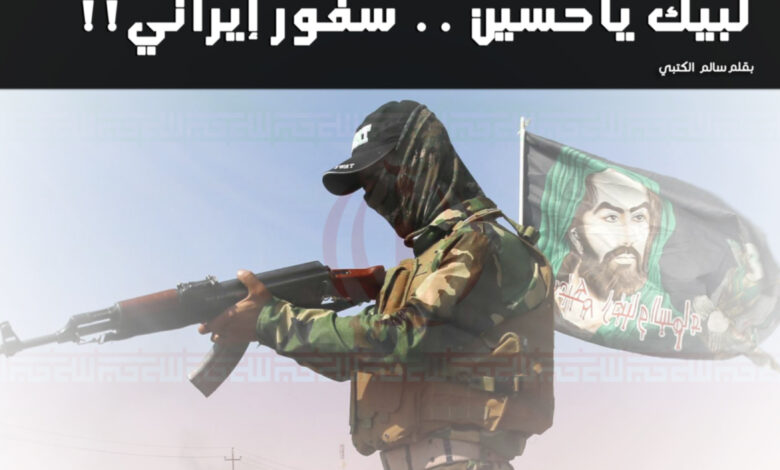
Simpletons say that Iran and its proxies have spontaneously changed the slogan of the campaign of Shiite mobilization forces to recover the city of al-Ramadi controlled by Daesh from Labayka Ya Hosayn ‘Here we come Hussein’ to Labayka Ya Iraq ‘Here we come Iraq’.Simpletons were convinced that Iran and its proxies realized it is dangerous to raise Shiite slogans in the supposedly national battle, but the fact is that Iran was aware of the signification of this sectarian slogan from the beginning and did not retreat until the ‘message’ was conveyed to Iraq, the US administration and the Arab states. The change changes nothing actually. It is a kind of political dissimulation to deceive the minds of masses.
Raising the former slogan was an official declaration about the identity of the sectarian war waged by Iran in Iraq. It is interesting that this sectarian slogan was criticized not only by Sunni Arabs but also by Iraqi Shiite leaders such as Moqtada al-Sadr, who said that ‘such a label would be inevitably misunderstood, so every lover of the homeland and the anti-sectarianist should renounce it,’ calling instead for ‘Labayk Salahuddin’ or ‘Labayk Anbar’.Certainly, al-Sadr in this regard has not given up on his confirmed sectarianism, but tried to be more covert in terms of sectarian goals, while Iran had exceeded this phase.
Some say that the former slogan was released officially, while the reality is that a spokesman for the Popular Mobilization Forces militia Ahmed al-Asadi said in the twenty-sixth of May at a press conference broadcast on Iraqi television that the forces will lead the operations under the slogan ‘Labayk Ya Hossein’ in coordination with the Iraqi armed forces, with the aim of controlling the northern and southern regions of Tikrit in Salahuddin province and then Anbar, so the silence of the Iraqi government about the slogan may be complicity. It also may be that Iraqi government has nothing to do about it, yet we do not want that for the government of a major Arab country of the size and weight of Iraq.
As for the US administration’s attitude toward this sectarian slogan, Pentagon spokesman Colonel Steven Warren said that he thinks that this does not help. I always said that the key to victory and the expulsion of Daesh from Iraq, is a United Iraq. Social divisions should be mended; people should unite against a common threat. This position is politically flaccid and denotes immaturity towards a subject so that countries adopt positions that have neither color nor taste just to prove they exist. This should not apply to the US that has invested a lot on the strategic level in Iraq since 2003, or that such a situation is occurring intentionally. These positions seem closer to the acceptance of a reality or even encouraging it.
The message behind the sectarian slogan reached the target audience before it was changed. Iran has moved to the second stage of the sectarian game of disintegration in Iraq, where the mobilization forces announced that recovering Anbar will take ‘some time’. It seems that all parties like the idea of ‘taking time’ to consolidate their plans. The United States believes that the defeat of Daesh requires at least ten years, the mobilization wants ‘some time’ to liberate Anbar, but the goal is to demographically change southern Iraq.
Look at the map of Iraq and you will understand that a Shiite presence in Anbar on Saudi Arabia and Jordan borders is appreciated by Iranian Gen. Qassem Soleimani who is strategically planning to intervene in the affairs of Arab countries. He wants to facilitate communication channels and provide support in the time necessary for the Shiites in Saudi Arabia. The idea of ‘some time’ brings back to minds the sectarian cleansing implemented by the Iraqi Shiite militias in Diyala, 65 km north of Baghdad.
Iran’s has evil intentions in Iraq and a historical goal having presence on the borders of the Arab states, especially the GCC countries, so as to facilitate sabotage and activate sleeper cells. This is linked to changing the Sunni demography in Iraq and annexing Sunni areas to Shiite ones. The Iraqi Prime Minister al-Abadi made a decision to separate the Nukhayb region from Anbar in order to annex it later to Karbala, which is a step that provides a clear explanation of the partition scenario in Iraq. The region has been claimed by the Shiites in recent years. Its population is linked to Saudi Arabia tribes. It has huge oil reserves, and will represent a ring in the Shiite chain around Saudi Arabia if its demography is changed.