Nothing is impossible in politics. It is the art of the possible and meeting halfway, where conflicting interests must be reconciled. Since a few years ago, the US media talked about scenarios of bombing Iran’s nuclear facilities. Today, everyone is talking about the terms of a nuclear deal as a likelihood of a radical step in the course of US-Iran relations after the appeasement with Cuba.
It will not be surprising if dramatic shifts occur in the relationship between States, but we must grasp their motives, implications and potential strategic impact. A lot has been said about the future of Daesh. the most striking fringe scenarios are talking about the survival of the organization and its ‘State’ for the years to come and the global transition from conflict with the organization to negotiations about legitimizing its regional and international status
In an previous article, I cited Professor Stephen Walt discussing the possibility of the victory of Daesh in the current battles in Iraq and Syria. For such a notable figure as Walt to discuss said possibility suggests it must be taken seriously. The views of Walt were far from fictive. He said that the triumph of Daesh would not mean that its leaders will be able to achieve their ambitions and make a major impact in the Islamic world by establishing the Caliphate spanning from Baghdad to Rabat. Rather, considering the Iraqi army’s inability to launch a successfully counter attack, a more likely scenario would be that Daesh controls the regions it has seized and challenges foreign efforts to undermine it.
Walt’s views represent the American mindset open to consider all possibilities, regardless of personal stances. Think tanks are normally expected to study in that manner all best- and worse-case scenarios, not to provide apological pieces for pre-established policies, plans or programs.
Remarkably, Walt put forward the idea of containment to deal with Daesh considering that its ‘State’ would not be a major actor in the international scene, so the American power should not waste efforts combating it. He justified that saying that a crowd of about 25 thousand jihadists, compared to a world population of 7 billion people, should not be a primary concern for superpowers. in other words, they should be ready of accept the presence a ‘State of Daesh’ as a fait accompli, at least temporarily, because, throughout history, world powers have failed to eradicate several radical movements and ended up recognizing them and, against their will, co-existing with them.
Walt’s ideas are not that far-fetched. The black swan theory is actually snowballing in the eyes of Western strategist circles and media outlets. ‘Dear ISIS, We Need To talk,’ a recent Newsweek article by Fredrik Elisson and Janine di Giovanni, cites the book by Jonathan Powell, who was the chief of staff of former British Prime Minister Tony Blair, entitled Terrorists at the Table: Why Negotiating Is the Only Way to Peace, in which ‘Powell argues that terrorist organizations with significant popular support can’t be defeated by force alone, even if the West resorts to brutal and unscrupulous measures. That goes for nationalist groups […] as well as religious extremists[.]
The British author says it is naive to rely on force alone to defeat terrorism, noting that negotiating with terrorists does not mean forgiving or forgetting the past, but prioritizing cessation of bloodshed. Applying this idea to Daesh, Vali Nasr, an Iranian American researcher, and Paul H. Nitze, the dean of the School of Advanced International Studies at Johns Hopkins University, maintain that negotiation is technically possible with any party, but the problem is that this kind of extremist organizations are not always ready to negotiate. They add that Daesh ‘has to be humiliated before it will be prepared to settle for less than it thinks it can gain by fighting.’
In this regard, an American shift of policy may be frowned upon or even ruled out. However, the alternatives are not limited to the aforementioned views. US policy to not negotiate with terrorists, dating back as far as the Reagan administration in the 1980s, had exceptions. In the early 1990s, the Bush administration negotiated with Hezbollah to release US hostages. There were also several negotiations with Taliban, the most recent of which was in 2014 through Qatari mediators for the release of American hostages.
The Western political mind in general does not rule out the possibility of having to negotiate with any ‘terror’ organization or group when interests require so. For instance, there was cooperation with al-Qaeda’s al-Nusra Front in Syria as ideologues of the terrorist front abandoned their hostility to the West, as declared by its leader Abu Mohammed Joulani in a recent interview with Al Jazeera. Some political theorists even went as far as suggesting to collaborate with al-Qaeda in Syria as an ally against Daesh, and describing it a more moderate.
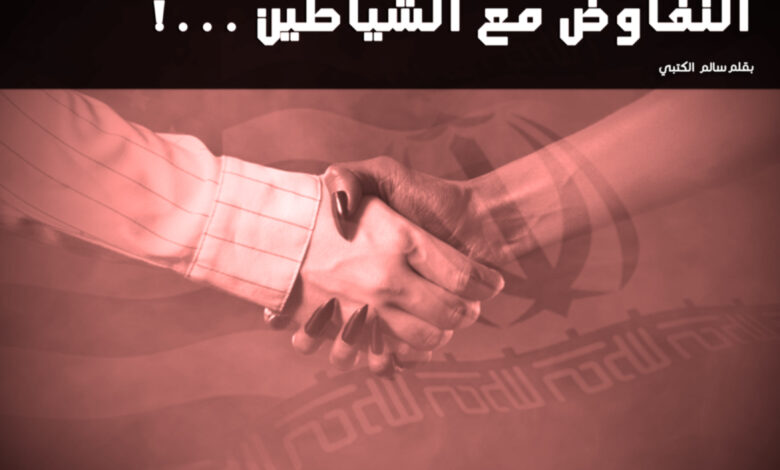
What is quite sure is that Western politicians move according to their calculations, interests and strategic objectives. They may resort to dialogue and negotiation with the ‘devils’ in Daesh, even through intermediaries and mediation. To avoid any surprises, the Arab States, and the Gulf countries in particular, must discuss such possible scenarios, so as to develop appropriate alternatives serving their own interests. Otherwise, we will keep running in circles of reactivity. What we need is proactive solutions to deal with the crisis according to the results of consultations with international allies and taking into account the interests of all, not the interests of a particular party.