The war against terrorism has been somehow reduced since the military victory over Daesh in Syria and Iraq. Another reason is the outbreak of regional and international conflicts in Syria for complex reasons and considerations.
International efforts to ideologically counter terrorism have also been undermined by the belief that military defeat is enough. Research laboratories successively warned about the danger of terrorist ideology. The threat of extremist ideology is no less than that of criminal acts of terrorist organizations. The most dangerous scenario in the fight against terrorism is that States are busy with other conflicts. In this case terrorism has an opportunity to expand, regain strength and re-spread in other societies and countries. The worse is that many countries suffer from the absence of the State in its traditional sense. The State in those countries is dissolved, disintegrated and completely absent from the political map.
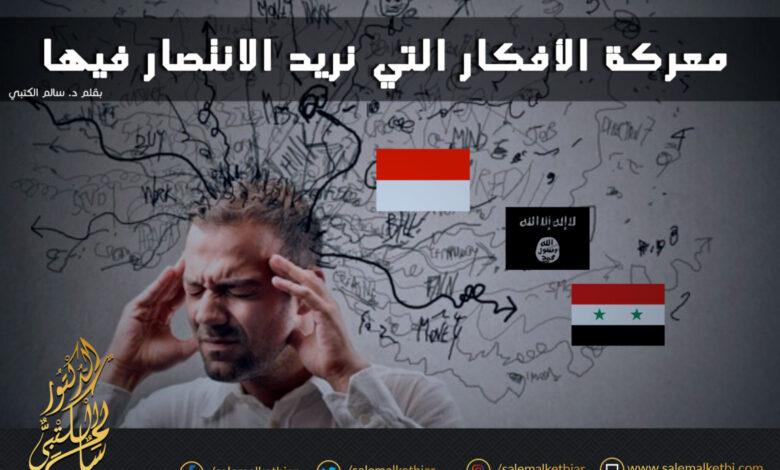
Evidence showed that the battle of ideas is extremely important in combating terrorism, Indonesia’s recent terrorist attacks as case. A family of six members, including two young daughters, conducted a series of suicide bombings that hit churches during Sunday Mass. 13 people were killed and dozens wounded during the attacks. Daesh has claimed responsibility for the attacks.
This terrorist crime, the deadliest in Indonesia for years, is fueling sedition and spreading growing fanaticism and hatred among religions.
Indonesian authorities said the family included a mother, father, two daughters aged 9 and 12 and two sons aged 16 and 18. The family had links to Jamaah Ansharut Daulah, a terrorist group that lends its support to Daesh. Media reported that the family has returned from Syria. The attack reflects the impact and seriousness of ideology in spreading terrorism. Daesh increasingly relies on the so-called lone wolves in carrying out its criminal operations.
The suicide terrorist, who led this cell, drove his car to a church. His sons rode two motorbikes to another church, where they detonated other bombs.
In such an unprecedented situation, experts and specialists must discuss the nature of these elements’ thinking. How can a person commit a suicide bombing using his children and wife? How the minds of young children were stuffed with terrorist ideas that led them to suicide? Certainly, the children did not know the dimensions of terrorism but were only obeying their father.
This crime alerts to a new terrorists’ thinking patterns. Terrorists are not isolationist and do not just carry out individual attacks, as were previous generations. They even carry out family attacks and use their children to bomb others. This is a danger that the world must be aware of.
The spread of extremist ideas must stop. Extremism is the bulwark of terrorism. Countering extremism will not be achieved by spreading counter-trends but by communicating concepts of moderation, accepting the other, openness and values of coexistence among Muslim societies and Muslim minorities in the West. Spreading counter-extremist ideology is a free gift for extremists and terrorists. They take it as a pretext to justify their crimes and to convince their sympathizers of the validity of their criminal motives.
Human society as a whole is a common form of coexistence. Religious extremism is not the only danger to coexistence. It is also a threat to counter extremism with counter-extremism. More dangerous than this is the slide towards fighting religion and religiosity itself. The fine threads that separate religion from one side, and extremism, fanaticism, hatred and incitement on the other side must be clear.
Indonesia’s terrorist attacks confirm that the world has a long way to go in eradicating extremism and terrorism. There is an urgent need for human solidarity and avoidance of sliding into conflicts. Terrorism takes conflicts as a pretext to regain its strength.