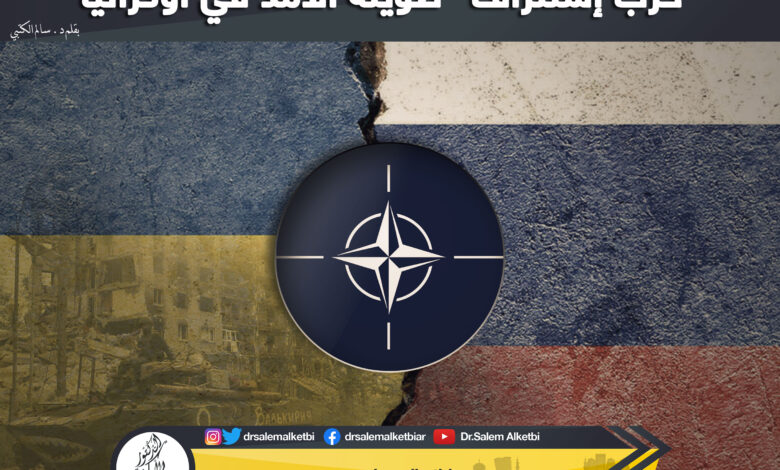
NATO leaders seem to be fully convinced of the need to prepare for what they describe as a long-term “war of attrition” in Ukraine. The NATO Secretary General Jens Stoltenberg, after a recent meeting with US President Joe Biden, noted the need for the West to be prepared for this war. “We just have to be prepared for the long haul,” Stoltenberg said. “What we see is that this war has now become a war of attrition.”
Needless to say, one of the main reasons for this sad international reality is that the West is now looking at what is happening in Ukraine from a certain perspective based on the need to defeat Russia, or, as the US Secretary of Defense put it, wanting to see Russia so weak that it cannot launch a similar military operation in the future.
In light of the evidence that this is difficult to achieve in practice, both in light of the different military capabilities of the Ukrainian and Russian sides and the character and personality of President Putin, the long-term war of attrition scenario is really the closest scenario that can take place in practice, the NATO official said.
Analysis of the current military landscape in Ukraine certainly shows that a victory for the Ukrainian military over the Russian army is highly unlikely. Restoring Ukrainian territory seized by Russian troops is now also unlikely.
Therefore, the closest point of view that the West wants to see is that losses will cease and Ukrainian troops will be able to stop the Russian army’s advance into the rest of the country. All of the above means that discussing a decisive military victory for any side is useless. This is for complicated reasons, since the criteria of victory and defeat in this case are not precise.
It depends on the calculations and goals of each side. For example, the West may consider the disruption of the Russian military machine from achieving its goals and inflicting heavy human and material losses to be an important strategic victory.
Others argue that the fact that Russia did not achieve its goal of ousting President Volodymyr Zelensky from power in Ukraine, failed to seize the capital Kiev, and was forced to change its military strategy to the Donbass region is an important strategic victory for Ukraine. It may help explain British Defense Department talk that Russia might lose the war in Ukraine.
In practice, we cannot speak of a defeat in the traditional sense in this war, which has affected everyone, including countries around the world not interested in it, let alone the devastation in Ukraine, which has lost more than a third of its infrastructure and is facing a financial deficit of about $5 billion. The real dilemma is that no one can expect this war to end.
The West is preparing for a long-term war of attrition, as discussed earlier. President Putin intends to continue seizing the entire territory of Russian-speaking Donbas. He seems to be in no hurry, and his ultimate goals remain unknown to all.
There is no doubt that the attrition scenario may not be so much an Atlantic goal as a result dictated by the circumstances of this war. Substantial and sustained military support for Ukraine strengthens its position on the ground and prolongs the war in one form or another. This issue is organically linked to the fate and existence of Ukraine as a sovereign state.
On the other hand, the Russian army is much exposed to Western intelligence. Reports about the effectiveness of its troops, the level of training, readiness and coordination between commanders are multiplying. There is also a lack of intelligence, due to which accurate expectations of Ukrainian army resistance have not been built.
Nor have accurate estimates been constructed of the size of Western military support for the Ukrainian army. This confused the Kremlin’s calculations. For example, according to some Western figures, Russian army losses 100 days after the war in Ukraine exceed human losses during the entire years of the Soviet invasion of Afghanistan.
A third factor that could have a significant impact on the succession scenario is the desire of the US and most of its European allies to deplete Russia’s military and economic power to the point where it refrains from reconsidering any military action outside its borders.
Another factor contributing to the prolongation of the war in Ukraine is the transformation of the conflict into a Western-Russian one, where Moscow is banking on the impact of energy shortages, rising prices, pressure from Western governments on public opinion, and the possibility of a Western split over high costs.
Western capitals are betting on turmoil inside Russia because of economic sanctions related to the war, which could end in the fall of President Putin, a change of ruling regime and withdrawal from Ukraine, as happened in Afghanistan. But that sounds like a pipe dream scenario. It has to do with Russian sovereignty and other national considerations.
In addition, it would be difficult for the Russian army to come to terms with the humiliation. Objectively speaking, Russia treats the actions of the West in the Ukrainian crisis calmly, rationally and very cautiously. The main motive is its desire to avoid a large-scale war or to provoke it to use more destructive weapons in such a way as to cause a change of attitude towards it in the world.
Furthermore, Moscow recognizes that prolonging the war is not exactly in the West’s interest: food shortages, rising energy prices and record levels of inflation are hard to tolerate in the long and medium term. It warns of a European-American dispute over the need to somehow end this war. Drawing the curtain on the crisis seems to be tied to the position of the West and, in particular, the US.
What is needed here is a realistic diplomatic approach to a settlement that will end this war. In the end, given the suffering of the entire world involved in footing the bill for this war, the whole issue outweighs the calculations of Russian or Western losses.
Almost all the peoples of the world bear the burden of this crisis, which has precipitated the beginnings of the foundations of a new world order. A scenario of attrition could provoke serious crises on all levels, increasing global suffering and tensions, foreshadowing serious consequences from which no one, in the West or the East, can escape.