The new US president Donald Trump has won the presidential election that took place in November last year. Therefore he enjoys the largest popularity in the United States regardless of the complex electoral calculation in the US.
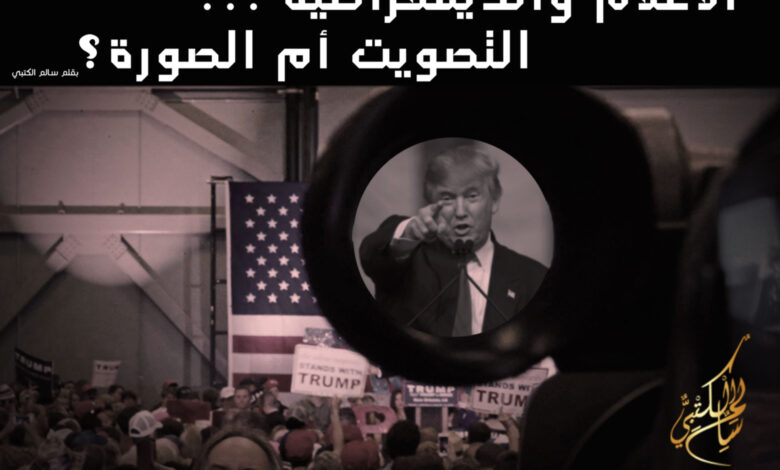
President Trump was disturbed by images published by the American media for the inauguration ceremony. Trump and his aides made a sharp attack on the media and described the images as “misleading”. The images have shown a decline in the number of those present for the ceremony compared to President Barack Obama’s inauguration ceremony more than 8 years ago. Media Advisor to Trump said “It was the largest crowd ever to attend the inauguration ceremony,” although the figures indicated that the number of attendees did not exceed 750 thousands. He added that the US administration will hold accountable the media.
There are official bodies that manage public spaces and can provide semi-official estimates, but some of these bodies had stopped providing estimates of the numbers due to threats concerning alleged errors.
President Trump says that the number of attendees at the inauguration ceremony had reached about a million and a half, but this estimate lacks, of course, official evidence. His aides had to try to support what he said through several means, including saying that the number in just one park has reached 720 thousand inside apart from the masses outside, and that those who boarded the subway in Washington on inauguration day has surpassed the numbers of those who came to Obama’s inauguration for his second term in 2013, but these allegations avoided reference to the inauguration of the first term of Obama, where crowds have achieved a historical record at the time.
However, the Trump team fell into the trap of comparisons. The body of transportation in Washington said that the number of metro tickets that were sold on the second inauguration of Obama has reached 782 thousand, compared to 571 for Trump.
Trump’s team feels very sensitive and senses the presence of a type of media—and perhaps official—stalking, as the team expressed skepticism about plastic chips to cover the grass in the parks for the first time in order to detect empty spaces, claiming “it was the first time white ‘floor coverings’ were used to protect the grass on the National Mall and that it drew attention to any empty space.” Even fences and metal detectors and acute security measures had an effect in reducing number, but officials responded that it was a matter of routine security measures on such occasions.
It is important that this striking sparring repeatedly saw Trump’s disregard to the media, describing reporters and employees to be among the people who “most lie to and mislead the world”, while major media organizations in the United States denied completely the charges the President and his advisers team of journalists addressed to them. CNN said the charges against it are due to the fact that it has accurately reported what happened, describing President Trump’s allegations as “false”.
The controversy has been extended to include former Presidents inaugural ceremonies. Officials in Washington DC confirmed that 1.8 million people attended the inauguration of former President Obama in his first term in 2009, and nearly a million people attended his 2013 inauguration. To George W. Bush’s ceremony in 2005 came about 400 thousand, and for his inauguration in 2001 the attendance reached about 300 thousand people. In Bill Clinton’s inauguration in 1993, 800 thousand attended while nearly 250 thousand came to his second inauguration ceremony in 1997. 140 thousand tickets were sold for the inauguration of Ronald Reagan in 1985.
Nonetheless, what is more important for politicians; images, or votes? What gives legitimacy: images, popular support, or both? Is there a difference between electoral legitimacy and popular legitimacy? Is there such a thing as media legitimacy? Has the media become an independent authority, part of the political legitimacy of leaders and presidents?
Trump has problems mainly with the traditional media, especially major US networks. He considers himself a product of pure new media. He is a superstar on Twitter and the controversy and accusations between Trump and the media have not stopped since the announcement of his candidacy in the presidentials.
The American media was adopting a hostile attitude towards Trump, who was only supported by few newspapers when the presidentials began. The media spoke of the unpopularity of Trump compared to Hillary Clinton and how his loss is inevitable, and that the Republican Party should abandon before being defeated.
Ahead of the US elections, The Washington Times published the results of a referendum conducted by the Quinnipiac University that showed that 55% of potential voters in the US presidential election believe that the media is biased against Trump. The poll was made at the end of last October, a few days before the US election. Newspapers have changed their historical lines to express their opposition to Trump. In an unprecedented move in its history of 148 years, San Diego Union-Tribune announced its support for Hillary Clinton. For the first time in 143 years, Detroit News endorsed a Democrat candidate. Arizona Republic supported a Democrat for the first time in 126 years. Trump enjoyed the support of only two widespread newspapers while Hillary Clinton was supported by more than 200 newspapers. These facts help explain the soft war and growing hostility between Trump and the media, especially after the man felt he defeated them all and won the confidence of the American people.
These statistics in fact represent historical shifts in the relationship and eternal power struggle between politics and the media.