Now that the African continent has become a major area of influence for China and Russia, now that traditional French influence on the African continent has declined significantly, and now that the US has had no role or influence in recent years and decades, President Joe Biden’s administration wants to try to heal Africa’s long neglect and catch up with the Chinese and Russians, who have greatly expanded their relations with African capitals in recent times.
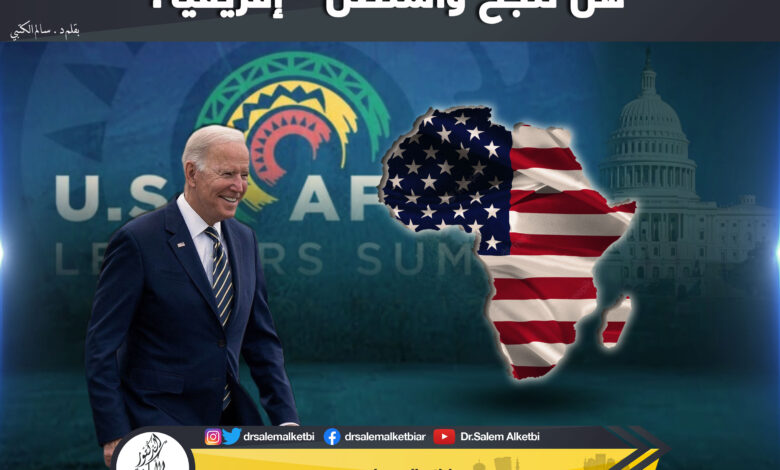
A summit of 49 African leaders was recently held in Washington to strengthen US influence on the continent, where China and Russia now rank high. At the summit, the US pledged $55 billion over three years to African countries. The Biden administration announced $4 billion by the end of 2025 to recruit and train health workers in Africa to learn from the Covid 19 crisis.
The summit also addressed space exploration: Nigeria and Rwanda signed agreements on Artemis, a US-led program to put humans on the moon by 2025, with the goal of expanding space exploration. They were the first two African countries to do so.
The most important issue in the background of this summit concerns the ability of the US to consolidate its influence on the African continent and counter Chinese and Russian influence there. Several considerations can be made in this regard, some in favor and some against US efforts.
Factors in favor of US efforts include, first, oversight of large-scale aid and funding programs, if they are actually implemented, traditional ties between Washington and many capitals on the African continent, and the US role in combating terrorism, which affects many parts of the African continent, particularly some eastern and western parts.
On the other hand, there are also factors that may limit the effectiveness of US efforts in Africa, such as US attitudes on issues sensitive to African countries, such as human rights and democracy. This file is one of the drivers for embracing Chinese (along funding and loan programs) and Russian influence (combating terrorism through the Wagner Group).
Beijing and Moscow do not interfere in the internal affairs of African countries and do not discuss the nature of the ruling regimes on the continent, whose regimes are characterised by militaries, coups and other aspects that always jeopardise relations with Western capitals, especially Washington, still pursuing a law drafted almost two decades ago and extended until 2025 that ties the abolition of tariffs to democratic progress.
By all accounts, Washington remains committed to this policy despite the announced changes. For example, in a statement on a meeting between Egyptian President Abdel Fattah Al Sisi and US Secretary of State Anthony Blinken on the sidelines of the summit, the US State Department indicated that the US Secretary of State raised with the Egyptian President the issue of respect for human rights in Egypt and stressed that “bilateral relations are growing stronger and making tangible progress in this area.”
This reflects the dependence of an issue such as Egypt’s request for US assistance in resolving the Renaissance Dam crisis on progress in other areas such as human rights, which has become the “compass” of relations between Washington and other countries, including Africa. The US-Africa Summit is not a repeat of the efforts of other international powers on this front.
The first summit was held eight years ago in 2014 under then President Barack Obama, and under Trump, Africa has been completely ignored. The Biden administration is pursuing a relatively different political discourse in reshaping its relations with countries on the African continent.
Calls for a stronger role for the continent at the international level by giving it a seat on the Security Council and official representation at the G-20 summit. The US Secretary of State unveiled a new US strategy for Africa called “Partnership” and announced a comprehensive review of US policy towards sub-Saharan Africa to counter Chinese and Russian influence.
The US clearly has a lot of room to increase its influence on the African continent through various approaches.
Foremost among these are helping African countries fight terrorism, building genuine development partnerships with sub-Saharan Africa, actively helping to resolve influential African conflicts such as the Tigray and Renaissance Dam crises involving Ethiopia, and divisive issues amongst some African countries.
It also supports the stability of countries such as the Democratic Republic of the Congo, facing an insurgency that threatens the stability of the country, and overcoming the effects of climate change, one of the main problems of the African continent, as well as the poverty and food crisis, exacerbated in Africa by the climate crisis and the war in Ukraine.
However, the US policy discourse at the Africa Summit was different, with President Biden announcing investments of more than $55 billion in the continent and promising American companies to invest more than $15 billion in Africa.
When Africa succeeds, the US succeeds, and the whole world succeeds, he said, avoiding reference to China altogether and explaining that his country would take a different approach, one of partnership far removed from dependency and aimed at fostering opportunities for shared success.
This puts US policy in direct comparison to China, which has a policy of non-interference in the countries in which it invests. Moreover, Beijing’s investments have overtaken those of the US. The value of Chinese loans to African countries since 2000 is approximately $120 billion.
This is seen by the US as a “debt trap” that is destabilizing the continent.
The outcome of the Africa-US summit is a declaration of intent that has yet to be tested by the parties themselves – African countries that see themselves as the playground of geostrategic rivalry between the US and Russia, which also hosted the African leaders’ summit last June, and China, whose president has visited the African continent four times.
Beijing is taking initiatives to pardon some African countries in response to US accusations that they are falling into a debt trap.