Since the official announcement of Ebrahim Raisi’s victory in the recent Iranian elections, regional and international political circles have been talking about major qualitative changes in Iran’s foreign policy. Change comes and goes, president after another. But it’s not up to Iran’s number two.
Rather, he is chosen according to the requirements of the moment. It doesn’t happen like in Western countries. In other words, the president-elect leaves little personal mark in the presidential office.
All that happens is that the presidential political discourse changes with the change of the mullahs’ regime president. The choice, since the early days of “screening” or electoral manipulation and onward, has been made on the basis of conditions and criteria that meet what the number one man wants.
The question then becomes: what is the difference between Rouhani and Raisi? The answer here is that there are differences in the personalities of the two men. This is normal. But these differences are not at the level of strategic thinking. Rather, they are at the level of tactics used to advance the regime’s interests. Both are loyal spawns of the regime, with different visions and ideas.
Rouhani was not on the opposition side of Supreme Leader Ali Khamenei for him to need Raisi, with whom he is completely on the same page. What happened was that Rouhani’s vision, in which Khamenei once saw merit for the regime, did not materialize as the leader and his companions had hoped. Specifically, it is the issue of Iran’s nuclear program.
So the leader chose a face-to-face strategy. The goal being to put new data on the negotiating table to satisfy the regime’s hawkish elements. The point is to maximize the pressure on the US and the West in general to accelerate the lifting of US sanctions against Iran. The difference between Rouhani and Raisi may be the same as between Khatami and Ahmadinejad.
The mullahs’ regime has a history of having a president labeled as a hardliner succeed a president labeled as a reformer/moderate, and vice versa. Iran’s foreign policy is much like a puppet theater, evolving between intransigence and moderation.
The one who determines the timing of this and that is the one behind the wheel, whether in the immediate or the future, and that is the Supreme Leader. He dictates the shifts in Iran’s foreign policy. He is the one who determines the interest of the system, he sets the course, and everyone must apply what he sees fit.
The result is a carefully calculated role play, both in terms of the selection of characters and the timing of protagonists appearing in the scene. In this way, the life cycles of the Iranian presidency can be understood as a whole.
The new president Ebrahim Raisi ran in the 2017 elections against the incumbent Hassan Rouhani. He received 38 percent of the vote. That is, he is a strongly present name in the Iranian political arena. However, he did not enjoy the same support and circumstances as in the last elections.
An orchestration of conditions and norms took place. The perfect environment for his access to power was put in place, to avoid any obstacle that could prevent him from prevailing, given the sensitivity of the current phase of the regime’s history. The orchestration was so strongly criticized by the regime’s own.
Supreme Leader Khamenei himself recognized an “injustice” suffered by some of those excluded from the lists of candidates by the Guardian Council. But he did not move to correct this injustice as Rouhani and others have called for. The recognition seemed to be uncoordinated.
That explains why there was no “correction” or return of some of the excluded to the electoral race. The guide chose to ignore his avowal of error for fear of a real electoral contest that would spoil a major chance of victory for Raisi.
This is it: the change in Iranian politics is a change planned by Supreme Leader Khamenei. He has apparently decided to change his plan for dealing with the US. The change requires a change of face, and environment and rules of negotiations. Thus, Raisi has come to implement a ready-made vision.
So the West must deal with the regime as a whole. Do not expect the new president to carry a vision that will wipe the slate clean.
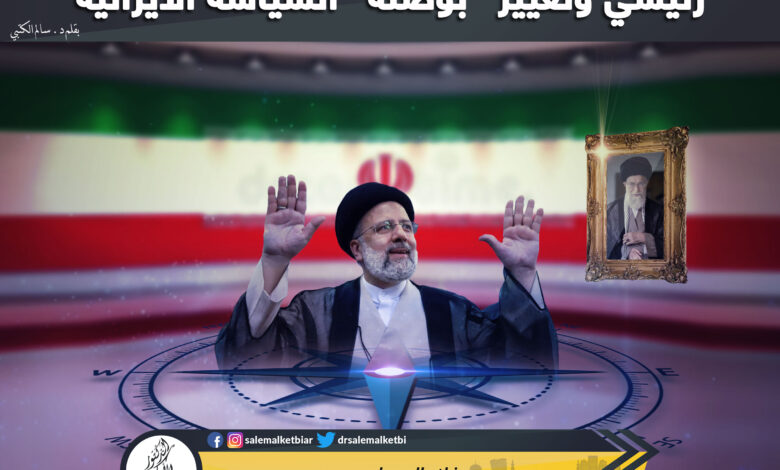
The compass of hard line and moderation is in the hands of the leader – no one else. Everyone should remember the experience of former President Ahmadinejad. He adopted some of the most violent and extreme rhetoric in the history of the Iranian regime. But ultimately, he did not deviate from the line drawn by the Supreme Leader.