There is no doubt that one of the most important factors of insecurity and stability in the Arab region is the absence of central states in their traditional role as pillars of regional security. Iraq is one of the most important Arab absentees in this regard. Its return to playing its role and assuming its historical responsibilities would be a major qualitative gain for the Arabs.
This is especially vital in light of the meddling by rapacious regional powers, including Iran and Turkey, against Iraq itself with continuous interventions in this great Arab country in desperate attempts to remove it from its strategic Arab fold and to consolidate these attempts and impose them on the ground.
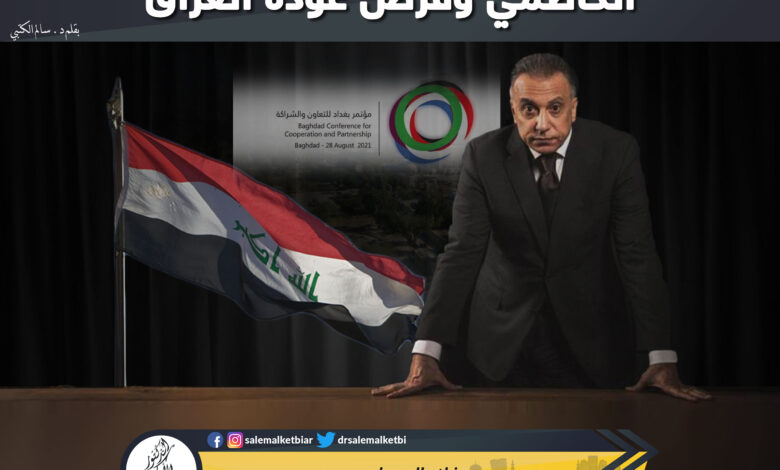
Therefore, the efforts of Iraqi Prime Minister Mustafa Al Kadhimi to restore the role of his country deserve all Arab and international support. Iraq’s return means a lot for Arab and global security and stability.
Iraq’s return to its historical role at the regional level means by extension stopping the strategic expansion of Iran and Turkey to the detriment of Arab national security. It will also mean supporting and strengthening the efforts of Arab countries assuming the role of firefighter in the crises that have been flaring up in several Arab countries since 2011.
The conference of the leaders of the neighboring countries, convened in Baghdad at the end of this month under the leadership of the government of Mustafa Al Kadhimi, deserves the full support of the Arab and Gulf countries.
This qualitative diplomatic approach was based on frankness and consideration of the dilemmas facing the stability of the region, as Iraq is one of the countries most affected by geostrategic conflicts among its regional neighbors. It is not helpful to raise expectations and build dreamy scenarios about the outcome of this nonetheless important conference.
But I think the conference promises to build momentum. It highlights the real obstacles to achieving security and stability in Iraq, and draws regional and international attention to the fact that Iraq is seeking to fill the void left by its absence in recent years. The task will not be easy at all.
There are conflicting interests and goals among some regional neighbors, including those who want Iraq to remain unwilling, enslaved to the whims of the mullahs and their Revolutionary Guards, and a scene of proxy conflict and settling of scores among neighbors.
This is an eye-opening moment that the Arabs must take advantage of and provide the necessary political support to Iraq, in order to continue to move forward toward achieving the goals of this summit. Iraq cannot completely eliminate violence and terrorism without ending plans to exploit it as an arena for power struggles.
Iraq, regardless of its internal circumstances, is not a small state for Iran to exploit in its conflict with the US, or for some to interfere in its internal affairs with various claims, arguments and pretexts.
The Conference of the Leaders of Iraq’s Neighboring Countries is a very important strategic step to limit the violations and cross-border expansion that the region is witnessing. Iraq should not be a safe corridor for some regional powers to achieve their expansionist goals.
On the contrary, a great regional state is capable of being a locomotive for the development of its regional environment for the benefit of its people and the rest of the nations. It is also an opportunity to melt the ice between some regional powers for the sake of Iraq and its people.
The return of calm and stability to the region is generally in the interest of Iraq and all. It provides a favorable environment to focus on development, construction and eradicating the scourge of terrorism from the territory of this great Arab country. Iraq certainly does not seek to break with its regional neighborhood.
It is about building a network of useful relations, communication and positive cooperation. The country is a determining factor in the equation of regional and international relations. Its interest is not affected by the intervention of external parties in its affairs.
But its interest always lies in the fact that there will be no rupture between it and those parties or between those parties and others. This is a problem that this conference helps to explain with a candor that the Iraqi scene may be in great need of at this time. Iraq needs its regional neighborhood. And vice versa.
Logic dictates that a strong and stable Iraq is a qualitative addition to its regional atmosphere and, of course, to Arab national security. But the challenge remains to convince some of the importance of this strategic vision, which may be different from their beliefs and actions on the ground.
Al Kadhimi needs strong Arab and international support to address domestic challenges before external ones. Iraq’s regional role can only be restored by freeing its decision, will, and policies from the influence of forces that want to hold it hostage to their hold and plans.