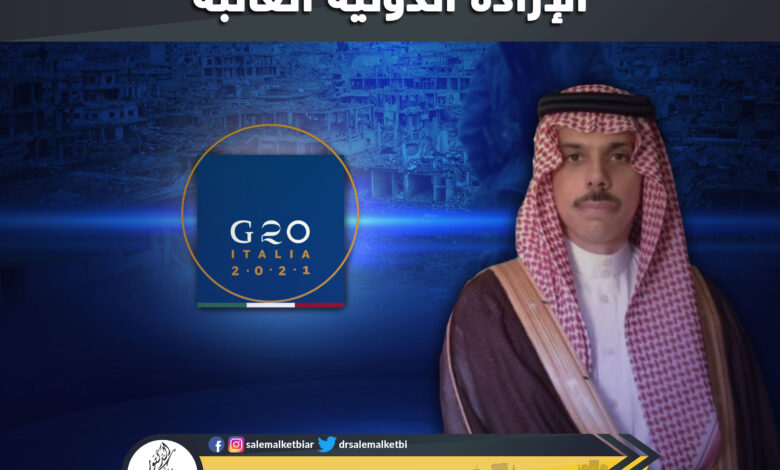
Saudi Foreign Minister Prince Faisal bin Farhan bin Abdullah recently pointed out at a ministerial meeting on Syria in Rome the lack of effective international will to resolve the Syrian crisis. This has given the opportunity to some parties to implement expansionist, sectarian and ethnic projects aimed at changing Syria’s identity. “It threatens to perpetuate the Syrian crisis and its regional and international impacts.”
The Saudi strategic vision in this context is quite correct. It is not limited to the Syrian crisis. But it extends to all the crises in the region.
No one disputes that the lack of international will is the real obstacle to security and stability in Libya. This is the same as on other regional issues such as the Renaissance Dam crisis. This one, everyone fears, could turn into a real water war between the countries of the Nile Valley.
The aggravation of the crises of the last few years is due to the lack of international political will. The absence of the supposed active role of the UN Security Council in defusing tensions and ending conflicts.
International institutions have not played a concrete role in resolving crises and conflicts since the creation of the UN in 1945, one might say. Another might say that the concept of a global collective is a fuzzy one, difficult to define or realistically shape. This is pretty much true.
But the political literature is accustomed to describing the great powers that dominate the world order and its decision-making – whether through the UN or through the international entities that have emerged after it such as the G-20, the G-7, or NATO – as the global collective.
It is a concept crossing entities and bloc. Is meant to include all decision-making capitals and all states and powers that help guide the compass of international relations, crisis resolution and security and stability. The fact is that these blocs do not make the crises in the Arab region and the Middle East a priority.
This is despite the severity of the crises and the diversity of the material, human, environmental and cultural effects and losses. Costs that are not limited to the narrow geographical scope of these crises. They affect other regions and peoples of the world.
The Syrian crisis is perhaps the clearest example. Recent figures and statistics indicate that there are approximately 6.7 million Syrian refugees, internally displaced persons, and asylum seekers in over 130 countries. Approximately 1.6 million Syrian refugee children in the region are under the age of 10.
There are 5.5 million Syrian refugees in Syria’s neighbors. More than 60% of them are women and children. These alarming figures highlight the seriousness of the prolonged crisis, receiving no international attention. Although, the Syrian refugee issue has become more like an international humanitarian disaster.
Not only are the countries hosting these refugees burdened, but they have become a means of blackmail for other countries, as is the case between Turkey and the EU.
Many of them, willingly or unwillingly, are exploited in terrorist acts and become involved in extremist organizations. This is the case of the routing of so-called Syrian mercenaries to Libyan territory with Turkish funding, support and arming.
Therefore, it is important to talk about the need for an international consensus to end the human suffering of the Syrian people and to find a solution to this cross-border crisis, ensuring the flow of international aid to its recipients. His Excellency called “not to politicize humanitarian affairs in Syria and not to neglect the humanitarian needs of the Syrian people. ”
The Libyan crisis is another example of the lack of international will. Everyone can see the impasse surrounding the implementation of the results of the Berlin I conference held in January.
Although the leaders of major countries such as Russia, France and Italy are present alongside Arab leaders, the Turkish president, European Commission President Ursula von der Leyen and UN envoy Ghassan Salameh, there is still a stalemate on the major obstacle in this crisis. Namely, the foreign mercenaries that Turkey has brought to Libyan territory.
The Berlin II conference, which was held on June 23, achieved similar results to the first conference, without showing a firm international will and exerting strong pressure on the Turkish side to withdraw its troops and the mercenaries it brought in.
The Libya stability initiative in Berlin II was even presented for the first time by the Libyans, but did not find strong and appropriate support forcing Turkey to implement one of its main points. The call for the departure of mercenaries from Libya. In this regard, the UAE shares the Saudi vision of finding solutions to regional crises.
In a speech to the UN General Assembly, HE Lana Nusseibeh, UAE Ambassador to the UN, expressed the UAE’s deep concern “about the decline of respect for international law in the world,” and believes that “a world without a rules-based international order is a world of chaos and instability.”
“It is one in which rogue elements operate that flout international norms and go unpunished. A world in which trusting relationships between countries break down. The most vulnerable in societies are left to fend for themselves without justice,” she said. “There is no region in the world where respect for international law is challenged as it is in the Middle East,” she added.
Therefore, we are counting on the UAE, in its non-permanent membership of the UN Security Council starting next year, to make a difference and draw attention to the need for international consensus and cooperation to resolve crises.
We look forward to leveraging its strong strategic relationships and partnerships with all major powers to resolve matters and shift attitudes toward solutions to crises and conflicts and to help ensure the survival of the existing world order.