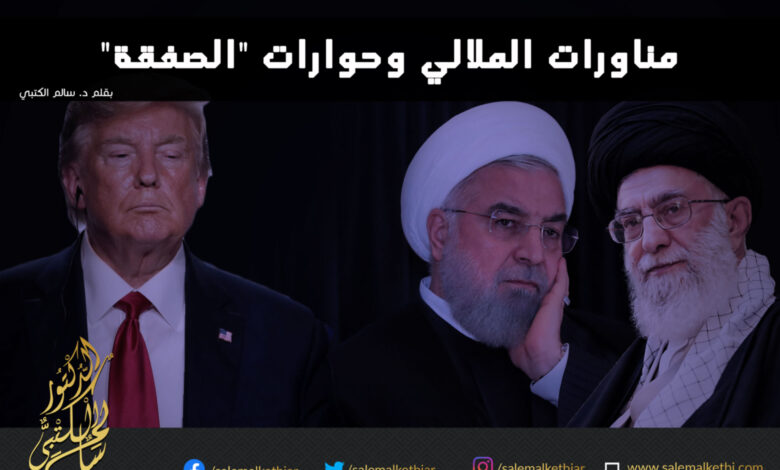
Since some 80 members of Iran’s Shura Council accused President Hassan Rouhani of violating Supreme Leader Ali Khamenei’s instructions by sending positive signals about negotiating with the United States, Rouhani and his diplomatic team have retreated from their previous positions to entrench again with hardliners, waiting for further Instructions from the Supreme Leader.
Rouhani, who said his country does not rule out negotiation, if it is in the country’s interest, said hours later that there would be no positive development in his country’s relationship with Washington without lifting sanctions against Tehran.
The warnings to Rouhani and his Foreign Minister Javad Zarif came from two direct sources, the Shura Council and the Revolutionary Guard.
Alluding to Zarif’s surprise visit to the recent G7 leaders’ meetings in France (he had met with French President Macron, Foreign Minister Jean-Yves Le Drian and representatives from Germany and Britain, and then traveled on an Asian tour that includes China, Japan and Malaysia), Gholam Hossein Gheyb Parvar, senior adviser to the IRGC commander, said that “God forbid this back and forth would be out of desperation or lack of self-esteem. God forbid the knees of our officials would shake.”
Not only that, but he made a serious accusation against President Rouhani’s diplomatic team. “It’s a pity that sometimes there are behaviors that smell like betrayal. Governments have a duty to deal with corruption, as do people.”
The question that arises here is whether there has been a rift within the mullahs’ regime over dealing with American pressure. Are the statements, on the contrary, nothing but a maneuver and role play aimed at extracting the greatest gains from the West, which will naturally try to strengthen the position of President Rouhani’s camp in the face of the more radical current within the regime?
In fact, the answer to this question is not easy. At first glance, neither possibility can be ruled out. However, there are indications that support either of these two hypotheses.
First, the Iranian foreign minister cannot visit France in parallel with president Rouhani’s positive signals to negotiate the nuclear deal without an explicit green light from the Supreme Leader. Given Iran’s complex political game, President Rouhani and his foreign minister cannot negotiate without Khamenei’s will. According to the Iranian Constitution, absolute power belongs to the Supreme Leader.
Second, it is not just about Zarif’s visit or a fleeting statement from President Rouhani. There have been assurances from Iran’s central bank governor, Abdolnaser Hemmati, that negotiations are continuing with Paris over its intention to offer Iran a $15 billion pre-purchase credit line to make for the exported oil to Europe before the United States exited the nuclear deal.
In response to a question about the French plan under the European Trade Mechanism with Iran INSTEX, Hemmati said that “it is being negotiated, and we [will see what happens]” and that the funds will be provided to Iran in hard currency.
President Trump responded with tacit approval at a joint press conference with President Macron.
The proposal has been negotiated for some time and is not the result of the G7 meeting. The central bank’s entry into the scene means that the deal goes beyond diplomatic moves and requires consultations and approvals at high levels within the mullahs’ regime.
There is also something behind the scenes of the Iran-U.S. crisis. Many regional developments are closely related to what is going on. For example, military heating is taking place on the Lebanese-Israeli border between Hezbollah and the Israeli army.
Since the 2015 nuclear deal between the Iranian regime and the P5+1 group did not have the support of the IRGC, at least superficially, things are expected to go ahead in the coming period with the same equation that the Iranian regime believes will bring it maximum strategic gains and concessions.