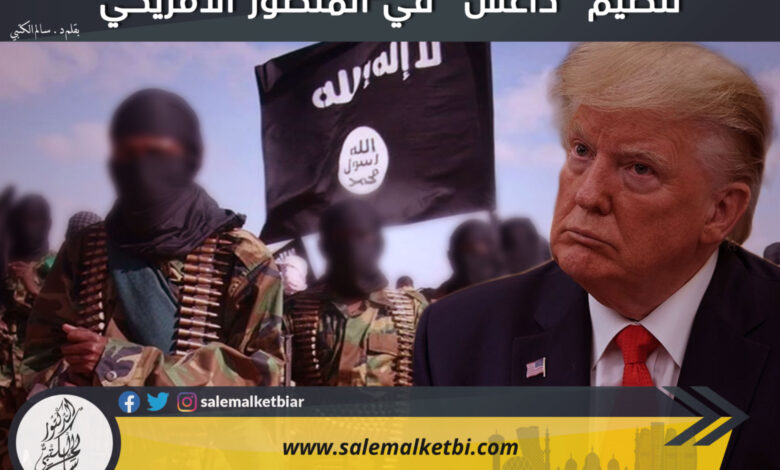
In its annual report on the fight against terrorism, the US State Department stated that, despite the administration’s victory over the group in Syria and the subsequent elimination of its leader Abu Bakr al-Baghdadi, Daesh expanded its global presence in 2018.
“Terrorist tactics and use of technologies evolved throughout 2018,” the Country Reports on Terrorism reads. “Additionally, battle-hardened terrorists headed home from the war zone in Syria and Iraq or traveled to third countries, posing new dangers.”
Although Daesh has lost all her territory, the report states that she has proven her ability to adapt and survive, including through its activities to motivate or steer its supporters through the Internet.
For counter-terrorism experts, the conclusions of the American report are not so surprising. Killing al-Baghdadi and defeating his group militarily does not mean its final eradication.
Terrorist organizations are primarily based on a promoted ideology to persuade their potential supporters to actively engage in the organization’s activities, or at least to help promote and defend its ideas. In this era of computing and the Internet, the viability of these organizations remains extremely high.
These organizations have turned cyberspace into platforms for virtual jihadism. They have filled this space with free media platforms that promote their terrorist ideas and activities.
However, it is difficult to judge the effectiveness of these organizations and their operational capacity by their online presence alone. Such a presence does not necessarily reflect the specific levels of threat posed by these organizations, nor does it mean that the danger is completely eliminated.
To determine the levels of risk and threat, the real criterion is to monitor the actions and plans of these organizations.
In particular, it should be monitored for its ability to implement what it promotes online, whether direct or foreseeable threats based on an analysis of media discourse and propaganda, the organization’s development trajectories and its geographical areas of interest.
In order to determine Deash’s specific ability to persist, several factors must be noted.
First of all, in my opinion, comes the role of the new leadership. The organization has declared a successor to al-Baghdadi, Abu Ibrahim al-Hashimi al-Qurashi.
The announcement of al-Baghdadi’s death and the revelation of the identity of the new leader testify to the relative cohesion of the organization, at least at the higher levels.
The announcement was made in less than a week. This may have contributed to the fact that there was a “will” from Baghdad to appoint his successor, which helped to resolve any possible controversy over the organization’s leadership.
It is also noted in the announcement of the investiture of the new leader of Daesh that he retained the title of “Commander of the faithful and Caliph of the Muslims.” The organization’s statement on this occasion that the continuation of Daesh’s terrorist approach, speaking of “conquering countries.”
In the period before al-Baghdadi’s death, there was no ideological debate within the organization’s Shura Council about the concept of the state, the change in hidden action, the organization’s objectives or modus operandi. The declaration contains references such as “the State stands today at the doorsteps of Europe and Central Africa? Nay; it is expanding and persisting, God willing, from the East to the West”
But it also implies an acknowledgement of defeat. The statement takes a retreating tone, “Don’t rejoice, America,” in reference to what it accomplished in its war against the organization.
The reference to Daesh being at the doorsteps of Europe and Central Africa only serves to lift the morale of Daesh’s members and to suggest the strength, viability and expansion of the Daesh. Indeed, a few days after the declaration was issued, the organisation carried out two terrorist attacks. The group targeted two military points in Mali, killing more than 50 soldiers.
Such statements should be treated with the utmost caution. This statement does not prove that there is a new leader of the organization, nor that the organization is able to pull itself together, especially in the absence of accurate information on his identity or nationality.
This announcement may be one of the tricks of the organization’s elements to keep the project alive, while waiting for what will happen later.
From an analytical point of view, the most important indicator is that the terrorism business is still fresh and covers a vast geographical area of the world. By 2018, terrorist operations had spread to 84 countries, with about 85% of them in the Middle East, South Asia and sub-Saharan Africa. Only 10 countries (Afghanistan, Syria, Iraq, India, Nigeria, Somalia, Philippines, Pakistan, Yemen, Cameroon, India, Nigeria and Syria) have suffered about 75% of all terrorist attacks in the world.
Terrorist organizations continue to receive sufficient funds to carry out their crimes in geographical areas that are already suffering from terrorism or are not under the control of the State but of terrorist militias.
One of the most dangerous aspects of Daesh is that not all of its members are strong supporters. A large part of its elements are mercenaries. Their loyalty to the organization depends on the extent to which new leaders of the organization can continue to buy their loyalty with money that can still be in the hands of these large elements.
Before its military defeat, the organization had, according to Western estimates, resources estimated at $6 billion at the peak of its activities. The organization received them from taxes, extortion, bank robberies in Iraq, revenues from the sale of oil and gas and other revenues.
But the collapse of the organization’s alleged state and fragmentation of its elements, as well as the collapse of its security network, have called into question the fact that a significant portion of the organization’s funds are still there.
In short, the US report on terror warns the world that the death of Baghdad does not mean the end of the terrorist threat.
It is therefore imperative to maintain the continuity and effectiveness of global counter-terrorism plans, strategies and alliances in order not to create the conditions for a new wave of this global threat.