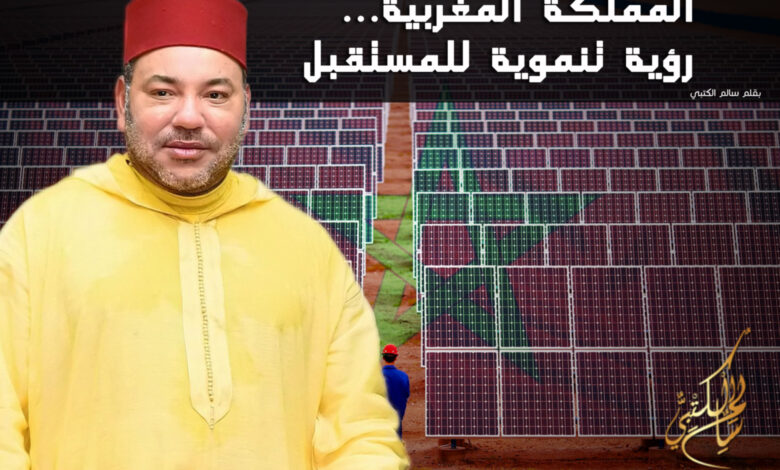
The Kingdom of Morocco, under the leadership of King Mohammed VI, has a clear developmental vision and is confidently moving towards the future with a clear strategic vision. This applies to all fields, whether political, economic, social, cultural and so on.
In politics, we note that Morocco aims to return to the African Union, which represents a vital support for Moroccan economy and provides the kingdom with a wider space to exercise regional and international influence. At the economic level, the recent project of solar energy production is one of the remarkable success stories of Morocco. Few days ago, King Mohammed VI gave the green light to start the fourth and last station of the largest project of solar energy production in the world. Thus the project is almost finished and the strategic dream is crystallizing.
The solar energy project in Morocco represents one of the vital future challenges, not only because of its importance in the future of energy production, but also as it represents a symbol of international partnership, solidarity and cooperation. The project includes Arab partners, led by Saudi Arabia, African partners as well as the European Union. This project represents for the EU an ambitious dream to strengthen the partnership across the Mediterranean, as well as to build stronger relationships with partners in the global south. The project is expected to contribute to international efforts aimed to reduce thermal emissions and address the problem of climate change. Studies expect that completion of this huge project will contribute to reducing carbon dioxide emissions by about nine million tonnes per year.
The ambitious project of solar energy production in the Kingdom of Morocco is a dream of generations and a future investment for this country. The project includes five stages that will be completed by 2020 and which contain recognized operational plans. The project is the largest station of solar energy in the world that provides electricity and clean energy to more than one million Moroccan homes. The project also meets more than 40% of the needs of Morocco’s energy. The country imports more than 95% of its needs in energy and aims to cover 42% of these needs through solar energy production by 2020. In addition, the project aims to fulfil its commitment to reduce emissions of the greenhouse gases by 13% by 2020 depending on solar, wind and water energy and a self-financing of ten billion dollars.
Reducing the burden on generations and the strategic plans to deal with present and future challenges is a feature of the leadership of King Mohammed VI. Actually, observers can perceive the positive results of the strategic plans that the king follows to promote development in Morocco.
The whole developed world bets on solar energy as a part of alternative energy. The UAE is among the most enthusiastic international states that promote plans and projects of renewable energy. For instance, Masdar is a city that represents a global model in this concern. IRENA, the international agency of renewable energy, is also based in Abu Dhabi.
Solar energy is the dream of future generations. Despite the fog, the UK is now one of the major European centers of solar energy production and it competes with Germany, the leading European country in this field. Thus, the entry of Morocco into this global race will enable it to achieve a regional leadership that can generate significant income in the future, both through the export of surplus energy, and in the areas of training and technical employment specialized in solar energy stations management. In addition, there will be an increase of opportunities for the development of research and studies in this field in cooperation with other countries.
Renewable energy in general, including solar energy, involves investment opportunities for the future, since it is no longer a local economic choice rather it has far-reaching economic benefits. China, which leads the sector of renewable energy alongside India, invests in this sector more than the combined investments of the United States, Japan and the United Kingdom. Major oil powers such as Saudi Arabia and the United Arab Emirates seek to invest in this sector as part of their economic diversification plans, and of their will to access to clean energy and to reduce thermal emissions, as well as to support scientific research and technical development in these countries.
There are globally about 3 million workers in the solar energy sector, more than a third of the jobs available in the entire renewable energy sector. This fact reflects the huge bet on this vital sector that attracted a global investment of about $ 160 billion in 2015. Investments in this sector exceed those in other important global sectors such as natural gas.
Morocco’s successful steps in the field of solar energy in addition to the financial and economic reforms, which are appreciated by the international financial institutions and that achieve tangible results, prove that the Kingdom is building better developmental pillars for future generations. All these steps are necessary to improve the business environment through the provision of incentives for foreign investment, especially that Morocco has distinctive features compared to many countries in the region, most importantly political and security stability, the international trust it enjoys and the regional and global status of Moroccan leadership.
There is a steady improvement in the economic indicators of Morocco which are reflected in the reports of international institutions. For instance, the statistics of the American institution Heritage Foundation show that Morocco has made a little progress at the global and regional level in the index of economic freedom of 2017 by 0.2 percent, which allowed it to rise to the eighth place in the Arab world and 86 globally, while Tunisia and Egypt ranked 10th and 12th respectively.
The American Institute commended Morocco’s efforts in the field of economic reforms, which it considered to have strongly stimulated and encouraged the private sector to achieve further growth in its activities. Morocco was ranked as the leading country in North Africa and the Mediterranean in terms of economic freedom, ensuring foreign investment and free trade. Morocco continued its progress in these indicators during the current year, which is the most important and necessary evidence in light of the situation of turmoil in many countries in the region and the world. Thus, all these indicators confirm that the Kingdom of Morocco is on the right path of development under the leadership of King Mohammed VI.