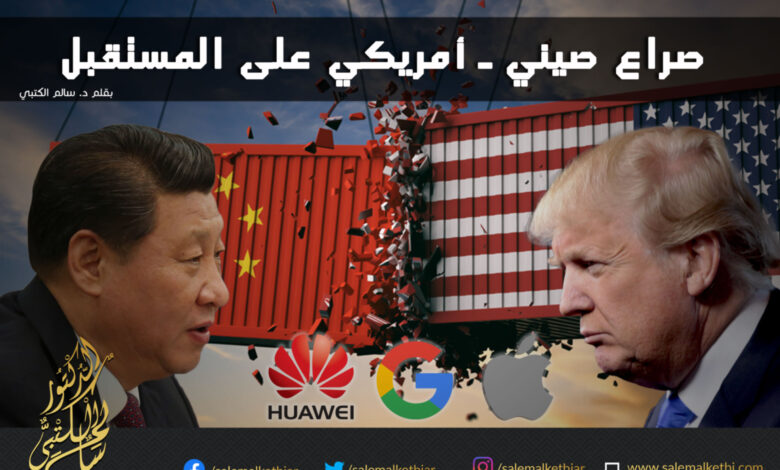
The trade conflict between the United States and China is basically a strategic conflict. In the past decades, military weapons blocs have fought to put their countries at the forefront of global competition. But today, the race has shifted to technology and ICT giants such as Huawei, Google and Apple.
Battlefields are no longer just deserts, seas, oceans and halls, but also financial markets and banks. Green and red stock market indicators have become real strategic observatories of conflict outcomes. Experts, economists and politicians are hoping for a China-U.S. agreement or understanding on trade disputes. However, if you know the conflict environment well, it is unlikely that a mutual understanding or commercial compromise between the two poles will materialize, given their ferocious rivalry.
Several signs confirm that this competition, or rather economically-oriented conflict, is a strategic conflict whose symptoms are not about to disappear as long as the causes and factors that fuel it are still there.
The geopolitical rivalry between China and the United States is getting hotter every day. It is advancing at an accelerated pace beyond that of the trade dispute. Thus, any trade deal is likely to have an impact on the economic aspect of the conflict and not on the rest of the sectors. Any truce or lull in the economic conflict is also unlikely to last.
China’s pace of economic superiority is higher than that of its American competitor. It goes without saying that the factors of economic conflict reappear faster than we think. Faced with the domination of Chinese products and goods on American markets, the United States will not stand by and watch. And it is not just about the worsening trade deficit. There is also the high unemployment rate among Americans and the tendency for more U.S. companies to manufacture in and import from China.
The problem of American hegemony over the existing world order lies mainly in the technological sector. The sector is clearly accelerating the pace of Chinese hegemony. Wealth and economic growth are now linked to this vital sector, which has become the most important pillar of national security for States in this century. It is therefore not surprising that technology companies are becoming the focus of sanctions imposed by the major powers. The United States has decided to form an international coalition to counteract Huawei’s boom. Washington urged its Western allies not to use the Chinese giant to set up their 5G mobile networks, on the pretext that the latter is spying on customers in the countries where it operates.
It is also striking how these conflicts have the characteristics of 21st century modernity. For example, China can defend its companies in the middle of the United States by speaking to the public through the American press itself. Huawei, who launched a public relations campaign in the United States, published an ad in the Wall Street Journal in where it sent a direct message to Americans: Don’t always believe what you hear.
For more than three decades, the US has placed China as a competitor and strategic adversary. Recently, it has raised the level of this threat. Last October, Vice-President Mike Pence said that China had chosen the path of “economic aggression” rather than “partnership.” In recent years, China’s strategic ambitions have become more clear-cut.
One aspect of this particular conflict is that it pits two different economic regimes against each other in fierce competition. One is built on the free market and the values of capitalism.
The other is a centralized state-run socialist economy which nonetheless demonstrated an enormous capacity for economic growth in the information and technology sector. Therefore, the success of either model will affect the economic policies of countries around the world.
For the time being, the trade war seems to be more damaging to the American economy than China’s. China is the US’s largest trading partner. Its exports increased by 7% last year, exacerbating any potential losses. President Trump’s economic adviser, Larry Kudlow, admitted that it is American companies that have paid tariffs on all products imported from China. In other words, it is US importers, not Chinese companies, who will pay the US government’s customs duties in the form of taxes. According to two university studies published in March, U.S. businesses and consumers paid almost all of the U.S. tariffs on imports from China and elsewhere last year. US experts also estimate that tariffs on a large part of imports, from steel to washing machines, cost US businesses and consumers $3 billion a month in additional tax costs.
The trade war could calm down, or perhaps get worse. But it won’t stop anyway. The economy has become the main strategic conflict between China and the United States. The world will soon be affected by the ebbs and flows of this conflict; it will not only have consequences for the Chinese and American economies, but will also affect the rest. Everyone will pay a heavy price for this bipolar competition, just as everyone had paid the price for the Cold War.