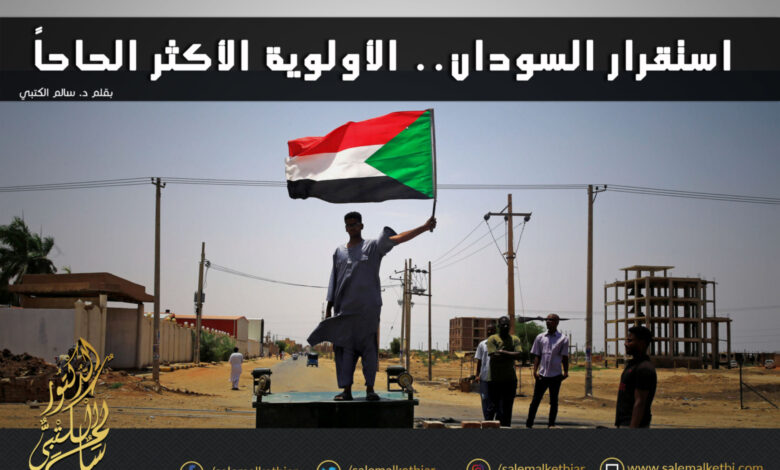
The recent events in Sudan in recent days have saddened any Arab who loves this great country, which is full of intellectuals and elites capable of providing political protection against the slide towards chaos and instability.
Since the dismissal of former President Omar al-Bashir, things have moved towards a peaceful dialogue between all Sudanese parties. However, there is concern about what has happened recently.
Calls for sit-ins, as well as Ethiopian Prime Minister Abiy Ahmed’s failed mediation, which has so far yielded no successful results, have clearly shown that the situation is getting more complex. The task seems more difficult than before. The opportunities for dialogue are rapidly diminishing and the differences between the parties in the political arena are widening.
The most dangerous of all, parties with well-known agendas in the region are raging in the media. They are trying to provoke a civil conflict in this peaceful country. Those who dispute that Sudan is the scene of attempted sedition should watch Qatar’s satellite channels and terrorist organizations.
It is widely believed that Sudan has a political history and an elite capable of managing the conflict in a civilized manner worthy of that history. But it goes without saying that all of Sudan’s friends are worried about what is happening, particularly in view of the current unrest and conflicts in the Arab region, which are not confined to certain Arab countries but which have major external implications.
The Arab concerns about the situation in Sudan seem legitimate and obvious. The dispute between Sudanese political parties was previously based on dialogue. Nevertheless, as the situation changed and clashes erupted, it is urgent to work towards security, stability, and a formula that would satisfy all parties.
Violence will not be in the interest of any party. It opens the doors of the unknown to the Sudanese people, who have suffered many conflicts for decades. All parties must now defend the interests of the Sudanese State and people, renounce intolerance and prejudices in governance, and be open to serious national dialogue.
There is therefore a need for mutual political flexibility. It is important to close the gaps exploited by actors wishing to exacerbate the conflict and make Sudan a battleground to achieve their ambitions, after their failures in other countries.
The Sudanese people are not in a situation where internal conflicts and civil unrest can be expected. But for many years, the media have been consulting each other in the region under the pretext of claiming democracy on behalf of the supporters of this seditious project. They keep demonizing others. They may even push things even further down the road to a crisis.
Arabs rely on the awareness of the Sudanese people, intellectuals and elite of the realities of the regional and international situation. They are able to direct this country towards its legitimate destination, in the language of dialogue that prevailed at the beginning after the fall of Bashir.
The bet will be won. Through its unique political heritage in the Arab world, Sudan has demonstrated its ability to follow a different model.
Objectively speaking, Sudan is going through a difficult period. The necessary trust between political parties is diminishing and events are accelerating. All Sudanese parties must be very cautious before any measures that could complicate the political transition.
Restoring calm and reducing recent tensions seem to be the most pressing requirements for a return to national dialogue. It must be based on the principle of “Sudan first,” because there are no winners or losers in a debate on the future of the nation.