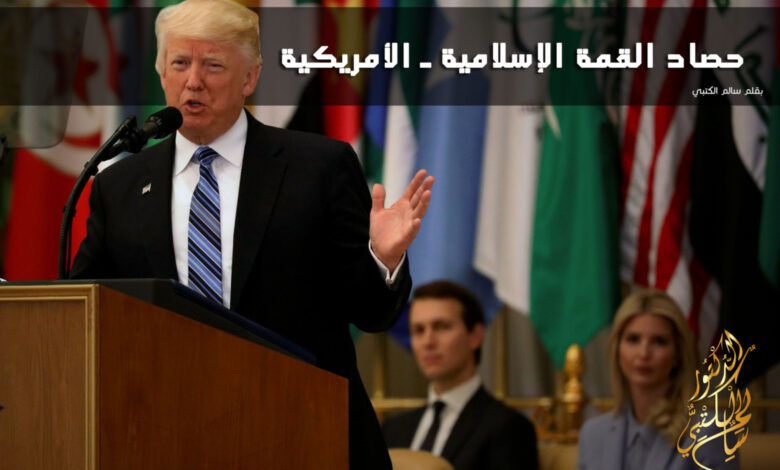
In recent days, the unprecedented Islamic American Summit took place in the Kingdom of Saudi Arabia, and was attended by 55 countries. President Donald Trump met the leaders, heads and representatives of Arab and Islamic countries. I followed up the various reactions and analytical readings of the results of this historic summit. I have agreed and differed with the analytical views of specialists and researchers.
Iran has been raised as one of the issues of concern but not a central issue for all attendees, as the focus of attention has shifted among leaders. Trump’s speech focused primarily on combating terrorism, followed by concern about Iran, which was mentioned only in a paragraph of about 300 words out of a total of about 2,600 words. The Saudi Monarch focused in his speech on the Iranian threat to his country and the GCC countries in the first place, followed by the issue of combating terrorism. The Jordanian Monarch and the Egyptian President focused on the issue of terrorism and the Palestinian cause, in order to put forward an integrated strategic vision to deal with the challenge of terrorism, and did not address the Iranian threat. It is clear that the divergence of priorities in this area is not due to differences in strategic visions and perceptions about the sources of threat, danger, insecurity and stability in the Middle East. It is a difference of priority among the decision makers of each country.
It does not matter how many words are allocated to the issue of Iran, what matters the nature of the positions is taken by the concerned parties. President Trump was decisive and clear as usual to stress the Iranian threat and the need to address and isolate it internationally. There was no hesitation in this regard. Saudi Arabia also emphasized the Iranian threat. Iran is facing a clear international coalition aimed at isolating and pressuring it to change its political and security behavior. It has become clear to Iran that any confrontation with Saudi Arabia would be a sure loss to Iran in the face of the Sunni Muslim world’s full bias towards the Saudi position. This is a certain message that Iran’s mullahs will consider carefully.
Iran did not respond to the global alignment against it in Riyadh- only offering words that did not have any real political meaning. Iranian Foreign Minister, Mohammad Jawad Zarif, said that Washington steals Saudi Arabia. “Iran, which has just held real elections, is being attacked by the American president in Saudi Arabia – the base of democracy and moderation,” said Zarif, in a tweet on his account. “Is this a foreign policy or a $ 480 billion injection from Saudi Arabia?” The Iranian foreign minister asked.
The question here is: does Zarif believe that the mullahs are holding real elections? Zarif forgot to talk about the billions that the mullahs are investing on militias of evil and terrorism in various States and that Iran has denied to its people. He expressed amazement about the declared investments between the US and Saudi Arabia.
The Iranian reaction to the summit is dependent on discussion with its Russian ally. Russia will determine the nature of the Iranian position. Either to continue its intervention policy or allow the worsening tension which may result in the fall of the Iranian regime.
President Trump’s speech to leaders of the Muslim world is a clear effort to restore American relations with the Muslim world. His election campaign raised fears of promoting a staunch anti-Muslim rhetoric. Trump emphasized that by saying, “a new chapter has opened,” adding that he did not come to lecture or impose the American way of life. He is attempting to reshape relations with the Muslim world by proposing a partnership rather than hostility. The summit has launched a completely different political line from Obama’s approach to Iran. President Trump distanced himself from the policy of cautious criticism of Iran, which was pursued by Barack Obama, whose administration tried to calculate a balanced policy across the Arabian Gulf, specifically between Saudi Arabia and Iran. Obama’s approach was to minimize the presence of the American military in the Gulf region and gave top priority to Asian strategy in order to address China’s growing strategic ambition in East Asia. Trump has abandoned this strategy because it gave Iran a valuable opportunity for its strategic and sectarian expansion at the expense of the US’s traditional allies in the Gulf region.