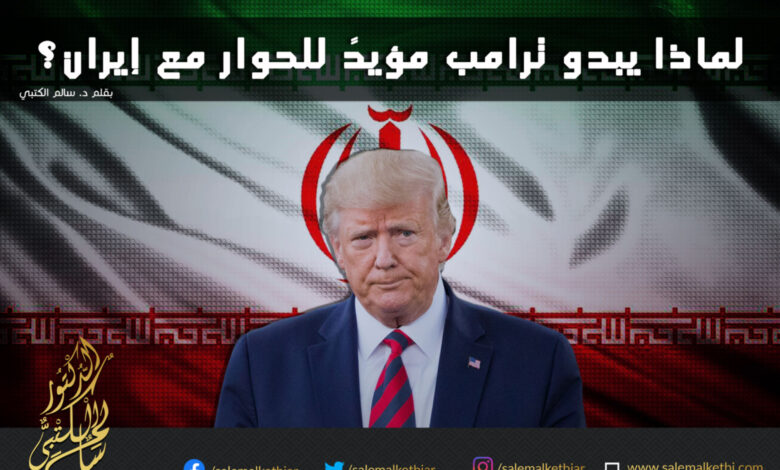
Analysts and experts note that U.S. President Donald Trump is increasingly convinced that the Iranian regime is inclined to dialogue with the United States, although the conviction is moving in a completely different direction from Tehran’s apparent hardening signals about the possibility of sitting back at the negotiating table with the Trump administration.
Extremely pragmatic, the mullahs’ regime has a tendency to put its self-interest first. Never mind the sparkling ideological slogans that the regime and its symbols devote to local and regional consumption by millions of its supporters and sympathizers, ready to accept any ideas uttered by the leaders of the Revolutionary Guards in particular and the mullahs in general. This intense self-interest must have led the mullahs to re-examine their positions on negotiating with President Trump.
Despite the impulsiveness of the U.S. president (who pulled out of the 2015 nuclear deal and also sided with Israel in an unprecedented way), it was he who refused to strike Iran after the downing of the U.S. drone, despite the insulting Iranian aggression to US power and prestige. He is also the one betting so far on the possibility of reaching a “deal” with the Iranian regime.
For its part, the Iranian regime is, ironically, betting on Trump in curbing the hawkish surge within the US administration, initially led by former national security adviser John Bolton. Bolton was dramatically sacked by President Trump in a move that could have drastic effects on the chances of dialogue between the two sides.
Likewise, President Trump himself is in no way inclined, in principle, to start new wars. He came to the White House rejecting direct US military interventions in various parts of the world, and has always criticized the policies of his predecessors in this regard. This has been evident recently.
President Trump engaged in marathon negotiations with the Taliban, the arch enemy of the United States. He even planned to hold a meeting of the movement’s leaders at the Camp David resort to coincide with the anniversary of the 9/11 attacks. However, the meeting was canceled due to a suicide attack claimed by the Afghan movement against the Afghan government.
Another thing, ahead of the US presidential election year, President Trump is facing intense attempts by House Democrats to isolate him. The attempts have limited influence with almost zero of chances of success, but nonetheless disturbing the White House.
The election year also makes it difficult for the president to make any decision to wage a military conflict. It is difficult to control the course of such conflict whose uncertain consequences could result in the loss of elections. Obviously, no US president would go to war in the year immediately before the election. The history of the election rounds testifies that attension shifts from wars and crises to managing the elections.
Also, the floor has already been set for President Trump to reach an agreement with the mullahs. Severe economic sanctions on the Iranian economy persuaded the mullahs that proceeding with a hardline approach may be costly. So the regime is already very much ready to accept the settlement of the crisis with the United States, and, paradoxically, with President Trump in particular, a dealmaker with tactical flexibility and willingness to compromise to a large extent.
By the same token, the settlement of the crisis is in Trump’s hands and restoring his relations with his European allies.
The Europeans are in a critical position between the hammer of the Iranian regime’s pressure and escalating steps to renounce its nuclear deal obligations, and the anvil that is President Trump’s tough sanctions on the Iranian regime.
President Trump’s response to the French mediation and European efforts could be a lifeline for European allies in this crisis. It will be counted for President Trump as an effort to bring the viewpoints of the US and its NATO allies closer.
One more thing, President Trump fears that keeping Iran in a tight corner with push it to further engage in an axis that counters US strategic interests. Maintaining pressure may weaken the US ability to contain China’s strategic threat and advance security and stability in the Middle East without military intervention.
Overall, there are many things why President Trump is big on offers to negotiate with the mullahs. One step ahead and one step back, the regime is maneuvering, as usual, with the offers of American dialogue, calling them, opportunistically, strategic US retreats.
Still, the biggest loser because of President Trump’s policies and tough sanctions is the Iranian economy and people. Apparently, the mullahs are trying to cover up their losses through media games and sporadic maneuvers using sectarian guerillas and arms financed by Iranian taxpayers’ money.