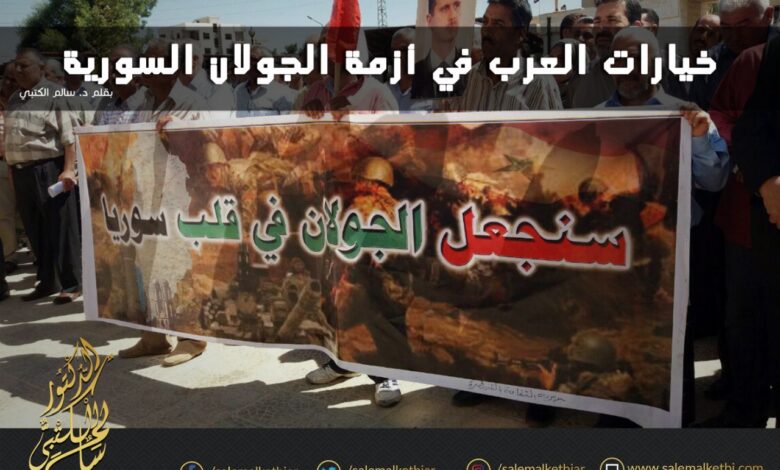
US President Donald Trump has placed all Arabs, especially the United States’ allies, in a delicate and sensitive situation by announcing that the occupied Golan is part of Israel’s territory.
Apparently, the Arabs have not done enough to anticipate this American approach.
The Syrian regime itself is plunged into its internal crisis, unaware of the danger of calling on Iran to help it fight terrorist organizations.
The Arab countries have been grown aware of US and Israeli moves on the Golan issue in recent months. However, the topic was not once raised in Arab-Arab or Arab-American discussions.
President Trump’s announcement of his intention was preceded by a series of direct and indirect messages. Before Trump’s statement, Republican Senator Lindsey Graham recently travelled to Israel to make a statement.
“Strategically, I am standing on one of the most important pieces of ground in the State of Israel, and who would you give it back to?” he said. “You’re going to give it to Assad? I think not. You might as well give it to Iran.”
“You’re going to give it to Russia? I think not. So, the idea of this territory going to somebody else is off the table.”
“Are we going to give it to Russia? I don’t think so. Thus, the idea of giving this region to any other party is rejected,” Graham told Netanyahu and US Ambassador David Friedman.
The United States first voted last November against an annual UN resolution condemning the Israeli occupation of the Syrian Golan Heights.
An influential member of Congress, Graham has more than once mentioned his efforts to President Trump to convince him to recognize Israel’s sovereignty over the Golan.
During Graham’s visit to Israel, Netanyahu said he had asked the senator that the United States and the international community recognize Israel’s sovereignty over the Syrian Golan. The intentions of the Americans were therefore clear and long-standing.
Trump learned some things when he recognized Jerusalem as the capital of Israel and decided to transfer the U.S. Embassy there.
Arab reactions were less intense than expected, contrary to what the U.S. intelligence services had expected. Their reports spoke about catastrophic consequences for US foreign policy if this resolution is adopted.
This time, President Trump took this opportunity to fulfil Israel’s dream of seizing other Arab territories. However, the American approach is catastrophic in strategic and legal terms.
The American way encourages the idea of occupation and threatens international peace and stability. It undermines any international effort to put an end to the practices and the last vestiges of occupation in the world.
The consequences of President Trump’s decision go beyond the Golan question to sabotage the foundations of law and international relations.
Legitimizing occupation undermines the roles of the United Nations and international organizations. More dangerously, it risks triggering conflicts and provoking a new generation of terrorists and extremists in the post-Daech era.
Many United Nations resolutions condemn the Israeli occupation of the Golan, including three resolutions adopted in 1980: the first concerns the Israelization of the Syrian Golan, the second the firm rejection of the Israeli decision to annex the Golan, and a third resolution condemning Israeli practices of forcibly granting Israeli citizenship to Syrian citizens in the Golan; and two resolutions in 1981, one requiring Israel to repeal its laws on the Golan, and a second resolution calling on Israel to cancel the annexation of the Syrian Golan
More recently, a resolution adopted in 2018 and adopted by a majority vote at the United Nations General Assembly recognizes Syria’s sovereignty over the occupied Golan.
Meanwhile, the world’s superpower has ignored all these decisions yet still wonders where the chaos in the world order comes from.
Now, it is all said and done. An official US document will soon be published recognizing Israel’s sovereignty over the Golan Heights.
The obvious question remains: what are the options for Arab diplomacy in the face of this new strategic disaster, even if the margin for manoeuvre is minimal?
Many statements and positions can be expected that vary in strength and degree of anger. But Arab countries are mostly out of pressure cards. This provides a valuable opportunity for Turkish and Iranian regional actors to present themselves as “heroes” in the eyes of Arab peoples, something that the American administration may not have thought about.
The Americans offered the Iranian mullahs and Turks a propaganda podium and terrorist organizations a new role in defending the Arab and Islamic world.
If President Trump wanted Israel and its people to be able to live in security, he would not have made his reckless decisions about Jerusalem and the Golan Heights.
It is impossible for Israel to live in peace amid the existing hostility that is made worse by such decisions. Now, the chances of peace and political settlement are completely destroyed in the foreseeable future.