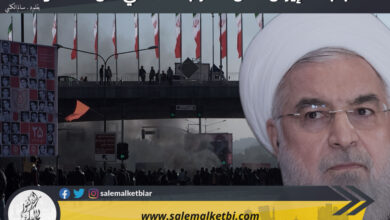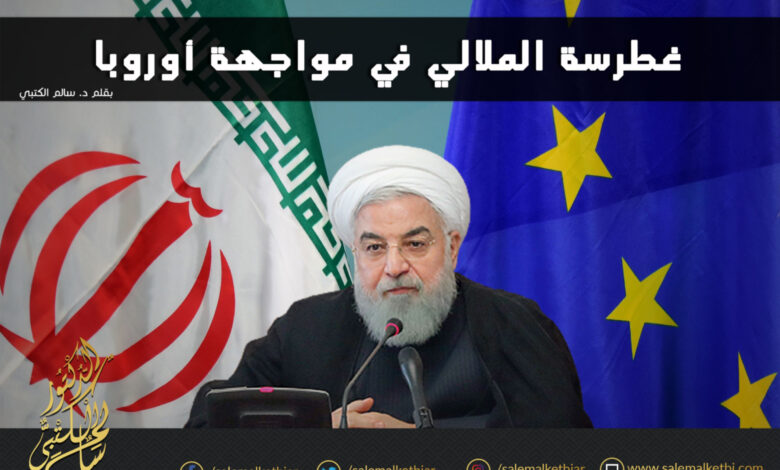
The Iranian regime has consistently launched one threat after another to European countries. The final warnings were made by Iranian leaders and officials at the visit of German Foreign Minister Heiko Maas to Tehran. He heard frequent statements from the mullahs about the economic war and that “those who started and supported the war are unlikely to be safe.”
This warning was relayed by Iranian Foreign Minister Mohammad Javad Zarif and echoed by news agencies. As the warning made clear, Iran is seeking to provoke the international community.
We know that the German minister came to Iran to ease the growing tensions in his relations with the United States, not to hear threats aimed at undermining security, not only against those accused by the mullahs of launching an “economic war” with this miserable regime, but also against those accused of supporting this war.
It is no secret that Zarif’s statements reflect the unease and scale of the crisis facing the Iranian regime. However, would the threat to a neutral party in the crisis produce the expected results? The mullahs think so.
Only a narrow-minded regime can express such positions and threats, which it believes will push the European side to ease the pressure on Iran, with no much thought given to it. The EU does not have effective political alternatives to save the nuclear agreement with Iran. It also cannot implement the economic cooperation mechanism with Iran outside American channels and evade the Trump administration’s sanctions.
Launched several months ago by France, Britain and Germany to circumvent US sanctions, the Instrument in Support of Trade Exchanges (INSTEX) has also failed. So how can Europe put pressure on the US to get the mullahs out of the corner they have got themselves stuck in, because of their intransigence and arrogance that have caused many of the region’s problems?
Germany believes that the nuclear agreement is still in force and that the US withdrawal does not mean the nuclear agreement is dead. For the Germans, Iran must respect its obligations under this agreement and maintain dialogue with Europe. But the mullahs consider that the American withdrawal from the agreement is now clinically dead. They also believe that the other parties to the deal (five major powers) must clash with the US for the good of the Iranian regime. Yet, the mullahs accuse Europeans of failing to live up to their obligations under the nuclear agreement signed in Vienna in 2015.
In Tehran, the German Foreign Minister stressed that the agreement “is of the utmost importance for Europe.” “They don’t want Iran to have nuclear weapons,” he said. Maas stressed that Germany and its European partners “have made every effort to fulfil their obligations” under this agreement, which is the truth. However, the mullahs want a bias for them, not what has been agreed, including commitments for each of the international signatory parties.
In May, after Washington’s withdrawal, Iran threatened to gradually break away from its nuclear agreement with the P5+1 group (United States, Russia, China, France, Great Britain and Germany) unless its partners, particularly the Europeans, help it to circumvent US sanctions.
In this regard, it seems strange that the burden of rescuing the mullahs lies solely with Europeans. Why haven’t the mullahs asked Russia, for example, to help them bypass US sanctions? Why did they not oppose China’s suspension of Iranian oil purchases as part of its commitment to comply with US sanctions?
In fact, the mullahs care little about the Europeans. They are convinced that the EU is the weakest part of the equation in their relations with the West. They exert maximum pressure on Europeans, while treating China and Russia differently.
Although the Iranian regime has included Russia and China in the so-called deadline “to meet their commitments, particularly in the banking and oil sectors,” only the Europeans were threatened.
The differences between Europe and President Trump’s administration and the difficulty of reaching an entente between them against it, at least for the time being, are the bet of the mullahs’ regime. But this persistent arrogance to ignore Europe’s influence and strategic role in international relations risks precipitating EU-US rapprochement and pushing Europeans to support President Trump’s policy in relations with the Iranian regime. At least, it could lead them to stop their efforts to reduce the escalation of tensions and let this miserable regime face its fate.