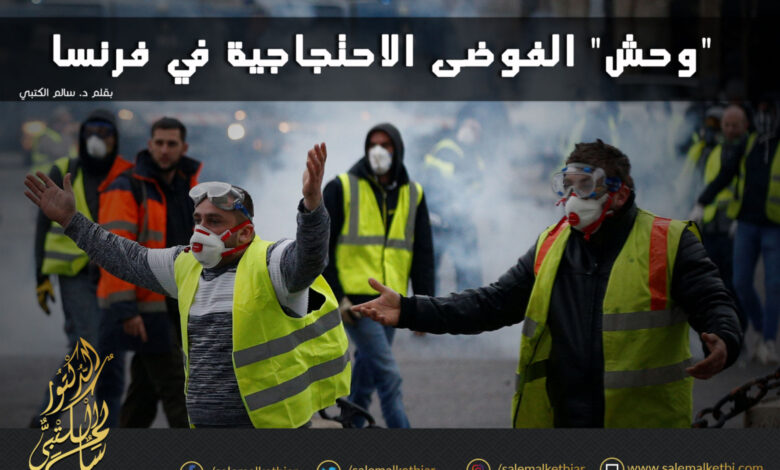
Commenting on what happened during the “Yellow Vest” demonstrations in France, Interior Minister Christophe Castaner said that the anti-government demonstrations in France had “created a monster that escaped his parents”, warning that some ” extremist elements “may be able to penetrate the demonstrations intended by the movement of yellow vests.
The “monster” mentioned by the French minister could indicate how the demonstrations have turned into practices that are difficult to control or counter. Demonstrations in France began to reject the decision to raise fuel taxes and developed in a few days to include other issues, including education reform, baccalaureate exams and some 40 other topics are now the subject of complaints!
This particular dynamic of the evolution of the demonstrations is generally accepted and is not surprising for specialists and researchers, and has already been repeated in many similar cases, old and new. It refers to the growing and unlimited influence of social media in mobilizing the masses, an issue that was supposed to be reserved for developing countries, but the most important result in the events in France is that developments and trajectories are almost similar in all cases; there is no difference between developing and developed countries.
Despite the lack of emergence of leaders in protest events in France, this phenomenon is worthy of study and research. Protest mechanisms in the information age are no longer as before; either in terms of the method of interaction or in terms of style of propagation and development, and therefore the modes of control and response to be used in such cases are different too.
The most dangerous in any protest is to slide towards subversion and exploitation by anarchists and elements of sabotage and extremists, of the atmosphere of protest, escalating the situation through the provocation of security organs and values by acts of violence and sabotage to feed the idea of chaos and spread it as much as possible. This is definitely likely because chaos incites extremists and anarchists to achieve their goals, It also incites hostile elements or hostile intelligence organs to implement their own goals against one country or another by exploiting the conditions of chaos and unrest, which constitute an ideal environment to undermine stability and destroy the pillars of security of any country or any society.
In light of the potential and possible consequences of the situation, in the context of chaos and violence, talking about standard security measures, discipline or other concepts is a kind of luxury that no political or security figure possesses. When State and community security is at stake, it is difficult for a sensible man to talk about standards or norms. Chaos and violence and the specter of the collapse of security systems undermine any conventional commitment. This is obvious because it is difficult for a sensible person to remain calm in the face of the destruction of monuments, interests and public goods!
The problem is that some people criticize the security services in developed countries to protect buildings and seek to impose security through the use of a considered measure of rigor, and do not blame the cause of the epidemic of vandalism, arson and destruction, as if democracy means that the State must allow looting of property, theft, fire and vandalism in times of chaos!
These events draw attention to the growing influence of social media on security and stability, generating protests on the Internet and not in party corridors, which are joined by crowds of all political tendencies, from left to right without ideological or political commitment, This issue is of great importance as it adds new challenges to the security of communities and countries, making it difficult to predict the paths of collective interaction with ideas disseminated via social media.
Much of the political conflict in the West has shifted from the party arena to the Internet, and information technology has become one of the most important influences in shaping the structure of politics and governance around the world in the 21st century.
Certainly the whole world is following the development of the demonstrations in France, these events have drawn attention to the impact of new media in the West after many thought that this effect is limited to developing countries, particularly in the Middle East, since the emergence of the role of social media in the spread of chaos and unrest in the events of 2011.
These events will inevitably be worthy of research and scientific study after the return of calm and after the final outcome of these events is known. But some Arab countries should pay attention to how the media of terrorist organizations and the media supported by Qatar deal with these protests. This kind of media highlights these events in an intense propaganda that emphasizes the idea of anger and protest in general as an obvious behavior of the people in relation to what they consider as pressure factorss of life. These media channel the consciousness of the Arab peoples who are under the pressure of life, and ask them to demonstrate, as if this behavior is normal in the face of the troubles of life!
The media of extremist organizations know that the cloning of the demonstrations in France would not be immediate, but they work to feed the anger of the individuals, and prepare the communities to undertake mass movements, and this is what one should be wary of especially as the official media behave too naively with the protests of France and highlight the causes, constantly mentioning the price differences of goods and services, and completely ignore the consequences of the demonstrations and the violence and chaos where a large number of protesters got involved!